Zigbee, Thread & Matter · Study deck

Zigbee Industrial Deployment

Picture a sensor mesh beside welders, motors, and moving metal.

Radio Remi is your guide for this deck.

zigbeeindustrialdeployment
Radio Remi, the module guide, in a scene from this chapter.
iotclass.org

After studying this chapter

Learning objectives

You will be able to:

  • Explain: The practical review question is not "will Zigbee cover the floor?" but "is there a router within reliable link range of every device, with enough overlap that losing one router does not partition the mesh?".
  • Explain: Coordinator recovery is also more than swapping hardware: the replacement must restore the same network key, extended PAN ID, and ideally the device table, or devices must be recommissioned.
  • Explain: Zigbee frame counters are expected to increase, so a coordinator that comes back with stale or reset counter state can have frames rejected until neighbors resynchronize.
iotclass.org

Major section

In 60 Seconds

The site, not the product label, sets the release boundary.

  • Zigbee is a low-power mesh radio system.
  • A gateway is the boundary device or service that links the mesh to another network.
  • A good test in one zone does not approve the whole plant.
  • Practitioner records placement, coexistence, power, custody, and handoff.

Key terms

gateway
gateway is the boundary device or service that links the mesh to another network.
One zone
One zone is named.

Why it matters

It avoids exact capacity, timing, service-life, or budget promises because those values go stale quickly and depend on the site.

iotclass.org

Major section

In 60 Seconds (continued)

An industrial Zigbee deployment should be approved from evidence, not from a polished factory example or a spreadsheet promise.

  • Those deeper facts can shrink the approved zone.
  • They never turn a quiet lab run into proof for a busy factory.
  • One message job is named.
  • The awake path is known.
iotclass.org

Major section

Evidence Families

Site boundary evidence records the zones, structures, moving equipment, interference sources, access limits, and monitoring behaviors in scope.

  • Coordinator custody evidence records where network authority lives, who can change it, how backups are handled, and how recovery is practiced.
  • Router placement evidence records why each relay location exists, what it can hear, what it cannot hear, and what happens when a relay is unavailable.
  • Application evidence records the report, command, alarm, state, or gateway-visible behavior that matters to operations.
iotclass.org

Major section

Industrial Mesh Backbone Evidence
Routers relay traffic and keep their radios awake, so they are the infrastructure.

  • Battery end devices are the sensors and actuators hanging off that backbone.
  • Coverage and resilience are functions of router density and placement.
  • Each added router can create alternate paths for self-healing, but only if its placement is supported by observations.

Key terms

end devices
end devices are the sensors and actuators hanging off that backbone.

Why it matters

The path ends with an operations handoff and a retest trigger because approval must remain owned after commissioning.

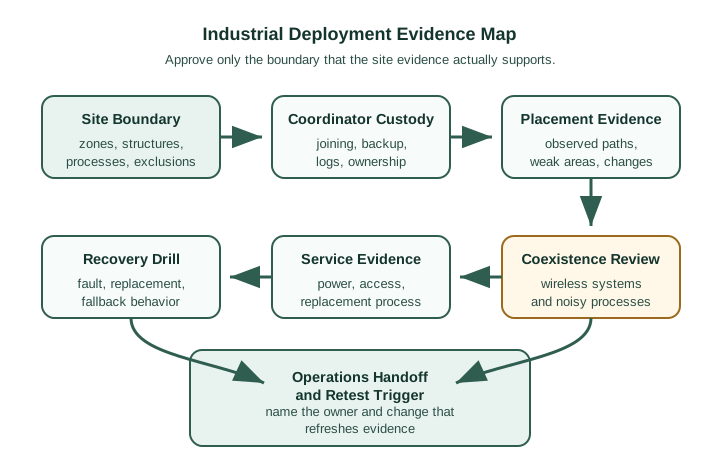
Industrial approval should follow a bounded evidence path from site scope through custody, placement, coexistence, service, recovery, handoff, and retest decisions.
iotclass.org

Major section

Industrial Mesh Backbone Evidence (continued)

The practical review question is not "will Zigbee cover the floor?" but "is there a router within reliable link range of every device, with enough overlap that losing one router does not partition the mesh?".

  • Custody names who controls the coordinator and gateway; placement and coexistence evidence then test whether the router backbone works under the site's structures, equipment, and radio activity.
  • Service evidence asks whether nodes remain supportable, while the recovery drill tests what happens when a dependency fails.
  • The path ends with an operations handoff and a retest trigger because approval must remain owned after commissioning.
iotclass.org

Major section

Industrial RF and Coordinator Custody
Metal shelving and machinery cause multipath and attenuation, while heavy Wi-Fi use and motor noise can raise the interference floor.

  • The second hard fact is custody: the coordinator is the Trust Center, and there is only one.
  • It holds the network key and the child or device list.

Why it matters

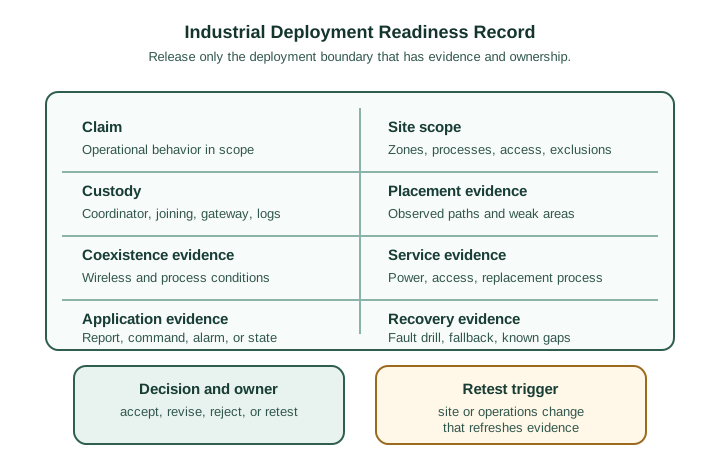
In @fig-zigbee-industrial-readiness-record-2, begin with the claim and site scope so that every later observation has a boundary.

The readiness record keeps site survey, channel planning, coordinator custody, service assumptions, and release ownership in one reviewable artifact.
iotclass.org

Major section

PAN Identity and Recovery State

A Zigbee network is identified by a PAN ID and an extended PAN ID.

  • Nearby networks can collide on a 16-bit PAN ID, so the extended PAN ID matters on crowded sites.
  • Recovery also depends on anti-replay state.
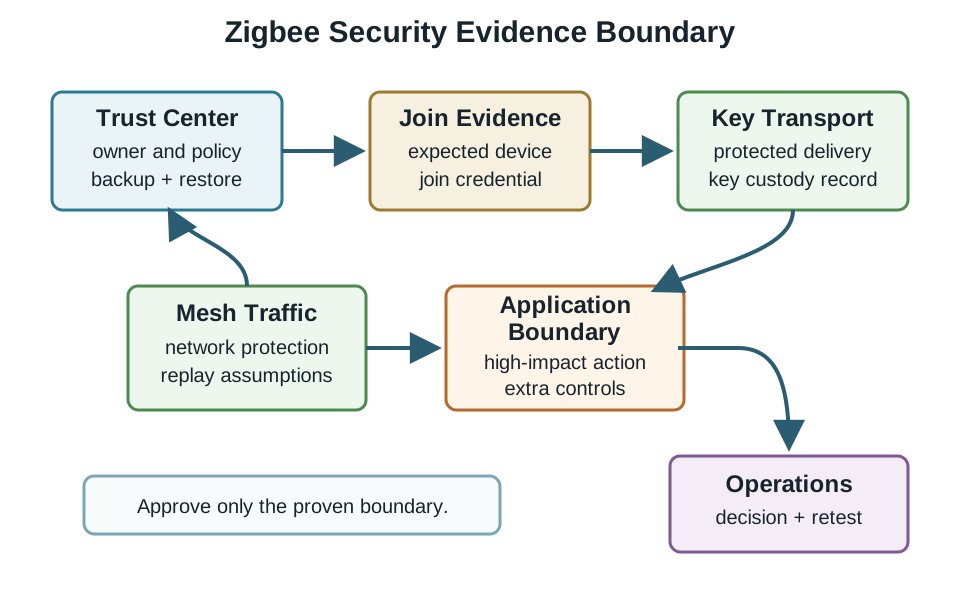
  • Those stages establish who may become a network member and how the shared key reaches that member.
Coordinator recovery depends on preserving the security boundary: Trust Center custody, key transport evidence, mesh replay assumptions, application boundary, and operations ownership.
iotclass.org

Major section

PAN Identity and Recovery State (continued)

Coordinator recovery is also more than swapping hardware: the replacement must restore the same network key, extended PAN ID, and ideally the device table, or devices must be recommissioned.

  • Zigbee frame counters are expected to increase, so a coordinator that comes back with stale or reset counter state can have frames rejected until neighbors resynchronize.
  • An industrial recovery plan should name the preserved network key, preserved extended PAN ID, preserved or rebuildable device table, and frame-counter persistence.
  • Restoring only the hardware is not restoring the network.
iotclass.org

Major section

Common Industrial Deployment Drift

Pilot drift: a successful pilot is treated as approval for every zone and shift.

  • Gateway drift: bridge-visible behavior is treated as proof of Zigbee-side application behavior.
  • Custody drift: joining and coordinator backup are left to informal practice.
  • Safety drift: monitoring evidence is reused as if it approved process-control behavior.
iotclass.org

Major section

Concept Relationships

Zigbee Hands-On Labs Evidence Portfolio explains how lab records feed deployment review.

  • Zigbee Mesh Lab Evidence Review defines the single-lab evidence structure.
  • Zigbee Routing supports path and recovery evidence.
  • Zigbee Security supports joining and custody review.
  • Zigbee Application Profile Evidence Review supports report, command, and gateway-visible behavior review.
iotclass.org

Deck summary

Key takeaways

The site, not the product label, sets the release boundary.

  • An industrial Zigbee deployment should be approved from evidence, not from a polished factory example or a spreadsheet promise.
  • Site boundary evidence records the zones, structures, moving equipment, interference sources, access limits, and monitoring behaviors in scope.
  • Routers relay traffic and keep their radios awake, so they are the infrastructure.
  • The practical review question is not "will Zigbee cover the floor?" but "is there a router within reliable link range of every device, with enough overlap that losing one router does not partition the mesh?".
iotclass.org

Retrieval practice

Recall check 1 of 5

Radio Remi says: answer from memory, then check your reasoning.

Q1What most determines coverage and resilience in an industrial Zigbee deployment?

AThe density and placement of mains-powered routers, because they form the always-on relay backbone.
BA few maximum-power routers, because higher transmit power removes the need for overlapping relay paths.
CBattery-powered relay nodes, because flexible placement makes it easier to fill gaps without installing power cabling.
DStatic addresses for the endpoints, because predictable device identifiers make failed paths easier to diagnose.
Show answer

Answer: A Mains-powered router density and placement drive industrial Zigbee coverage and self-healing; end devices are leaves on that backbone.

iotclass.org

Retrieval practice

Recall check 2 of 5

Radio Remi says: answer from memory, then check your reasoning.

Q2An industrial team finishes a Zigbee pilot and wants to approve production rollout. Which claim is strongest?

AThe pilot supports rollout to similar production zones because they use the same equipment models and planned sensor traffic.
BThe pilot supports the recorded site boundary, custody model, placement evidence, application behavior, and recovery drill.
CThe pilot supports process-control use because its recorded delivery times meet the planned control loop’s timing needs.
DThe pilot supports keeping the channel for production because the site survey found it quieter than the alternatives.
Show answer

Answer: B Industrial deployment claims are useful when bounded by the evidence collected at the site, with unsupported conditions and retest triggers recorded.

iotclass.org

Retrieval practice

Recall check 3 of 5

Radio Remi says: answer from memory, then check your reasoning.

Q3Why must an industrial Zigbee deployment plan explicitly for coordinator loss?

AThe coordinator is the sole Trust Center holding the network key and child or device list.
BThe coordinator relays every data packet, so losing it always stops all mesh routing immediately.
CEach router uses an independent network key, so the coordinator is the only device with replaceable credentials.
DThe coordinator stores all application history, so replacing it deletes sensor readings and maintenance logs.
Show answer

Answer: A Industrial RF needs a site survey and channel plan, and the single coordinator or Trust Center needs network-key and device-list backup for recovery.

iotclass.org

Retrieval practice

Recall check 4 of 5

Radio Remi says: answer from memory, then check your reasoning.

Q4A replacement coordinator is installed but every device must rejoin from scratch. What was most likely not preserved?

AThe Zigbee network security state: network key, extended PAN ID, and device table.
BThe site's Wi-Fi credentials, which Zigbee devices use when authenticating to a new coordinator.
CThe routers' mounting heights, which decide whether devices recognize a replacement coordinator.
DThe sensor calibration values, because Zigbee joining depends on application calibration storage.
Show answer

Answer: A Recovery needs preserved network key, extended PAN ID, device table, and frame-counter persistence; otherwise a new coordinator behaves like a new network.

iotclass.org

Retrieval practice

Recall check 5 of 5

Radio Remi says: answer from memory, then check your reasoning.

Q5A Zigbee pilot worked, but no team owns joining changes, gateway backup, missing-report triage, or retest decisions. What is the correct review decision?

AAccept the deployment because the pilot messages arrived.
BRevise the deployment record to define operations ownership before release.
CIgnore operations ownership because it is separate from network design.
DApprove safety-related control use because monitoring messages were visible.
Show answer

Answer: B Industrial readiness includes custody, triage, backup, and retest ownership.

iotclass.org

Print reference

Answers 1 of 2

Answer key.

  1. A · Mains-powered router density and placement drive industrial Zigbee coverage and self-healing; end devices are leaves on that backbone.
  2. B · Industrial deployment claims are useful when bounded by the evidence collected at the site, with unsupported conditions and retest triggers recorded.
  3. A · Industrial RF needs a site survey and channel plan, and the single coordinator or Trust Center needs network-key and device-list backup for recovery.
iotclass.org

Print reference

Answers 2 of 2

Answer key.

  1. A · Recovery needs preserved network key, extended PAN ID, device table, and frame-counter persistence; otherwise a new coordinator behaves like a new network.
  2. B · Industrial readiness includes custody, triage, backup, and retest ownership.
iotclass.org