Zigbee, Thread & Matter · Study deck
Zigbee 3.0, Matter, and Bridges
Zigbee is a low-power device network.
Radio Remi is your guide for this deck.

After studying this chapter
Learning objectives
You will be able to:
- review Zigbee standards claims without turning live market statements into durable course content,
- separate Zigbee, Thread, and Matter responsibilities in future-facing architecture decisions,
- evaluate bridge-mediated interoperability as a translation claim rather than native protocol equivalence,
- define retest triggers for standards updates, bridge changes, controller changes, and product roadmap changes.
Major section
In 60 Seconds
A strong review does not say that Zigbee is disappearing, that Matter automatically replaces Zigbee, or that a chip, hub, or version label proves migration readiness.
- Zigbee is a low-power device network.
- A protocol is a set of rules for an exchange.
- Firmware is the code stored on the device.
Major section
Start With the Future Claim
The claim may depend on a hub, a bridge, a new test, or a new product.
- A bridge can keep useful gear in service, but it may not carry each feature or trust rule.
- A road map can guide plans, but it is not proof of shipped support.
- Retest after code change.
- Retest after hub change.
Major section
Start With the Future Claim (continued)
Stronger claim: this deployed Zigbee device remains supported through this hub, exposes these behaviors through this bridge, follows this published specification boundary, and requires retest after bridge firmware, controller behavior, certification scope, or device firmware changes.
- The evidence maps later in the chapter set those limits.
- Retest after rule change.
- The stronger claim is reviewable.
Major section
Standards Evidence Families
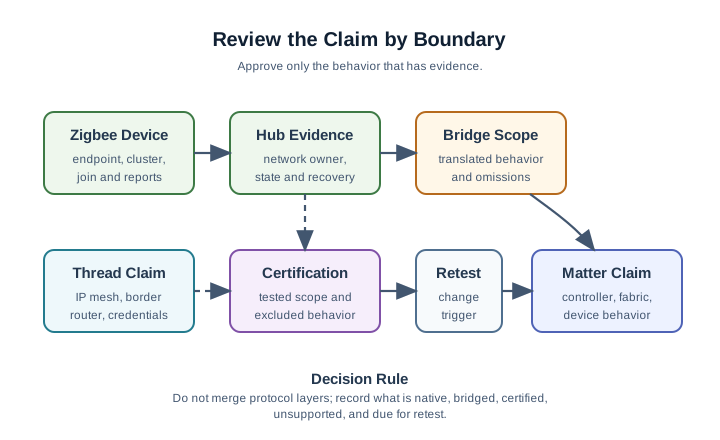
Specification evidence identifies the published Zigbee, Matter, Thread, or related standard in scope.
- It should name the behavior being relied on, not just the standard family.
- Implementation evidence shows what the actual device, hub, bridge, controller, firmware, and app do.
- A standards label does not prove complete behavior.
- Certification evidence shows the scope of tested behavior.
Major section
Standards Evidence Families (continued)
The boundary map keeps a future-facing claim reviewable.
- Bridge evidence shows which Zigbee clusters or commands are translated, which behavior is omitted, how failures appear, and who owns the bridge updates.
- Certification for one device, role, bridge function, or software version should not be stretched to unrelated behavior.
- A Zigbee device claim needs endpoint and cluster evidence.
Major section
Standards Evidence Families (continued)
Certification and retest boundaries tell the reviewer when a past approval is no longer enough.
- Operations evidence shows support ownership, update custody, backup records, rollback or recovery path, monitoring, and retest triggers.
- A hub claim needs coordinator, trust-center, and controller evidence.
- A bridge claim needs translation evidence.
Major section
Bridge Translation and Trust Boundary
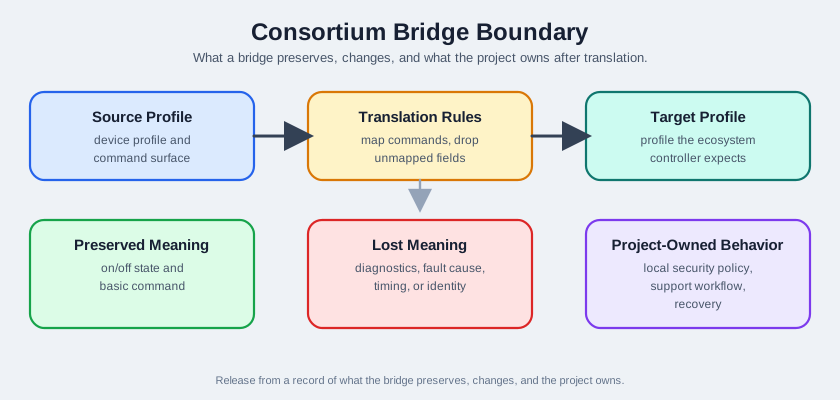
Simple on/off and level-control behavior may map cleanly, but manufacturer-specific clusters, scenes, groups, reporting edge cases, and diagnostic behavior may be omitted or represented differently.
- The review record should say which behavior is preserved, which behavior changes, which behavior disappears, and who owns the bridge rule.
- The bridge is also a trust boundary.
Major section
Migration Evidence Without Budget Drift
The review should not recommend a migration path because it is fashionable.
- Migration review should avoid hard-coded budget figures, market-size claims, named-chip assumptions, and date-bound roadmaps.
- Those numbers age quickly and can mislead learners.
- It should approve the path whose assumptions have evidence.
Major section
Build a Standards Review Record
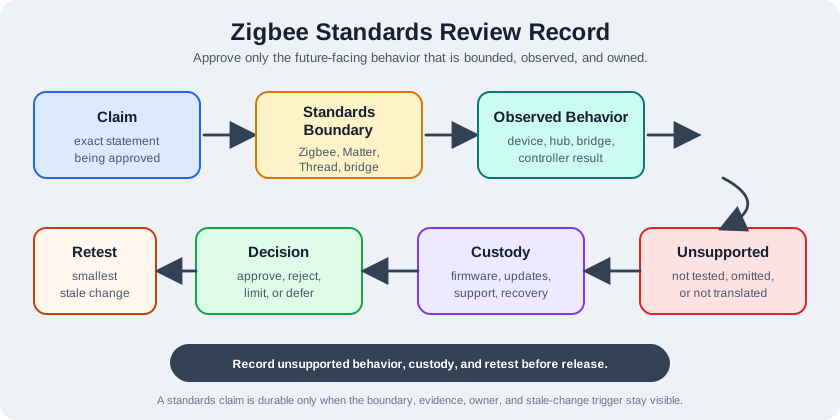
Claim: the exact statement being approved.
- Unsupported behavior: behaviors that were not tested or are not translated.
- Custody: owner for firmware, bridge updates, controller compatibility, support, and recovery.
- Retest trigger: the smallest change that makes the decision stale.
Major section
Common Standards Drift
Prediction drift:: The chapter describes what the market will do instead of what the learner can verify.
- Protocol mixing:: Matter, Thread, Wi-Fi, Ethernet, Zigbee, and bridges are treated as one interchangeable layer.
- Certification stretch:: Certification evidence for one scope is used to approve another scope.
- Roadmap proof:: Planned support is treated as delivered support.
Deck summary
Key takeaways
A strong review does not say that Zigbee is disappearing, that Matter automatically replaces Zigbee, or that a chip, hub, or version label proves migration readiness.
- The claim may depend on a hub, a bridge, a new test, or a new product.
- Stronger claim: this deployed Zigbee device remains supported through this hub, exposes these behaviors through this bridge, follows this published specification boundary, and requires retest after bridge firmware, controller behavior, certification scope, or device firmware changes.
- Specification evidence identifies the published Zigbee, Matter, Thread, or related standard in scope.
- The boundary map keeps a future-facing claim reviewable.
Retrieval practice
Recall check 1 of 6

Radio Remi says: answer from memory, then check your reasoning.
Q1What did Zigbee 3.0 unify compared with earlier Zigbee?
Show answer
Answer: A Zigbee 3.0 unified the previously separate application profiles into one common application layer.
Retrieval practice
Recall check 2 of 6

Radio Remi says: answer from memory, then check your reasoning.
Q2Which evidence best supports a Zigbee 3.0 interoperability claim?
Show answer
Answer: A Zigbee 3.0 unification must still be tied to endpoint, cluster, firmware, certification, and hub-path evidence.
Retrieval practice
Recall check 3 of 6

Radio Remi says: answer from memory, then check your reasoning.
Q3How does an existing Zigbee lighting network typically participate in a Matter ecosystem?
Show answer
Answer: A A Zigbee-to-Matter bridge exposes selected Zigbee behavior as Matter endpoints; it is not a native protocol conversion of each device.
Retrieval practice
Recall check 4 of 6

Radio Remi says: answer from memory, then check your reasoning.
Q4What is true of a Zigbee-to-Matter bridge at the application layer?
Show answer
Answer: A A bridge is a translation and trust boundary, so the approved claim must name mapped behavior, omitted behavior, firmware, controller path, and support owner.
Retrieval practice
Recall check 5 of 6

Radio Remi says: answer from memory, then check your reasoning.
Q5A design note says that adding Matter support proves the device also became a Thread device. What is the best review response?
Show answer
Answer: B The review should separate Matter application evidence from Thread network evidence and approve only the behavior that was actually shown.
Retrieval practice
Recall check 6 of 6

Radio Remi says: answer from memory, then check your reasoning.
Q6A hub exposes a Zigbee light through a Matter bridge. Which statement is the strongest approved claim?
Show answer
Answer: B This claim is bounded by the bridge, the controller path, and the observed behavior, with unsupported functions listed separately.
Print reference
Answers 1 of 2
Answer key.
- A · Zigbee 3.0 unified the previously separate application profiles into one common application layer.
- A · Zigbee 3.0 unification must still be tied to endpoint, cluster, firmware, certification, and hub-path evidence.
- A · A Zigbee-to-Matter bridge exposes selected Zigbee behavior as Matter endpoints; it is not a native protocol conversion of each device.
- A · A bridge is a translation and trust boundary, so the approved claim must name mapped behavior, omitted behavior, firmware, controller path, and support owner.
Print reference
Answers 2 of 2
Answer key.
- B · The review should separate Matter application evidence from Thread network evidence and approve only the behavior that was actually shown.
- B · This claim is bounded by the bridge, the controller path, and the observed behavior, with unsupported functions listed separately.