Zigbee, Thread & Matter · Study deck

Common Zigbee Mistakes

Imagine a battery room sensor that worked on a bench.

Radio Remi is your guide for this deck.

zigbeetroubleshootingdeployment
Radio Remi, the module guide, in a scene from this chapter.
iotclass.org

After studying this chapter

Learning objectives

You will be able to:

  • Explain: This chapter reviews recurring Zigbee failures by asking which evidence boundary is weak: power, RF coexistence, mesh routing, application profile, coordinator recovery, permit-join security, sleepy-device behavior, scale segmentation, or physical custody.
  • Explain: The parent holds downlink for a finite indirect-transmission timeout, so the poll interval must be short enough for commands to be collected before they expire and long enough to preserve battery life.
  • Explain: Zigbee security rejects replayed frames, so a device that loses frame-counter state after a reboot or power interruption can have frames rejected until it rejoins or repairs state.
iotclass.org

Major section

In 60 Seconds

In the real room it joins, reports once, and then goes quiet.

  • Calling the whole network bad will not find the fault.
  • Zigbee is a low-power radio system in which nearby devices can pass messages through a mesh.
  • A gateway is the boundary device that links that mesh to another network or service.

Key terms

gateway
gateway is the boundary device that links that mesh to another network or service.
Most Zigbee mistakes
Most Zigbee mistakes are boundary mistakes.
iotclass.org

Major section

In 60 Seconds (continued)

A working app path does not prove that direct device binding works.

  • A quiet channel during setup does not prove that the site stays quiet.
  • Practitioner records the site test, owner, fix, and retest trigger.
  • Under the Hood explains sleep timing, radio overlap, route repair, key custody, and scale.
  • Those details can narrow the first diagnosis.
iotclass.org

Major section

In 60 Seconds (continued)

They do not make one successful join proof of long-term service.

  • Most Zigbee mistakes are boundary mistakes.
  • This chapter reviews recurring Zigbee failures by asking which evidence boundary is weak: power, RF coexistence, mesh routing, application profile, coordinator recovery, permit-join security, sleepy-device behavior, scale segmentation, or physical custody.
  • The goal is not to memorize a list of rules.
  • The goal is to approve only the behavior that has been observed, documented, and retested.
iotclass.org

Major section

Start With the Observed Failure
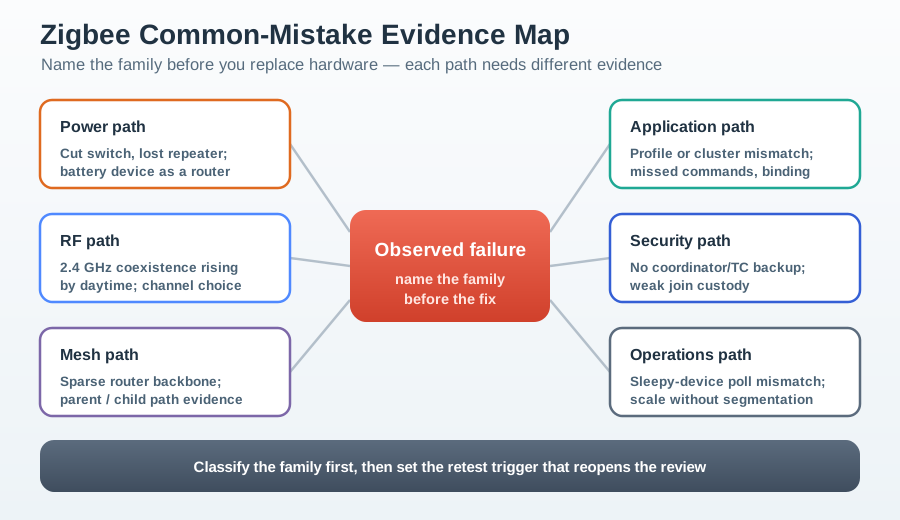
"Zigbee is unreliable" is too broad to approve or fix.

  • A better statement says which behavior failed and which evidence boundary is under review.
  • Each family can appear to a user as "a device is unreliable," but each needs different evidence and a different fix.
Zigbee common-mistake evidence map: one observed failure connected to power, RF, mesh, application, security, and operations evidence paths, and a retest trigger.
iotclass.org

Major section

Power-Path Mistakes

Many Zigbee devices that use mains power also act as routers.

  • A smart switch, dedicated powered router, or operations instruction can be valid, but the record should say which one was verified.
  • A battery-powered device should not be treated as a reliable router.
  • Routers need an awake radio so they can relay frames and parent end devices.

Key terms

If a battery device
If a battery device is configured or assumed to act like a router, it either drains quickly or sleeps and silently breaks dependent paths.
iotclass.org

Major section

Coordinator-Recovery Mistakes

A working network is not a recovery plan.

  • The recovery record should state what can be restored, what must be repaired manually, and which behavior was tested after restoration.
  • A useful backup is more than an exported settings file.
  • If a platform cannot restore one of those pieces, the release claim should name the manual repair work instead of implying seamless recovery.
iotclass.org

Major section

Sleepy-Device Mistakes

A sleepy end device periodically sends a MAC data poll to its parent to collect buffered downlink.

  • The parent holds downlink for a finite indirect-transmission timeout, so the poll interval must be short enough for commands to be collected before they expire and long enough to preserve battery life.
  • Frame-counter persistence is a separate under-the-hood failure mode.
  • Zigbee security rejects replayed frames, so a device that loses frame-counter state after a reboot or power interruption can have frames rejected until it rejoins or repairs state.
iotclass.org

Major section

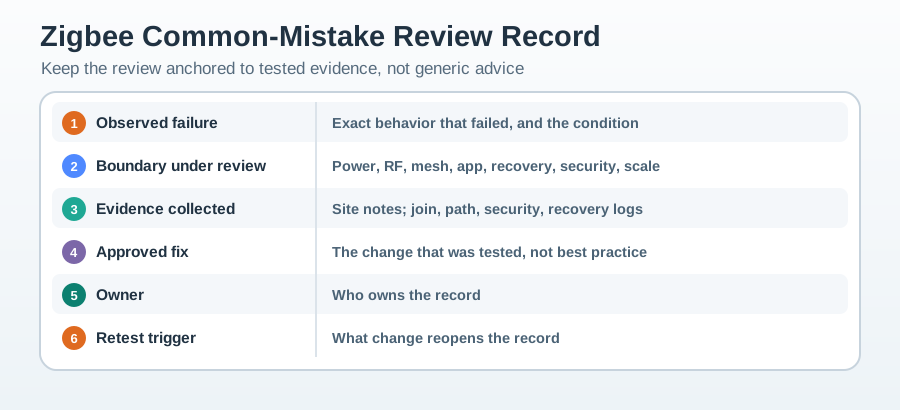
Build a Mistake Review Record

3 Evidence collected then retains site notes and the relevant join, path, security, or recovery logs.

  • 5 Owner assigns custody, and 6 Retest trigger names the change that reopens the record.
  • The mistake cases below can therefore be closed individually without turning one successful repair into a universal rule.
Zigbee common-mistake review record with six fields: observed failure, boundary under review, evidence collected, approved fix, owner, and retest trigger.
iotclass.org

Major section

Summary

Zigbee mistakes are usually not isolated facts to memorize.

  • A reviewer should ask which boundary is weak, collect evidence for that boundary, approve only the tested behavior, and record what change reopens the review.
  • The strongest fixes are specific.
  • They say which path, device role, channel plan, gateway rule, security process, recovery step, or operations boundary was corrected and retested.
iotclass.org

Deck summary

Key takeaways

In the real room it joins, reports once, and then goes quiet.

  • A working app path does not prove that direct device binding works.
  • They do not make one successful join proof of long-term service.
  • "Zigbee is unreliable" is too broad to approve or fix.
  • Many Zigbee devices that use mains power also act as routers.
iotclass.org

Retrieval practice

Recall check 1 of 6

Radio Remi says: answer from memory, then check your reasoning.

Q1A Zigbee channel seems quiet during setup but control becomes flaky under normal daytime use. Which evidence boundary is the likely culprit?

ARF coexistence, since Wi-Fi and other 2.4 GHz traffic rises during the day
BThe application profile silently rewrote itself overnight
CThe coordinator's internal clock drifted out of synchronization
DThe sensors' firmware version became too new to operate
Show answer

Answer: A A channel quiet at setup but flaky by day is a classic RF-coexistence boundary as 2.4 GHz traffic rises.

iotclass.org

Retrieval practice

Recall check 2 of 6

Radio Remi says: answer from memory, then check your reasoning.

Q2What is the most productive first step when a Zigbee device is intermittently unreliable?

AClassify the symptom into the evidence family before replacing hardware.
BImmediately replace the device and approve the network if the replacement joins without errors.
CIncrease coordinator transmit power and skip path evidence if nearby devices respond once.
DDisable security temporarily and treat any short-term improvement as a release fix.
Show answer

Answer: A Zigbee failures cluster into design families; classify the symptom before blaming hardware.

iotclass.org

Retrieval practice

Recall check 3 of 6

Radio Remi says: answer from memory, then check your reasoning.

Q3Why is treating a battery-powered Zigbee device as a router an anti-pattern?

ARouters must keep their radios awake to relay traffic, so battery routers either drain quickly or break dependent paths when they sleep.
BBattery devices lack IEEE addresses, so the coordinator cannot identify them after they join the network.
CBattery devices are unable to send sensor reports, so every report must be relayed by a powered lamp.
DBattery devices cannot use application clusters, so they are incompatible with all endpoint-based profiles.
Show answer

Answer: A Routers relay traffic and need an awake radio; battery Zigbee devices should normally be reviewed as end devices, not mesh routers.

iotclass.org

Retrieval practice

Recall check 4 of 6

Radio Remi says: answer from memory, then check your reasoning.

Q4A sleepy Zigbee sensor reports readings reliably but frequently misses commands sent to it. What is the most likely cause?

AIts poll interval is longer than the parent's buffered-downlink timeout, so commands expire before the device asks for them.
BIt lost frame-counter state after a power event, so neighbors reject all of its outgoing frames.
CIts application cluster changed units, so every command is decoded as a temperature report.
DThe coordinator has too much transmit power, so the sleepy device refuses downlink frames.
Show answer

Answer: A Sleepy end devices collect buffered downlink by polling a parent; command reliability depends on poll interval versus parent buffer timeout.

iotclass.org

Retrieval practice

Recall check 5 of 6

Radio Remi says: answer from memory, then check your reasoning.

Q5A group of battery sensors reports offline whenever several powered lights are cut off by manual wall switches. What is the strongest first review conclusion?

AThe sensors are defective because battery devices should not depend on powered lighting devices.
BThe powered lighting devices may be part of the mesh path
CThe coordinator should be replaced immediately because offline sensors prove coordinator failure.
DThe application profile is the only likely issue because sensors and lights use different device types.
Show answer

Answer: B Cutting power to a router can remove a path that end devices were using.

iotclass.org

Retrieval practice

Recall check 6 of 6

Radio Remi says: answer from memory, then check your reasoning.

Q6A Zigbee network accepts new devices at any time because the team wants installation to be convenient. What is the strongest review action?

AApprove the setting because convenient joining reduces installation friction.
BKeep joining disabled by default and open it only for a controlled addition.
CMove the coordinator to a visible public location so installers can reach it quickly.
DIgnore join events after installation because joined devices are already trusted.
Show answer

Answer: B The approval should describe a controlled custody process — verify the expected device and record the join event — not an open-ended convenience setting.

iotclass.org

Print reference

Answers 1 of 2

Answer key.

  1. A · A channel quiet at setup but flaky by day is a classic RF-coexistence boundary as 2.4 GHz traffic rises.
  2. A · Zigbee failures cluster into design families; classify the symptom before blaming hardware.
  3. A · Routers relay traffic and need an awake radio; battery Zigbee devices should normally be reviewed as end devices, not mesh routers.
  4. A · Sleepy end devices collect buffered downlink by polling a parent; command reliability depends on poll interval versus parent buffer timeout.
iotclass.org

Print reference

Answers 2 of 2

Answer key.

  1. B · Cutting power to a router can remove a path that end devices were using.
  2. B · The approval should describe a controlled custody process — verify the expected device and record the join event — not an open-ended convenience setting.
iotclass.org