RFID, NFC & UWB · Study deck
Z-Wave Simulation: Topology and Failure Experiments
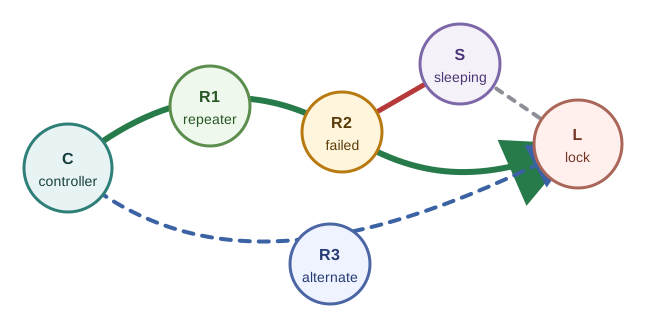
A Z-Wave route can fail when one repeater goes dark or an endpoint sleeps.
Radio Remi is your guide for this deck.
After studying this chapter
Learning objectives
You will be able to:
- Define what a Z-Wave software simulation can and cannot validate.
- Build scenario records that separate topology assumptions, device roles, route constraints, events, and assertions.
- Exercise classic mesh routes, sleeping endpoints, and Z-Wave Long Range star links without treating the model as RF proof.
- Inject route, node, inclusion, security, and command-class failures in a controlled way.
Major section
Start With the Story
A model can show route choices before anyone moves real devices.
- A simple model makes cause easy to see, but it may leave out walls, noise, or battery wear.
- More detail feels real, yet it can hide a poor rule in many settings.
- A Z-Wave simulation is not RF proof, but it is a useful way to test reasoning before buying or moving devices.
Major section
The Simulation Boundary
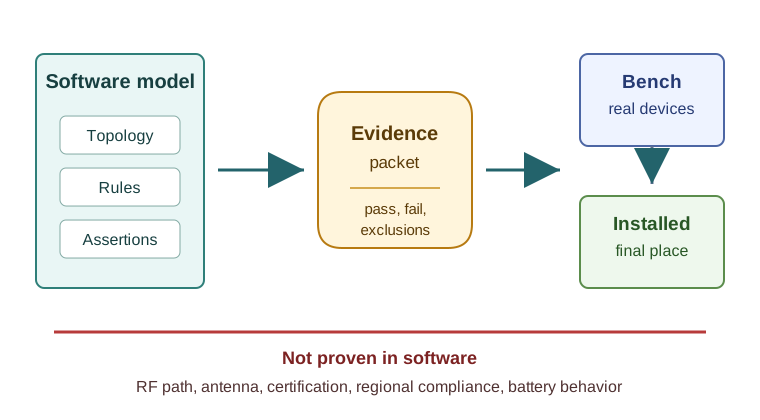
The boundary is not paperwork; it is how you stop a useful model from becoming a misleading claim.
- Their output is an: Evidence packet that must record pass, fail, and exclusions rather than hiding assumptions inside a green result.
- This boundary anchors the rest of the chapter: simulation narrows route and state-machine questions, while hardware and site tests decide whether the design works physically.
Try it: The Simulation Boundary in the chapter
Major section
Eddie's Math Bridge: Price a Simulated Route Repair
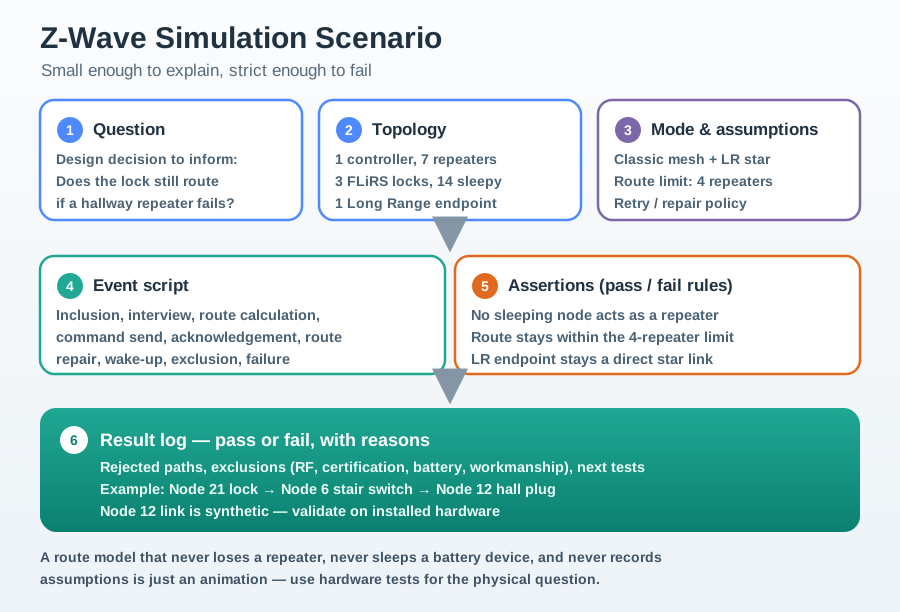
A useful model might contain 1 controller, 7 always-listening classic repeaters, 3: FLiRS locks, 14 sleeping sensors, and 1: Long Range endpoint.
- For example, the model can say that Node 21 lock reaches the controller through Node 6 stair switch and Node 12 hall plug.
Major section
Scenario Design
A useful scenario is small enough to explain and strict enough to fail.
- A route simulation that never loses a repeater, never sleeps a battery device, and never records assumptions is just an animation.
- The route closes at: Result log — pass or fail, with reasons.
Deck summary
Key takeaways
A model can show route choices before anyone moves real devices.
- The boundary is not paperwork; it is how you stop a useful model from becoming a misleading claim.
- A useful model might contain 1 controller, 7 always-listening classic repeaters, 3: FLiRS locks, 14 sleeping sensors, and 1: Long Range endpoint.
- A useful scenario is small enough to explain and strict enough to fail.
Retrieval practice
Recall check

Radio Remi says: answer from memory, then check your reasoning.
Q1A Z-Wave route simulator shows every modeled device is reachable. What can you safely conclude?
Show answer
Answer: D A Z-Wave simulation confirms the modeled topology meets scenario assumptions but still requires hardware and field validation.
Print reference
Answers
Answer key.
- D · A Z-Wave simulation confirms the modeled topology meets scenario assumptions but still requires hardware and field validation.