RFID, NFC & UWB · Study deck
Z-Wave Simulation: Timing and Evidence Analysis
Classic mesh and Long Range may reach the same node by very different paths.
Radio Remi is your guide for this deck.
After studying this chapter
Learning objectives
You will be able to:
- Compare Z-Wave mesh and Long Range timing.
- Analyse association, latency, and injected-failure results.
- Explain: The classic endpoint may use repeaters.
- Explain: A direct command then costs one step, a route through two repeaters costs roughly three steps, and a route through four repeaters costs roughly five steps before any retry.
Major section
Step 1: Compare Classic Mesh and Long Range
The classic endpoint may use repeaters.
- The LR endpoint should be modeled as a direct gateway-to-device star link.
- The pass condition is that the model keeps the two topology rules separate.
- An LR endpoint may solve a direct-reach design problem, but it should not be counted as a classic mesh repeater unless the target product and controller documentation explicitly support that role.
Major section
Latency, Associations, and Timing Assumptions
A direct command then costs one step, a route through two repeaters costs roughly three steps, and a route through four repeaters costs roughly five steps before any retry.
- Each hop adds transmission time, per-node processing, and acknowledgements, so a four-hop path is meaningfully slower than a direct path.
- For a workshop scenario, you might assign 40 ms of modelled time to each transmit-plus-ack step.
- Associations need the same discipline as route timing.
Major section
Latency, Associations, and Timing Assumptions (continued)
Z-Wave data rates are modest compared with Wi-Fi, so the simulation should make hop count and retry cost visible instead of hiding them behind a single "reachable" result.
- Those numbers are not measured Z-Wave latency; they are a visible assumption that lets students compare route shapes.
- The two repeaters are intermediate devices; the final step reaches the endpoint.
- The bench test does not need to reproduce the placeholder milliseconds.
Major section
Latency, Associations, and Timing Assumptions (continued)
If the scenario allows 2 retries after a failed acknowledgement, a marginal four-repeater path can consume three attempts before repair starts.
- The result log should show each attempt, the failing segment, and whether the route finally succeeded, switched to an alternate, or escalated to Explorer Frame discovery.
- Modelling associations shows why an associated pair can react faster and continue working when the controller is busy or offline.
- A switch-to-lamp association can be modelled as direct device control only when the scenario states the source device, target device, group, and command being sent.
Major section
Explorer Frame Flood and Retries
At event 4, if stored paths fail, launch the explorer-frame search.
- The most instructive thing to simulate is what happens when a route breaks.
- When known routes are exhausted, an Explorer Frame can spread outward through the network to discover a new path.
- The flood model should track duplicate suppression and hop budget.
Major section
Explorer Frame Flood and Retries (continued)
A Z-Wave transmission is acknowledged with retries, so first model the retry: a lost frame is retransmitted according to the scenario policy, each attempt adds latency, and then the node gives up on that route.
- That flood is controlled, but it is still much more expensive than a normal routed message.
- Neighbours rebroadcast under a hop budget, duplicate suppression keeps repeated frames from expanding forever, and the destination reply lets the network cache a recovered path.
- A route-repair scenario for Node 21 can start with cached path controller -> 6 -> 12 -> 21.
Major section
Explorer Frame Flood and Retries (continued)
A simulation reveals the cost: route repair briefly generates more traffic than a normal command, which is why explorer behavior is a last resort rather than the default.
- If Node 6 and Node 8 both hear the explorer, each may rebroadcast according to the ruleset.
- If Node 14 receives duplicates, it should forward only according to the model's suppression rule.
- If every discovered candidate exceeds the classic repeater limit, the run should fail with "no valid classic route" instead of inventing a longer path.
Major section
Evidence Handoff
Simulation evidence is most useful when it is written for the next reviewer.
- A good handoff says, "Here is what the model checked, here is what it assumed, and here is what hardware must still prove.".
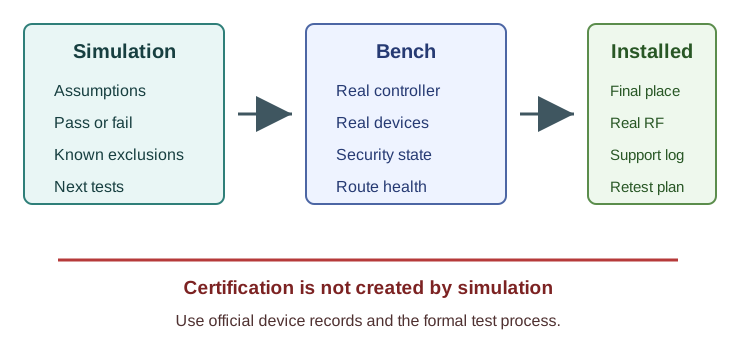
- A simulation keeps its assumptions, pass or fail result, exclusions, and next tests visible.
- Certification remains separate.
Major section
Evidence Handoff (continued)
The bench stage uses a real controller and devices to check security state, timing, and route health.
- The installed stage repeats the question with final placement, RF conditions, support logs, and a retest plan.
- A simulated pass cannot certify a device or settle a field route; official device records and the formal test process are separate release evidence.
- A simulator can help prepare a product or installation review, but it does not certify a Z-Wave device, validate RF compliance, or prove that a mixed installation meets certification requirements.
Major section
Worked Scenario
A design review needs to decide whether a smart lock near an exterior door has enough classic mesh support.
- The team has not installed hardware yet, so they build a software scenario.
- The contact sensors are excluded from route paths.
- The LR sensor is modeled as direct to the gateway and does not improve the classic route.
Major section
Common Mistakes
Treating the graph as an RF survey: A route edge in software is an assumption until measured or observed with real devices.
- Mixing classic mesh and LR rules: A Z-Wave Long Range endpoint should not be counted as a classic repeater in a route exercise.
- Running only the happy path: A useful simulation includes at least one failed acknowledgement, removed repeater, incomplete interview, or sleeping-device case.
- Reporting certification from simulation: Simulation can prepare evidence for review, but certification requires the formal process and certified device records.
Deck summary
Key takeaways
The classic endpoint may use repeaters.
- A direct command then costs one step, a route through two repeaters costs roughly three steps, and a route through four repeaters costs roughly five steps before any retry.
- Z-Wave data rates are modest compared with Wi-Fi, so the simulation should make hop count and retry cost visible instead of hiding them behind a single "reachable" result.
- If the scenario allows 2 retries after a failed acknowledgement, a marginal four-repeater path can consume three attempts before repair starts.
- At event 4, if stored paths fail, launch the explorer-frame search.
Retrieval practice
Recall check 1 of 2

Radio Remi says: answer from memory, then check your reasoning.
Q1A Z-Wave simulation shows a brief spike in network traffic and latency right after a repeater is removed, then normal fast operation resumes. What is being modelled?
Show answer
Answer: B Route repair modelling shows retries on the failed route, then a hop-limited explorer-frame flood that increases traffic and latency until a new path is discovered and cached.
Retrieval practice
Recall check 2 of 2
Radio Remi says: answer from memory, then check your reasoning.
Q2A Z-Wave route simulator shows that every modeled device is reachable. Which conclusion is safe to make from software-only evidence?
Show answer
Answer: D Software simulation validates the scenario model, not the physical deployment.
Print reference
Answers
Answer key.
- B · Route repair modelling shows retries on the failed route, then a hop-limited explorer-frame flood that increases traffic and latency until a new path is discovered and cached.
- D · Software simulation validates the scenario model, not the physical deployment.