RFID, NFC & UWB · Study deck
Z-Wave Routing and Healing
A Z-Wave route fails at the worst time: after furniture moves, a repeater is unplugged, a sleeping sensor misses a wake window, or a device sits at the edge of coverage.
Radio Remi is your guide for this deck.

After studying this chapter
Learning objectives
You will be able to:
- Explain how a classic Z-Wave source route is selected, carried, acknowledged, and remembered.
- Identify which devices can act as repeaters and which devices should be treated as non-routing endpoints.
- Describe how failed acknowledgements, alternate routes, Explorer Frames, and rediscovery fit into route repair.
- Distinguish a targeted route repair from a broad network rediscovery or "heal" operation.
Major section
In 60 Seconds
Classic Z-Wave routing is source-routed.
- A sending node uses stored route evidence, places the route in the frame, and each repeater forwards to the next listed hop.
- The successful route becomes the route to try first next time.
- When direct or stored routes fail, the network can try alternate routes and then use Explorer Frame discovery as a last resort.
Major section
Core Ideas
Source route: the selected path is carried in the transmitted frame instead of being decided independently at every hop.
- Repeater: an always-listening classic Z-Wave node that can forward routed traffic for other nodes.
- Last Working Route (LWR): the most recently successful route a node can try before less proven alternatives.
- Explorer Frame: a discovery frame used when known routes no longer reach the target.
Major section
Core Ideas (continued)
Rediscovery or heal: a controller action that rebuilds route and neighbor evidence after topology changes or repeated failures.
- Sleeping endpoint: a battery device that wakes for events or scheduled communication and normally does not repeat traffic.
- Frequently Listening endpoint: a low-power endpoint that can be reached by wake-up beams but still does not act as a route repeater.
- Z-Wave Long Range endpoint: an LR node that uses direct star communication with the gateway rather than classic mesh routing.
Major section
Source Routing, Not Hop-by-Hop Routing
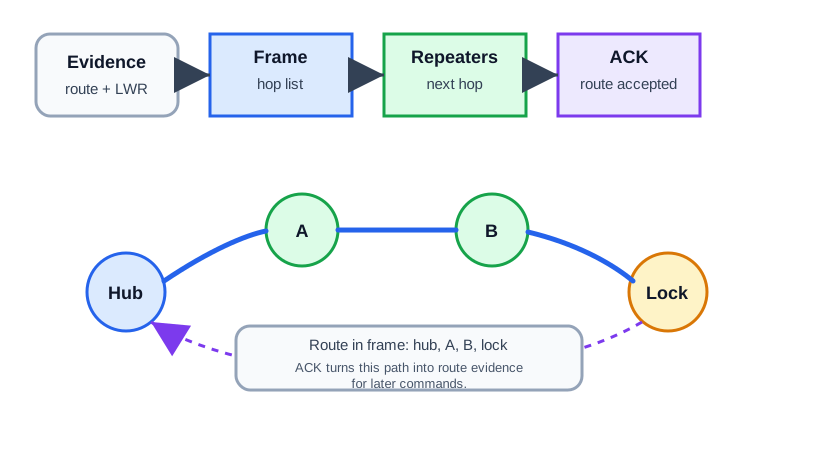
Classic Z-Wave repeaters do not run a full distributed routing decision for every packet.
- The route is selected before transmission and included in the frame.
- Each repeater reads its position in the route and forwards to the next listed node.
- That ordering makes for later commands depend on route + LWR.
Major section
Source Route Evidence Is an Installed-Location Claim
A house might show one controller, nine mains-powered switches and plugs, four FLiRS locks or thermostats, and sixteen sleepy sensors.
- The app reports thirty nodes, but the classic route backbone is only the nine always-listening devices.
- The FLiRS and sleepy endpoints can be destinations; they are not the devices that carry another endpoint's command.
- The repeater limit is also an acceptance constraint.
Major section
Repeaters and the Classic Mesh Backbone
A battery contact sensor, motion sensor, button, or handheld remote should normally be treated as an endpoint, not as a path-building device.
- In classic Z-Wave, the reliable backbone is built from always-listening devices that can forward traffic.
- Product category alone is not enough.
- Good repeater evidence is measured after installation.
Major section
Sleeping and Frequently Listening Endpoints
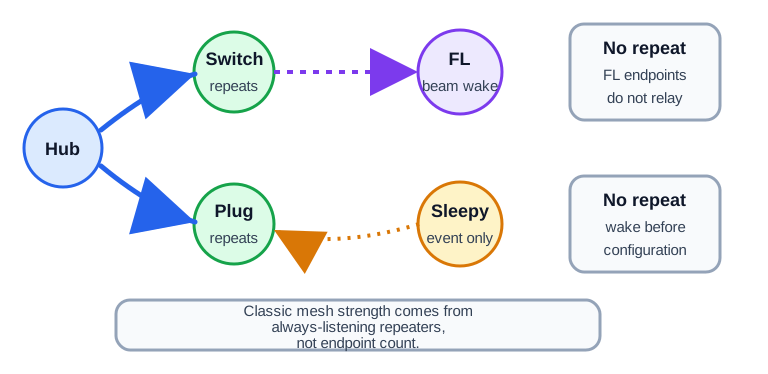
To test sleeping and frequently listening endpoints, inspect how: Hub relates to: No repeat in it. Not endpoint count makes the purpose concrete.
- Twenty sensors plus two repeaters is still a two-repeater backbone.
Major section
Route Repair and Healing
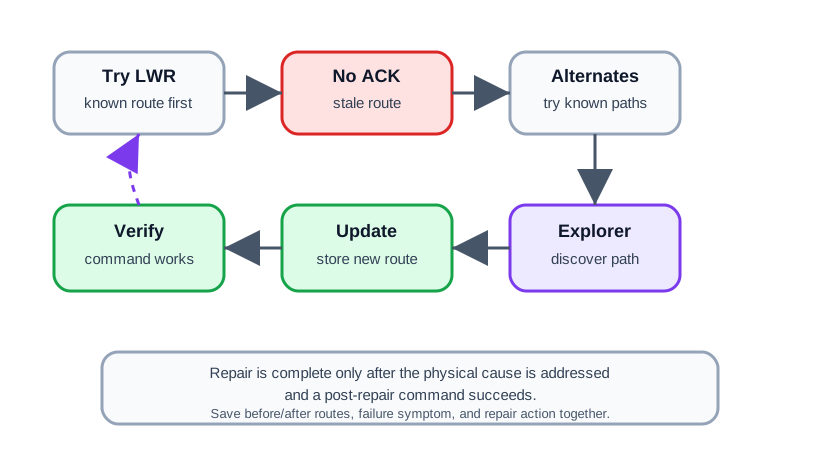
Route repair starts when a command path stops producing the expected acknowledgement.
- A controller or sending node may try the last working route, then other known routes, and then Explorer Frame discovery when known routes fail.
- The remaining question is and a post-repair command succeeds.
- Reopen route repair and healing whenever try known paths changes.
Major section
When Known Routes Fail
Furniture moves, a plug-in repeater is unplugged, a controller is relocated, a metal appliance appears near a route, or a battery device waits for a manual wake-up.
- Z-Wave route recovery should be read as layered evidence rather than as one "heal" button.
- If that fails, it tries other known routes from the controller's routing table.
- If known routes fail, Explorer Frame discovery can search for a fresh path.
Major section
When Known Routes Fail (continued)
If both fail, the evidence points to a local path problem, not a reason to exclude every device.
- If a new route through Node 8 and Node 14 acknowledges commands, record that before-and-after path and the physical change that made it work.
- A broad rediscovery can produce useful route tables, but it can also hide the original cause if it is run before anyone records the failed path.
- If a window sensor has a stale interview, wake it on schedule or manually before treating routing as broken.
Major section
Explorer Frames Are Controlled Flooding
Pure source routing has a weakness: if the controller's map is stale, every precomputed route can fail and the message is stuck.
- Explorer Frames are the last-resort discovery mechanism.
- When a node exhausts known routes, it broadcasts an Explorer Frame that neighboring always-listening nodes rebroadcast under a hop limit.
- Long Range changes this logic.
Major section
Explorer Frames Are Controlled Flooding (continued)
Duplicate suppression and the route limit keep the search bounded.
- Most commands use cheap precomputed source routes with bounded latency.
- When topology has shifted, Explorer Frame discovery can repair the path without a full network heal.
- The controller sends to Node 24 using cached route controller -> 6 -> 14 -> 24.
Major section
Explorer Frames Are Controlled Flooding (continued)
When stored options fail, an Explorer Frame asks nearby always-listening nodes to propagate the search while suppressing duplicates and respecting the route limit.
- The sender then uses that route and caches the successful result as fresh route evidence.
- If the route only works through a portable plug, the repair is operationally fragile even though the protocol found a path.
- The evidence packet should include the physical role of each repeater.
Major section
Explorer Frames Are Controlled Flooding (continued)
Explorer Frames cannot make every case healthy.
- If all candidate paths would require more than four repeaters, the topology is too stretched for classic routing.
- If the only nearby devices are sleepy sensors, there is no forwarding backbone.
- In a mixed installation, write down whether each endpoint is classic mesh or LR before adding repeaters.
Major section
Troubleshooting Evidence Packet
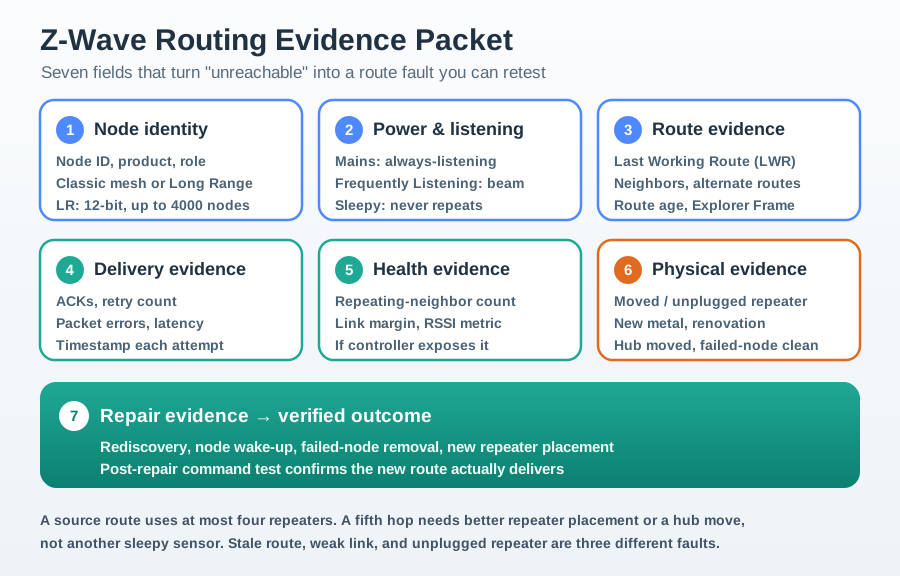
Z-Wave troubleshooting gets weaker when it is based on screenshots that only say "offline" or "busy." Build a packet that explains the route failure in terms an installer or future maintainer can retest.
- A low signal reading, a stale route, and an unplugged repeater are different problems even if the app surfaces each as "unreachable.".
Major section
Classic Mesh vs Z-Wave Long Range
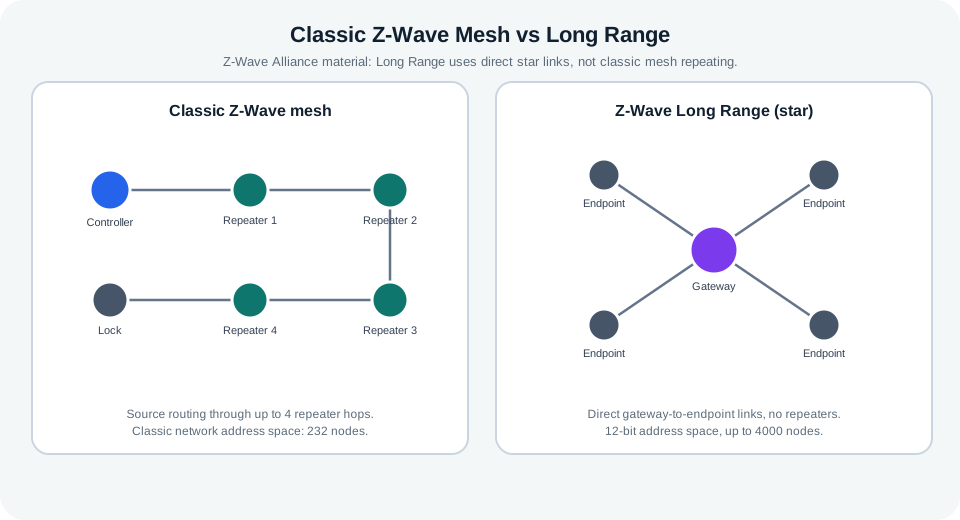
Z-Wave Long Range changes the topology.
- Z-Wave Alliance material describes LR as using a 12-bit address space with support for up to 4000 nodes, while classic Z-Wave uses the smaller classic node space.
- The more important routing point is that LR nodes do not become repeaters for classic routes.
Deck summary
Key takeaways
Classic Z-Wave routing is source-routed.
- Source route: the selected path is carried in the transmitted frame instead of being decided independently at every hop.
- Rediscovery or heal: a controller action that rebuilds route and neighbor evidence after topology changes or repeated failures.
- Classic Z-Wave repeaters do not run a full distributed routing decision for every packet.
- A house might show one controller, nine mains-powered switches and plugs, four FLiRS locks or thermostats, and sixteen sleepy sensors.
Retrieval practice
Recall check 1 of 3

Radio Remi says: answer from memory, then check your reasoning.
Q1How does classic Z-Wave routing move a frame toward its destination?
Show answer
Answer: D Classic Z-Wave is source-routed: the sender embeds a stored route and each repeater forwards to the next listed hop.
Retrieval practice
Recall check 2 of 3

Radio Remi says: answer from memory, then check your reasoning.
Q2A Z-Wave device's usual route stops working after a repeater is moved. How can the message still get through, and why is this not done for every message?
Show answer
Answer: C Classic Z-Wave normally uses cached source routes through mains-powered repeaters.
Retrieval practice
Recall check 3 of 3

Radio Remi says: answer from memory, then check your reasoning.
Q3A classic Z-Wave command to a door lock fails after the controller tries the Last Working Route and several known alternatives. What is the next routing mechanism to look for in the evidence?
Show answer
Answer: A After known routes fail, Explorer Frame discovery is the local mechanism that can discover a new path.
Print reference
Answers
Answer key.
- D · Classic Z-Wave is source-routed: the sender embeds a stored route and each repeater forwards to the next listed hop.
- C · Classic Z-Wave normally uses cached source routes through mains-powered repeaters.
- A · After known routes fail, Explorer Frame discovery is the local mechanism that can discover a new path.