RFID, NFC & UWB · Study deck

Z-Wave for Smart Homes

Picture a hallway light that works from the wall switch but not from the far end of the house.

Radio Remi is your guide for this deck.

z-wavesmart-homesub-ghz
Radio Remi, the module guide, in a scene from this chapter.
iotclass.org

After studying this chapter

Learning objectives

You will be able to:

  • Describe Z-Wave's role in smart-home and small-building automation.
  • Separate classic Z-Wave mesh behavior from Z-Wave Long Range star behavior.
  • Explain why regional frequency support must be checked before buying devices.
  • Identify the first design questions for a Z-Wave deployment.
iotclass.org

Major section

Start With the Story

A protocol means the agreed rules and message order devices use to communicate.

  • This proves one installed path, not every building layout; the deeper sections explain Z-Wave roles, mesh behavior, inclusion, security, region fit, and Long Range choices.
  • A Z-Wave design starts in a real home or small building, not in a protocol table.
  • The system has locks, lights, sensors, plugs, thermostats, regions, walls, batteries, hubs, and users who expect automations to work without thinking about routes.
iotclass.org

Major section

Eddie's Math Bridge: Turn Sub-GHz Into Link Margin · Core Ideas

The mathematical gist.: A carrier near 868 MHz has a 0.346 m wavelength, about 2.77 times the 0.125 m wavelength at 2.4 GHz.

  • With the same link budget, that ideal frequency-only comparison gives 2.77 times the range before walls and antenna details are added.
iotclass.org

Major section

What Z-Wave Is Good For
Z-Wave is strongest when the workload is small control and status traffic rather than high-throughput data.

  • A light switch command, lock state, thermostat setpoint, leak alert, shade command, or contact-sensor event is a good fit.
  • Camera video, firmware image distribution, high-rate telemetry, and large payload streams are not.
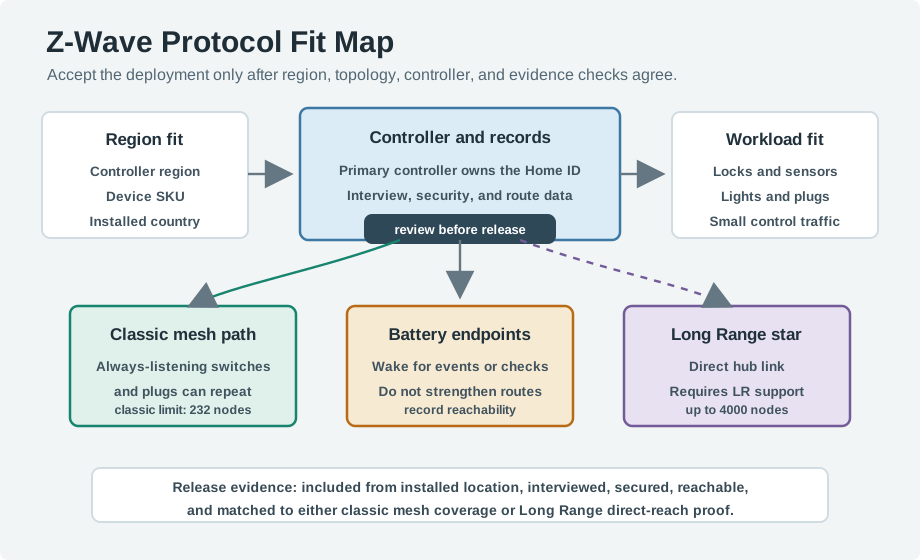
Z-Wave protocol fit map tying region evidence, controller records, classic mesh repeaters, sleeping endpoints, and Long Range star links to a release decision.
iotclass.org

Major section

Sub-GHz and Topology Evidence

The 20 battery sensors are useful endpoints, but they do not make the route backbone stronger.

  • The tradeoff is data rate.
  • Z-Wave is designed for small commands and status events, not video or large telemetry streams.
  • That same home may also have one shed or gate sensor outside the normal mesh.

Numbers to remember

908 MHzoften around 908 MHz in the United States
iotclass.org

Major section

GFSK Pulse Shaping and Classic Identifier Fields

Frequency-shift keying represents bits by moving the carrier between frequency states.

  • If the baseband symbol sequence jumps abruptly between $-1$ and $+1$, its sharp edges contain high-frequency components that spread the modulated signal beyond the desired channel.
  • The shaped control signal is the convolution.
  • and the instantaneous carrier frequency becomes.
iotclass.org

Major section

GFSK Pulse Shaping and Classic Identifier Fields (continued)

Calling all three “GFSK” hides where an implementation or interoperability failure occurs.

  • The modulator therefore changes frequency smoothly instead of responding to a rectangular edge, reducing sidelobes and occupied bandwidth.
  • The receiver and transmitter must implement the same PHY profile; pulse shaping is not a field tuning knob to change independently.
  • : Classic Z-Wave identifiers must be read together, not as globally unique device identity.
iotclass.org

Major section

GFSK Pulse Shaping and Classic Identifier Fields (continued)

Manchester-style coding controls transition and clock-recovery properties of the bitstream; Gaussian filtering shapes the pulses; FSK maps the shaped result into carrier-frequency deviation.

  • A Node ID is meaningful only with its Home ID.
  • Security keys, command classes, controller records, and inclusion state remain separate fields.
  • For packet logs and fleet records, capture at least Home ID, Node ID, controller, device identity, security class, route role, and observation time so “Node 7” cannot be confused across networks or after a controller migration.
iotclass.org

Major section

Classic Z-Wave and Z-Wave Long Range · Network Identity and Device Roles
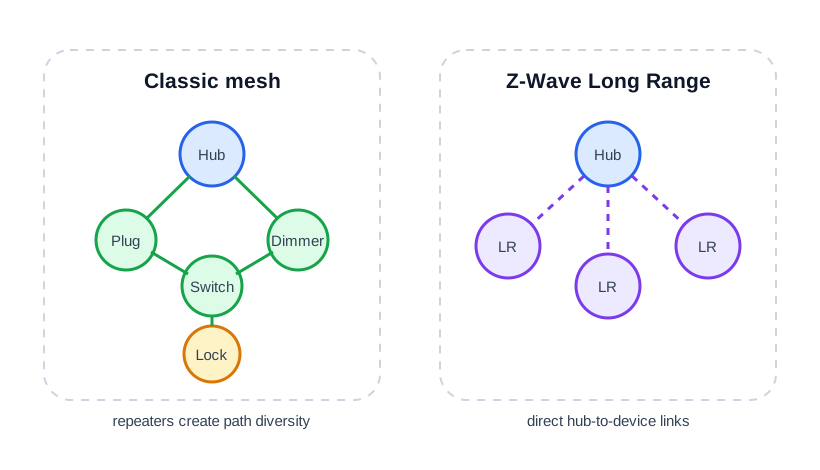
Classic Z-Wave and Z-Wave Long Range can appear in the same product ecosystem, but they solve different topology problems.

  • A direct star link still needs region support, controller support, signal margin, security inclusion, and device interview records.
  • End devices are the controlled devices.

Key terms

Every classic Z-Wave network
Every classic Z-Wave network is defined by identifiers assigned by the controller.
Topology comparison showing classic Z-Wave mesh repeaters beside Z-Wave Long Range direct star links from the same gateway.
iotclass.org

Major section

First Design Questions · Frequency and Region Fit
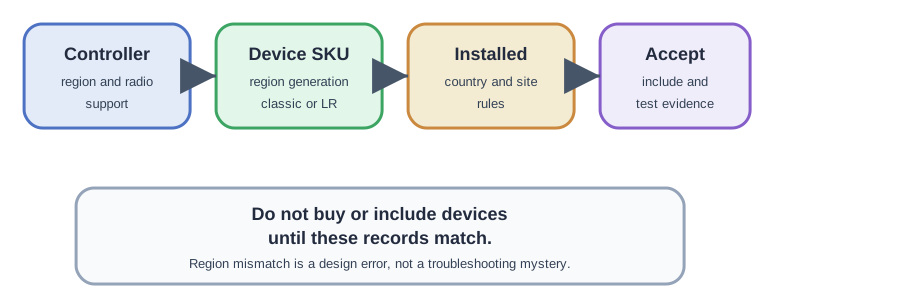
Z-Wave is sub-GHz, but "sub-GHz" is not one global frequency.

  • Devices are produced for regional frequency plans.
  • A device built for one region may not work legally or reliably with a controller from another region.
  • The comparison reaches until these records match.

Why it matters

That record is more useful than a copied frequency table because products and country allocations can be updated over time.

Z-Wave regional fit checklist showing controller region, device SKU, installed country, and acceptance evidence before inclusion.
iotclass.org

Major section

How Z-Wave Compares

Z-Wave is one option in a smart-home protocol portfolio.

  • Zigbee uses 2.4 GHz in many deployments and has a broader multi-vendor ecosystem with profile and implementation variation.
  • Both require installed testing; neither should be accepted from a marketing claim alone.
  • Thread is IP-based and often discussed with Matter ecosystems.

Numbers to remember

2.4 GHzZigbee uses 2.4 GHz in many deployments
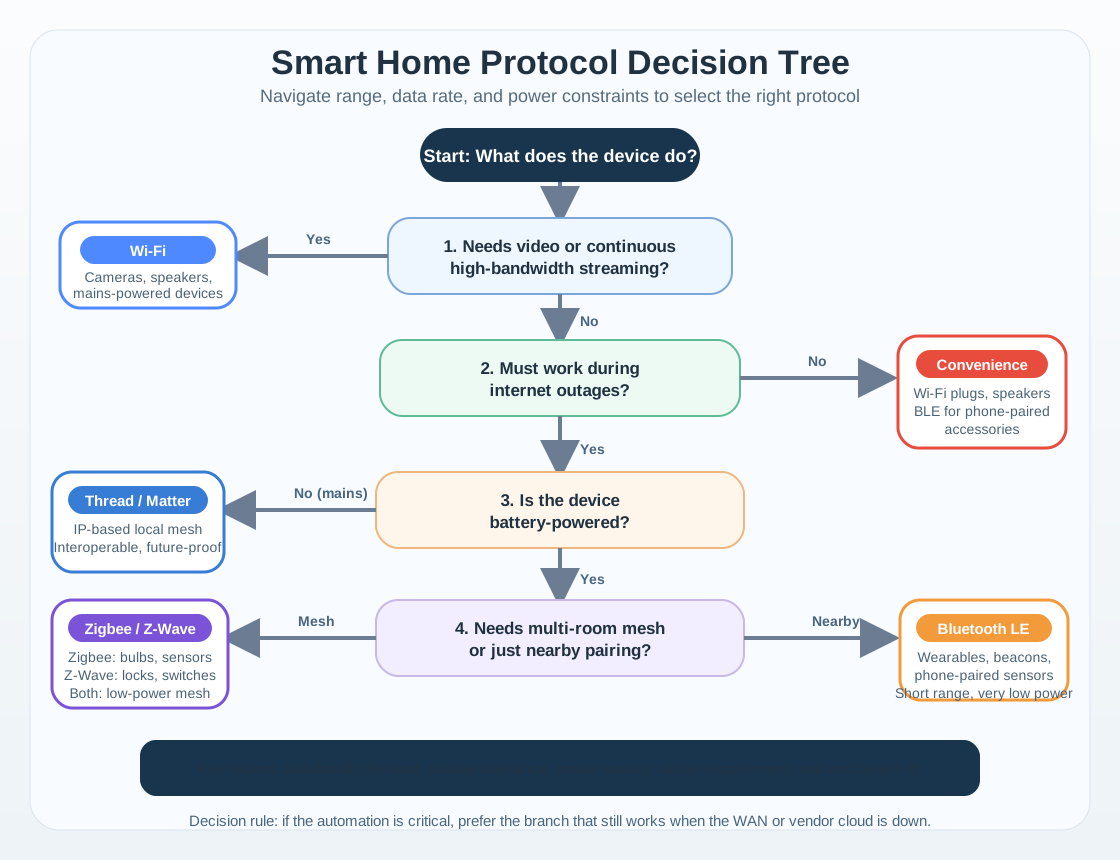
Smart-home protocol decision tree comparing Z-Wave and Zigbee mesh against Wi-Fi, Thread/Matter, and Bluetooth LE by bandwidth, outage tolerance, power, and range.
iotclass.org

Major section

How Z-Wave Compares (continued)

Z-Wave is not IP-native at the device mesh layer; integration usually happens through a controller/gateway.

  • Thread fit depends on border routers, IP operations, and Matter goals; Z-Wave fit depends on controller support, regional frequency, and device-role evidence.
  • Wi-Fi is better for high-throughput devices and direct IP integration.
  • Z-Wave is better for low-bandwidth control/status endpoints where device power, local automation, and smart-home hub integration matter.
iotclass.org

Major section

How Z-Wave Compares (continued)

Bluetooth and BLE fit phone-adjacent pairing, wearables, beacons, and nearby control.

  • Z-Wave fits persistent installed automation with a dedicated controller and device records.
  • The comparison is a sequence of workload questions, not a league table.
  • The resulting branch narrows the candidate set; regional support, security, interoperability, and installed radio evidence still decide whether the selected protocol is acceptable at this site.
iotclass.org

Major section

Interoperability, Command Classes, and Acceptance · Worked Example

Z-Wave's interoperability story depends on certification and standard command classes.

  • Certified devices implement command classes such as Binary Switch, Multilevel Sensor, Door Lock, Notification, and Battery so a controller can learn what the device can do during interview instead of guessing from a product name.
  • Certification proves a shared protocol language; the installed network still has to prove region fit, security inclusion, role classification, route evidence, or LR direct-link evidence.
  • For example, a certified lock can still be unreliable if it was included near the hub, moved to a metal door, and never retested from the installed location.
iotclass.org

Major section

Common Pitfalls · Match the Concepts

Mixing regions.: A device bought from another market can have the wrong regional frequency.

  • Counting sleepy sensors as repeaters.: Battery devices usually do not build the classic mesh backbone.
  • Assuming Long Range means mesh extension.: LR is direct star communication, not a repeater path for classic mesh nodes.
  • Trusting app presence as acceptance.: A device appearing in the controller UI is not enough.

Key terms

Assuming Long Range
Assuming Long Range means mesh extension. LR is direct star communication, not a repeater path for classic mesh nodes.
iotclass.org

Major section

Summary · Key Takeaway

Z-Wave is best understood as a smart-home automation protocol with specific topology and evidence requirements.

  • Classic Z-Wave depends on repeat-capable mains-powered devices to create a mesh.
  • Z-Wave Long Range adds direct star communication and larger address space, but it is not a replacement for installed validation.
  • Region, controller support, security inclusion, device role, and route or signal evidence are the facts that make a Z-Wave design reviewable.
iotclass.org

Deck summary

Key takeaways

A protocol means the agreed rules and message order devices use to communicate.

  • The mathematical gist.: A carrier near 868 MHz has a 0.346 m wavelength, about 2.77 times the 0.125 m wavelength at 2.4 GHz.
  • Z-Wave is strongest when the workload is small control and status traffic rather than high-throughput data.
  • The 20 battery sensors are useful endpoints, but they do not make the route backbone stronger.
  • Frequency-shift keying represents bits by moving the carrier between frequency states.
iotclass.org

Retrieval practice

Recall check 1 of 3

Radio Remi says: answer from memory, then check your reasoning.

Q1What distinguishes Z-Wave Long Range from the classic Z-Wave mesh?

ALR endpoints talk directly to the hub in a star with a larger address space
BLR switches to the 2.4 GHz band instead of the sub-GHz band
CLR removes the need for any hub or controller entirely
DLR turns every battery device into a mesh repeater
Show answer

Answer: A Z-Wave Long Range uses a hub-centered star topology with a larger address space, unlike the classic mesh.

iotclass.org

Retrieval practice

Recall check 2 of 3

Radio Remi says: answer from memory, then check your reasoning.

Q2A homeowner buys a Z-Wave switch, sensor, and lock from three different brands and expects them to work with one controller. What two Z-Wave design choices make this reliable?

AOperation in the 2.4 GHz band for maximum bandwidth, with a vendor-specific driver loaded per device.
BA 32-bit Node ID giving billions of addresses, so devices from different brands never collide.
CSub-GHz operation for whole-home control traffic, plus certification around standard command classes.
DEach device forming its own Home ID network so the different brands never interfere with each other.
Show answer

Answer: C Z-Wave combines regional sub-GHz operation with certification around standard command classes.

iotclass.org

Retrieval practice

Recall check 3 of 3

Radio Remi says: answer from memory, then check your reasoning.

Q3A deployment has classic Z-Wave switches indoors and a new Z-Wave Long Range leak sensor near an outdoor shed. What should the reviewer remember?

AThe LR sensor extends and strengthens the classic indoor mesh because it sits farther from the hub.
BThe LR sensor still needs an LR-capable hub, regional support, and installed signal evidence.
CThe classic mesh switches cannot coexist with any Long Range devices on the same site.
DThe LR sensor must be included through the nearest classic mains-powered repeater.
Show answer

Answer: B LR changes the topology to a star, but it does not remove the need for a controller, matching regional band support, inclusion, security, and installed-signal evidence.

iotclass.org

Print reference

Answers

Answer key.

  1. A · Z-Wave Long Range uses a hub-centered star topology with a larger address space, unlike the classic mesh.
  2. C · Z-Wave combines regional sub-GHz operation with certification around standard command classes.
  3. B · LR changes the topology to a star, but it does not remove the need for a controller, matching regional band support, inclusion, security, and installed-signal evidence.
iotclass.org