Wireless Sensor Networks · Study deck
WSN Tracking Implementation
Picture a cart that carries medicine through a hospital.
Packet Pete is your guide for this deck.
After studying this chapter
Learning objectives
You will be able to:
- Review a WSN tracking implementation framework as a set of contracts and evidence records.
- Identify the lifecycle labels needed for tentative, current, predicted, ambiguous, lost, recovered, partial, and historical tracks.
- Explain how sensor coordination, data association, energy state, and gateway custody affect implementation quality.
- Evaluate worked implementation scenarios without relying on brittle numeric claims or vendor-style promises.
Major section
Start With the Field Story
The screen must show where it is now.
- It must also admit when the trail is weak.
- A gateway is the device or service that carries sensor records into the wider system.
- Telemetry means time-stamped reports about what the tracker saw and how it behaved.
- This Overview gives the release story, not the full tracking model.
Major section
Start With the Field Story (continued)
If two carts pass close together, do not merge them just to keep the display neat.
- Practitioner shows the lifecycle records, handoff tests, and field review.
- Those deeper rules may refine the simple trip, but they must never turn an uncertain sighting into a certain claim.
- A sensor makes a sighting.
- The record keeps its time.
Major section
Start With the Field Story (continued)
A framework must show which nodes observe, how estimates are labelled, where uncertainty is stored, who owns handoff, and what telemetry proves the tracker is ready.
- The record keeps its source.
- One owner holds it at a time.
- Failed uploads remain in custody.
- The screen shows the limit.
Major section
In 60 Seconds · WSN Tracking Framework Review
A tracking framework needs contracts between sensing, estimation, association, prediction, coordination, gateway, and application layers.
- Implementation quality depends on records, not only algorithms: source observation, state estimate, owner, age, uncertainty, custody, and release label must travel together.
- Multi-target behavior needs explicit association rules and conflict labels before a system can display separate target tracks.
- Energy behavior needs sleeping, waking, sampling, relaying, gateway handoff, and recovery costs in the same review record.
Major section
Implementation Architecture Map
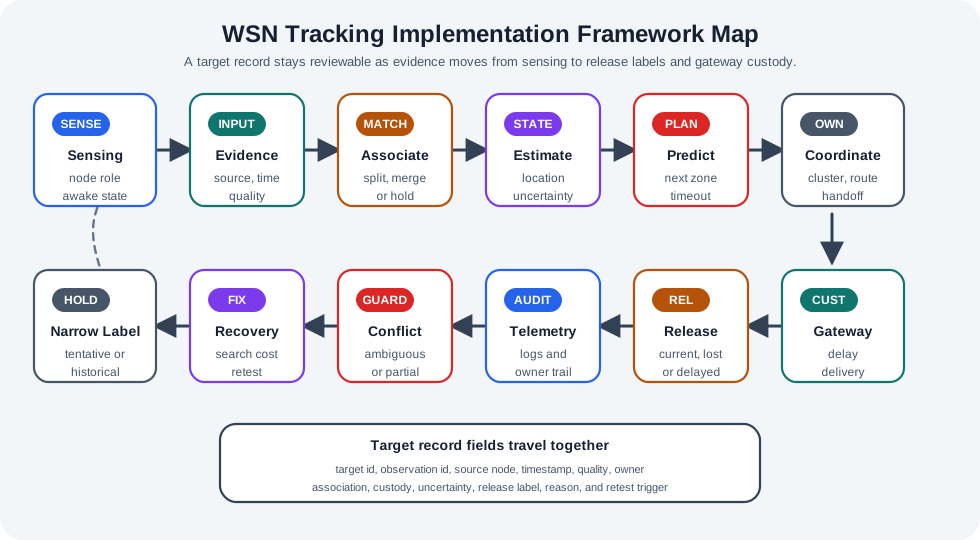
The separate node role label adds a distinct review condition, preventing the first two stages from being accepted on their own.
- The complete reading is that wSN tracking implementation framework architecture map showing sensing, evidence intake, association, estimation, prediction, coordination, gateway custody, release labels, telemetry, recovery, and retest fields.
- This distinction carries forward into implementation architecture map.
- The map shows the path from sensed evidence to released target state.
Major section
Implementation Architecture Map (continued)
A framework review should verify each module boundary.
- If a module drops evidence age, measurement quality, owner, or uncertainty, the final target label becomes weaker even when the algorithm itself is reasonable.
- Sensing layer: Preserves node role, awake state, sensing mode, local noise, observation time, and missing coverage.
- Evidence intake: Normalizes direct observations, summaries, relayed records, mobile-collector uploads, and delayed gateway updates.
- It should move only when stored evidence satisfies the guard condition for that transition.
Major section
Lifecycle Labels
A target can be newly observed, confirmed, predicted, temporarily missing, recovered, split into two possible tracks, merged after duplicate reports, or retired as historical.
- Tentative: A possible target exists, but evidence is not strong enough to release as current.
- Current: Recent evidence and ownership support the displayed target state.
- Lost: The expected observation did not appear within the recovery boundary.
Major section
Lifecycle Labels (continued)
Predicted: The state is an extrapolation from earlier evidence and must retire on timeout or contradiction.
- Ambiguous: Evidence could belong to more than one target, zone, or path.
- Lifecycle labels need guard conditions.
- A transition guard is the rule that must be true before a record can move to a stronger label.
- The guard also needs a denial reason.
Major section
Lifecycle Labels (continued)
For example, tentative to current requires fresh evidence, accepted association, active owner, bounded uncertainty, and gateway custody inside the decision window.
- Weakening transitions are just as important: current to predicted happens when evidence is old but a bounded motion model still applies, and predicted to lost happens when the timeout expires without confirmation.
- If it fails because owner handoff is incomplete, the reason should name the previous owner, next owner, and recovery action.
- An implementation framework needs lifecycle labels because target state changes over time.
Major section
Data Association and Conflict Handling · Energy and Coordination
Multi-target implementation is not just more detections.
- When targets cross, sensors overlap, or reports arrive late, the framework needs conflict behavior.
- An implementation framework should coordinate sensors without turning sleeping zones into false certainty.
- Sensor state: Sleep, idle, sensing, relaying, summarizing, and gateway-transfer states should be visible in logs or summaries.
Major section
Validation Gate Map · System, Vertical, and Release Boundaries
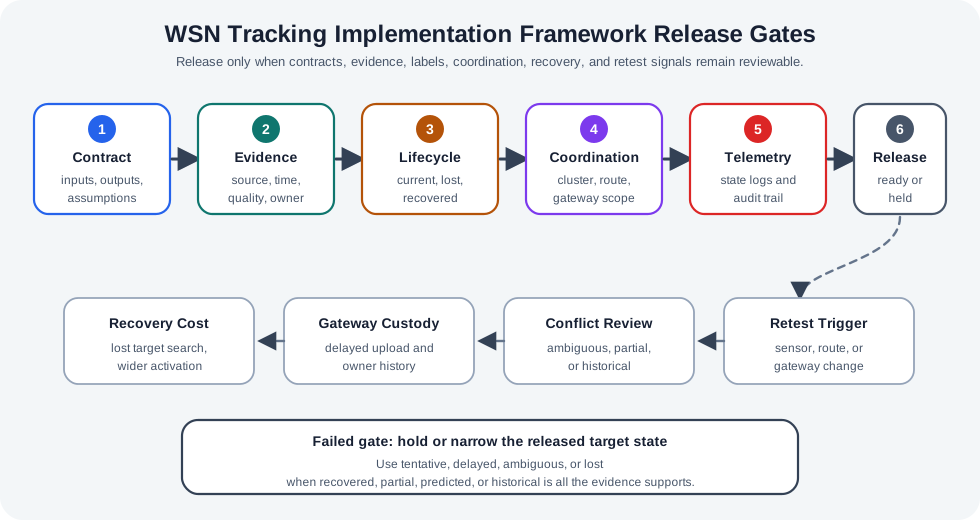
Their relationship makes the structure behind Validation Gate Map reviewable.
- The module contract states inputs, outputs, and assumptions; the evidence record keeps source, time, quality, and owner.
- Lifecycle labels separate current, lost, and recovered states.
- Telemetry preserves state logs and an audit trail.
- Conflict review keeps ambiguous, partial, or historical evidence visible.
Major section
Telemetry and Observability · Worked Review: Facility Asset Tracking
Tracking frameworks need telemetry that supports review, not only dashboards.
- A useful dashboard shows what the framework knows and what it does not know.
- Network telemetry: Awake nodes, missing nodes, queue delay, route changes, retransmissions, and gateway delay.
- Implementation claim: The framework can release current or last-known target states without confusing stale records for current locations.
Major section
Perimeter Multi-Target Tracking · Worked Review: Sparse Field Collector
Scenario: a perimeter deployment reports two moving targets crossing adjacent sectors.
- Implementation claim: The framework can keep separate target identities through overlapping detections and sector handoff.
- Scenario: a mobile collector receives summaries from sparse WSN zones and uploads them after passing a gateway.
- Implementation claim: The framework can ingest delayed summaries without losing observation time or collector custody.
Major section
Common Framework Mistakes · Readiness Checklist
Algorithm-first design: The page names filters or association methods before defining evidence records and release labels.
- Global assumptions: The framework acts as if every node, route, gateway, and collector is always reachable.
- Energy outside the record: Sleep, wake, relay, and recovery behavior are discussed separately from target-state quality.
- Performance overclaims: The chapter gives fixed accuracy, energy, or cost numbers without deployment scope and measurement evidence.
Major section
Summary
A WSN tracking implementation framework is ready when target records are auditable across the whole path from sensor observation to released state.
- The important question is not whether a page names a sophisticated algorithm.
- The important question is whether a reviewer can see how evidence, uncertainty, ownership, energy state, conflict handling, gateway custody, recovery, and release labels were preserved.
- The deeper implementation chapters can then discuss algorithm components, system patterns, and production framework details without drifting into unverified performance claims.
Deck summary
Key takeaways
The screen must show where it is now.
- If two carts pass close together, do not merge them just to keep the display neat.
- A framework must show which nodes observe, how estimates are labelled, where uncertainty is stored, who owns handoff, and what telemetry proves the tracker is ready.
- A tracking framework needs contracts between sensing, estimation, association, prediction, coordination, gateway, and application layers.
- The separate node role label adds a distinct review condition, preventing the first two stages from being accepted on their own.
Retrieval practice
Recall check 1 of 4

Packet Pete says: answer from memory, then check your reasoning.
Q1Before a tracking framework can display separate tracks for two nearby targets, what does it need?
Show answer
Answer: D Separating nearby targets requires explicit data-association rules and conflict labels before distinct tracks can be shown.
Retrieval practice
Recall check 2 of 4
Packet Pete says: answer from memory, then check your reasoning.
Q2A framework receives a delayed gateway batch while two target histories are in conflict. The dashboard wants to show one current track and drop the rejected observation. What should the release service do?
Show answer
Answer: C Release labels should be guarded by evidence age, association status, ownership, custody, and rejection reasons.
Retrieval practice
Recall check 3 of 4
Packet Pete says: answer from memory, then check your reasoning.
Q3A tracking implementation page shows a target marker and names a filter, but it does not preserve source observation, timestamp, uncertainty, owner, gateway delay, or lifecycle label. How should reviewers decide whether the target marker can be shown as current?
Show answer
Answer: D A reviewable implementation framework must preserve the evidence behind each released target state.
Retrieval practice
Recall check 4 of 4
Packet Pete says: answer from memory, then check your reasoning.
Q4Two targets cross paths and the framework cannot confidently decide which observation belongs to which target. What should the implementation do?
Show answer
Answer: C Multi-target implementation needs conflict labels and preserved candidate evidence.
Print reference
Answers
Answer key.
- D · Separating nearby targets requires explicit data-association rules and conflict labels before distinct tracks can be shown.
- C · Release labels should be guarded by evidence age, association status, ownership, custody, and rejection reasons.
- D · A reviewable implementation framework must preserve the evidence behind each released target state.
- C · Multi-target implementation needs conflict labels and preserved candidate evidence.