Wireless Sensor Networks · Study deck
WSN Tracking Fundamentals
Picture a lone worker moving through a large plant during an inspection.
Packet Pete is your guide for this deck.
After studying this chapter
Learning objectives
You will be able to:
- Explain the difference between detection, localization, prediction, and tracking continuity.
- Identify the evidence a WSN target record must preserve before it is released.
- Review handoff and recovery points where a moving target can be mislabeled.
- Describe how energy state, measurement quality, and gateway custody affect tracking claims.
Major section
Start With the Field Story
Tracking begins when one reading is not enough.
- One group of sensors sees the badge near a pump, then another group sees a weak trace near the next room.
- The safety desk must decide whether both observations belong to the same person and whether the track is still current.
- Detection asks whether a target was observed.
Major section
Start With the Field Story (continued)
A line on a map is not proof that identity and time survived the handoff.
- A remote history can aid review, but it must not turn an old estimate into a live location.
- This opening does not select a sensing method or promise exact position.
- The core difference between detection and tracking is continuity.
Major section
Start With the Field Story (continued)
A WSN must connect observations over time, manage uncertainty, hand off between nodes, and decide when an estimate is good enough for action without pretending that every target path is known.
- Wireless sensor network target tracking is the work of keeping a moving target record honest as evidence moves from sensing nodes to an operator, gateway, or automated decision.
- A tracking page should not only say that a target was found.
- It should show what was observed, what was estimated, which sensors owned the record, when the state changed, and when uncertainty became too large to trust.
Major section
Tracking Claim · Tracking Evidence Loop
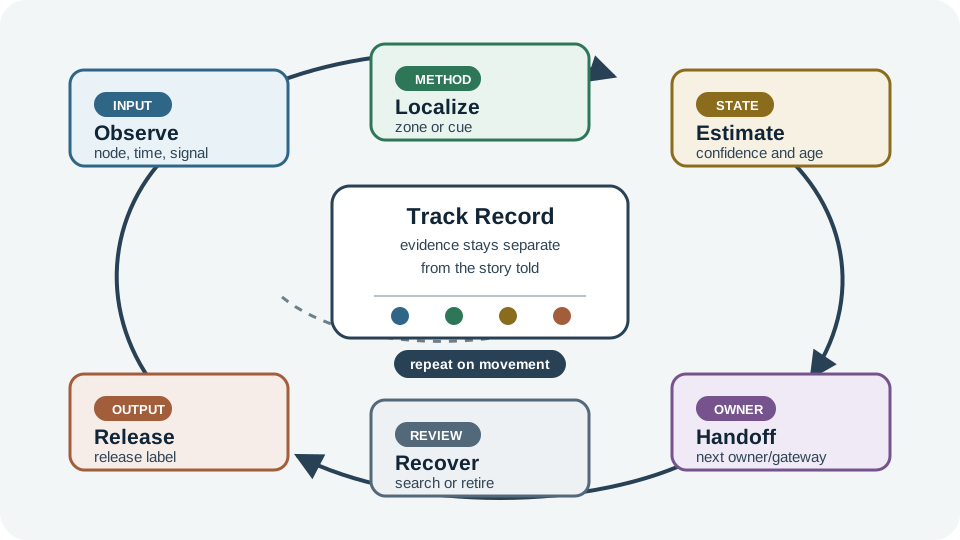
Tracking fundamentals review claim: The system can maintain a target state over time by preserving observation evidence, position estimates, uncertainty, sensor ownership, energy state, gateway custody, handoff history, recovery actions, and release labels.
- Their relationship makes the evidence behind Tracking Evidence Loop reviewable.
- The loop below separates observation, localization, estimate, handoff, release, and recovery.
- The first group sees the badge near a pump and keeps the event time and source.
- A line across the map cannot prove identity or timing.
Major section
Detection Is Not Tracking · Measurement Evidence
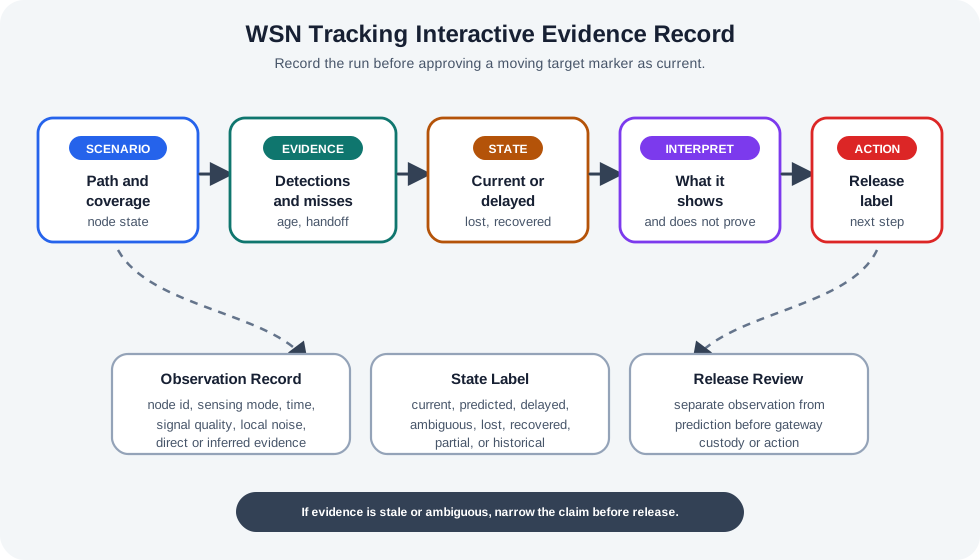
A single detection can be useful, but it is not a track by itself.
- Tracking requires a sequence of states that remain interpretable as the target moves through the network.
- The review should force that missing step into the open.
- Wireless tracking can use several measurement families.
- Each family has different uncertainty, calibration, and failure behavior.
Major section
Handoff and Recovery Gates · Energy State Is Evidence
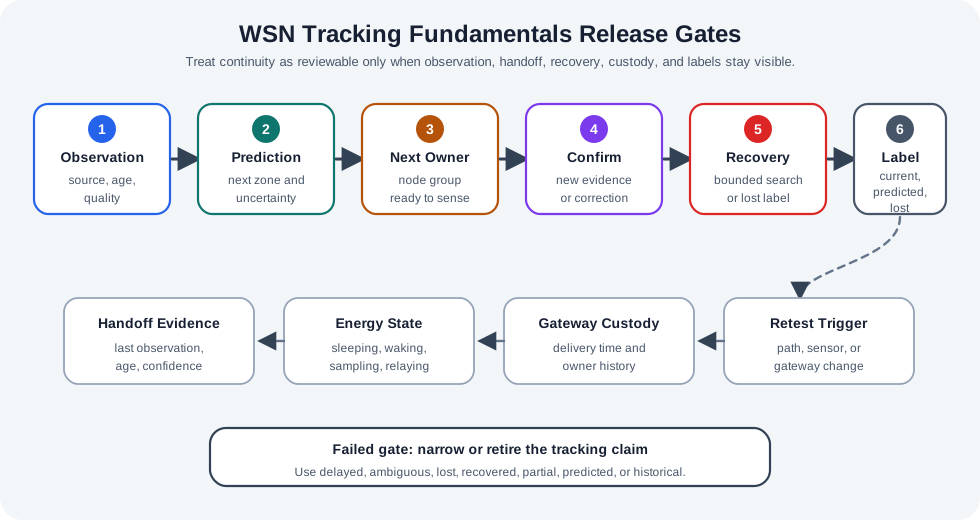
At this point, handoff and recovery gates needs an inspectable chain rather than another rule of thumb.
- The first identifies the field observation, the second establishes the starting condition, and the third marks the acceptance limit.
- A handoff is not just a routing event.
- Prediction must still be labeled as prediction.
Major section
Gateway Custody · Worked Review: Boundary Motion
The target record may pass from sensor nodes to a cluster head, mobile collector, gateway, cloud service, dashboard, or operator.
- Each custody step can change what the record means.
- Local custody: Nodes and clusters preserve raw or summarized observations while the target is near them.
- Network custody: Routing, aggregation, and store-forward behavior can delay, combine, or drop updates.
- Application custody: Dashboards and alerts must label whether a state is current, predicted, delayed, partial, or historical.
Major section
Worked Review: Asset Lookup · Worked Review: Mobile Collector
Scenario: an operator asks where a tagged tool was last seen in a facility.
- Claim to review: The system can report a last-known zone and the age of that evidence.
- Risk label: A no-response result is not proof of absence.
- Scenario: a mobile collector receives target summaries from a sparse sensor field while moving past several zones.
Major section
Common Tracking Mistakes · Readiness Checklist
Turning detection into certainty: One motion event, packet, or signal sample becomes a target track without geometry, confirmation, or age.
- Hiding handoff gaps: The page shows a smooth path even though no sensor owned the track during a transition.
- Using prediction as proof: A predicted marker is displayed as current even after its supporting observation is stale.
- Ignoring sleeping zones: The network claims absence in areas that were not awake, not queried, or not reachable.
Major section
Summary
WSN tracking fundamentals are about preserving target meaning over time.
- A strong chapter separates detection from tracking, observation from prediction, and current state from stale or historical state.
- It makes handoff, uncertainty, energy state, custody, and recovery visible before asking learners to trust a target marker.
- If the answer is yes, the tracking record is ready for formulation, algorithm, prediction, implementation, and application-specific review.
Major section
Key Takeaway · Concept Relationships
WSN Tracking Fundamentals Review should connect tracking models, prediction, localization, handoff, sampling rate, energy cost, uncertainty, and deployment evidence before accepting a design.
- From coverage WSN Coverage Fundamentals explains whether sensors can observe the target area in the first place.
- From routing WSN Routing Fundamentals explains how target evidence reaches cluster heads, gateways, and applications.
- To formulations WSN Tracking Formulations Review chooses push, poll, guided, or hybrid behavior after the fundamentals are clear.
Deck summary
Key takeaways
Tracking begins when one reading is not enough.
- A line on a map is not proof that identity and time survived the handoff.
- A WSN must connect observations over time, manage uncertainty, hand off between nodes, and decide when an estimate is good enough for action without pretending that every target path is known.
- Tracking fundamentals review claim: The system can maintain a target state over time by preserving observation evidence, position estimates, uncertainty, sensor ownership, energy state, gateway custody, handoff history, recovery actions, and release labels.
- A single detection can be useful, but it is not a track by itself.
Retrieval practice
Recall check 1 of 6

Packet Pete says: answer from memory, then check your reasoning.
Q1During normal target movement through an operating WSN, at which point is tracking continuity most at risk?
Show answer
Answer: C Handoffs between sensor groups are where tracking continuity is most at risk and must carry confirmed and uncertain state.
Retrieval practice
Recall check 2 of 6

Packet Pete says: answer from memory, then check your reasoning.
Q2Which sequence best describes one reviewable cycle of WSN target tracking?
Show answer
Answer: B A reviewable WSN tracking cycle separates detection, localization, prediction, and release so the user can see what is observed, estimated, predicted, and displayed.
Retrieval practice
Recall check 3 of 6

Packet Pete says: answer from memory, then check your reasoning.
Q3Two targets pass close together and the tracker receives several nearby measurements. What new review problem must the page address?
Show answer
Answer: A Multi-target tracking adds data association: each measurement needs a defensible target identity, rejected alternatives, and an uncertainty label when identities may swap.
Retrieval practice
Recall check 4 of 6

Packet Pete says: answer from memory, then check your reasoning.
Q4Why is prediction considered intrinsic to WSN tracking rather than an optional visual smoothing step?
Show answer
Answer: C Prediction is intrinsic because WSN tracking happens between discrete, duty-cycled observations.
Retrieval practice
Recall check 5 of 6

Packet Pete says: answer from memory, then check your reasoning.
Q5A WSN page says a target is still being tracked after it leaves one sensor zone, but no next-zone sensor has confirmed a new observation yet. How should the track be labelled while the next-zone observation is missing?
Show answer
Answer: D A track can remain useful during a handoff, but the state label must reflect the evidence.
Retrieval practice
Recall check 6 of 6

Packet Pete says: answer from memory, then check your reasoning.
Q6A tracking prototype reports a target position but does not show the sensing nodes, measurement type, timestamp, uncertainty, or gateway delay. What is missing from the fundamentals review?
Show answer
Answer: D A reviewable target record needs source, time, method, uncertainty, energy state, custody, and release label.
Print reference
Answers 1 of 2
Answer key.
- C · Handoffs between sensor groups are where tracking continuity is most at risk and must carry confirmed and uncertain state.
- B · A reviewable WSN tracking cycle separates detection, localization, prediction, and release so the user can see what is observed, estimated, predicted, and displayed.
- A · Multi-target tracking adds data association: each measurement needs a defensible target identity, rejected alternatives, and an uncertainty label when identities may swap.
- C · Prediction is intrinsic because WSN tracking happens between discrete, duty-cycled observations.
Print reference
Answers 2 of 2
Answer key.
- D · A track can remain useful during a handoff, but the state label must reflect the evidence.
- D · A reviewable target record needs source, time, method, uncertainty, energy state, custody, and release label.
