Wireless Sensor Networks · Study deck
Push, Poll, and Guided Tracking
A gateway is a node that joins one network to another.
Packet Pete is your guide for this deck.
After studying this chapter
Learning objectives
You will be able to:
- Compare push, poll, guided, and hybrid WSN tracking formulations without treating any one as universally best.
- Identify the evidence each formulation must preserve before a target state can be displayed.
- Explain how formulation choice changes latency, energy, custody, recovery, and state labels.
- Review worked tracking scenarios and select an honest formulation label.
Major section
Begin With Who Needs the Next Position
A gateway is a node that joins one network to another.
- Latency means the time from a field event to the useful result.
- The system can push each change, wait for a person to ask, or guide a search toward likely nodes.
- Poll can save reports, but it may answer late.
Major section
Begin With Who Needs the Next Position (continued)
A guided search can focus work, but it needs sound prior state.
- A mix can adapt, but switching adds state and proof duties.
- For a tracking mode, review each mode and its release record; check custody, state change, energy, delay, and recovery before accepting the result.
- A guided guess is not a sighting.
Major section
Begin With Who Needs the Next Position (continued)
This makes speed and energy trade-offs easy to compare.
- If the mode changes, mark the change and its cause.
- If state is too old or key nodes are lost, the system should say unknown and use the safe field process.
- A tracking screen must not look more certain than its evidence.
Major section
In 60 Seconds
It fits urgent decisions only when false triggers, traffic load, energy cost, and gateway handoff are visible.
- Poll tracking stores observations until a query asks for them.
- It fits delayed decisions only when stale data, query scope, and missing responses are labeled.
- Guided tracking uses network evidence to steer a mobile actor, inspector, robot, or collector.
Major section
WSN Tracking Formulations
A hidden assumption between cluster and: SINK could overturn wsn tracking formulations.
- It sets the usable limit for wsn tracking formulations.
- In the visual at Figure: The same three formulations compared by when they, the two labels make the required comparison explicit.
- The ongoing wsn tracking formulations analysis should preserve all three.
Major section
Formulation Review Map
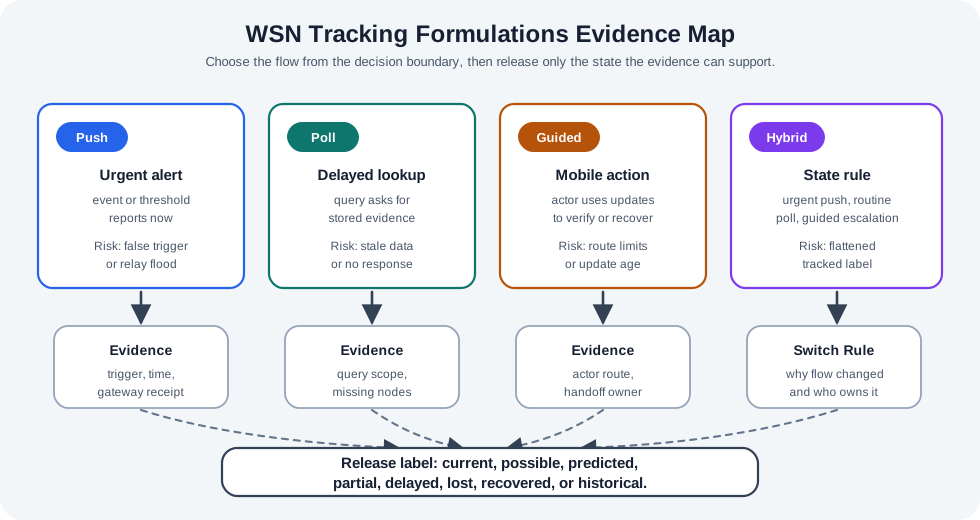
Poll asks for stored evidence later, so the reviewer must handle stale data and missing replies.
- Guided tracking uses an actor's route and update age to verify or recover a target.
- Hybrid flow needs a state rule for switching among them and an owner for that change.
- Evidence for Formulation Review Map starts in the WSN tracking formulations evidence map for push, poll, guided, and hybrid choices diagram.
- Figure the WSN tracking formulations evidence map for push, poll, guided, and hybrid choices diagram chooses evidence flow from the decision need.
Major section
Poll Tracking Review
Sensors may detect and store evidence locally, but the system does not publish every observation immediately.
- Evidence needed: Preserve query scope, local observation time, response time, missing nodes, stale records, and aggregation method.
- Poll tracking is not automatically energy-efficient.
- A short query interval, broad query scope, repeated retries, or many responding nodes can make polling expensive.
Major section
Guided Tracking Review
The actor is not just viewing the track.
- It changes position, sampling plan, route, or attention based on the network evidence.
- The actor may have travel limits, communication gaps, safety constraints, stale updates, or conflicting target paths.
- Guided tracking is not only about interception.
- The formulation is guided when the target evidence changes what the actor does next.
Major section
Hybrid Formulations
Hybrid tracking needs extra care because labels can flatten during handoff.
- A hybrid design is acceptable when each state has a clear rule.
- Poll background: Historical state, maintenance checks, and audit records are queried on demand or on a slow schedule.
- Guided escalation: A mobile actor is guided only after an alert, missed confirmation, or operator decision.
Major section
Latency, Energy, and Custody
Formulation review is a three-way evidence problem.
- A chapter that only discusses latency or only discusses energy is incomplete.
- The same target record can mean very different things under different formulations.
- A pushed alert may be recent but noisy.
- A polled record may be accurate but old.
Major section
State and Switch Records
Under the hood, a tracking formulation is a state record for evidence.
- The release layer should be able to see each state without guessing.
- This state view also keeps cost claims honest.
- Latency includes sensing, local processing, queueing, query wait, relay delay, mobile contact, gateway upload, and operator display time.
Major section
Release Gates
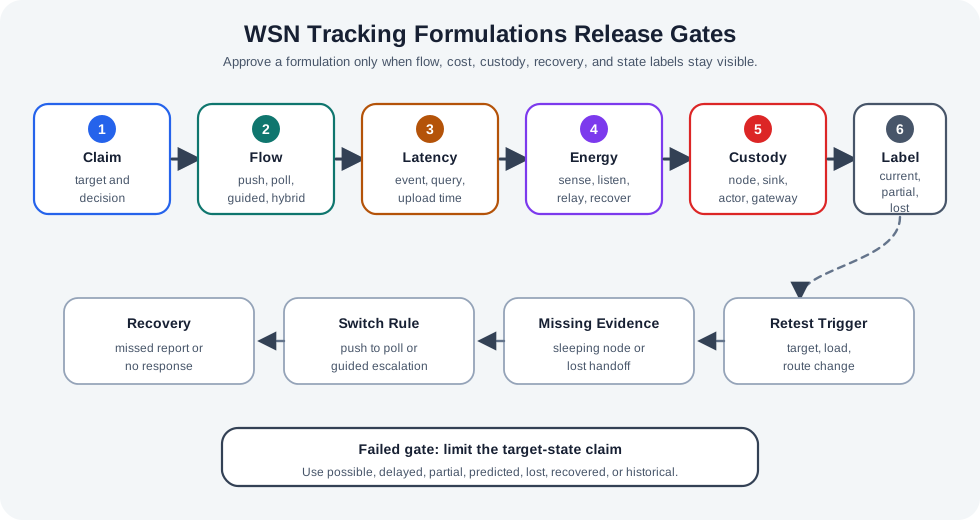
It names the target and decision, then records push, poll, guided, or hybrid flow.
- Latency includes event, query, and upload time; energy includes sensing, listening, relay, and recovery.
- A switch rule explains when flow changes, while recovery covers missed reports and missing replies.
- Sleeping nodes and lost handoffs remain visible as missing evidence.
Major section
Common Formulation Mistakes
One formulation is treated as best: The page says push, poll, or guided is always superior instead of tying the choice to a decision and evidence record.
- Latency hides evidence age: The dashboard shows a current marker without separating observation time, query time, processing time, and upload time.
- No response means no target: Poll results treat missing nodes as proof that no target exists instead of labeling query coverage.
- Guidance overstates control: A mobile actor is shown as guaranteed to reach or intercept a target without route, safety, update-age, or fallback evidence.
Major section
Readiness Checklist
Whether the target state is observed, queried, predicted, summarized, guided, delayed, or historical.
- The recovery behavior for missed reports, no query response, stale updates, and lost guidance.
- The release label for current, possible, predicted, delayed, ambiguous, lost, recovered, partial, or historical records.
- The retest trigger when target behavior, network load, gateway path, or operator decision changes.
Deck summary
Key takeaways
A gateway is a node that joins one network to another.
- A guided search can focus work, but it needs sound prior state.
- This makes speed and energy trade-offs easy to compare.
- It fits urgent decisions only when false triggers, traffic load, energy cost, and gateway handoff are visible.
- A hidden assumption between cluster and: SINK could overturn wsn tracking formulations.
Retrieval practice
Recall check 1 of 4

Packet Pete says: answer from memory, then check your reasoning.
Q1A tracking system stores observations and returns them only when a query asks. Which formulation is this, and when does it fit?
Show answer
Answer: A Storing observations until a query arrives is poll tracking, suited to delayed decisions with staleness labels.
Retrieval practice
Recall check 2 of 4

Packet Pete says: answer from memory, then check your reasoning.
Q2A hybrid WSN first pushes an alert, stores later observations for poll lookup, then guides a mobile verifier after uncertainty grows. What must the release record preserve?
Show answer
Answer: B Hybrid tracking needs explicit state and switch records so push, poll, guidance, and delayed handoff do not collapse into one unsupported current label.
Retrieval practice
Recall check 3 of 4

Packet Pete says: answer from memory, then check your reasoning.
Q3A WSN page says poll tracking is best because it saves energy, but the application is a boundary alert where operators need rapid awareness of possible intrusion events. Which tracking approach fits the boundary alert requirement, and what limits need showing?
Show answer
Answer: C Formulation choice starts from the decision boundary.
Retrieval practice
Recall check 4 of 4

Packet Pete says: answer from memory, then check your reasoning.
Q4A polled asset-tracking query returns no result because several nodes did not respond. Which label best preserves quality?
Show answer
Answer: B A no-result poll is not the same as proof that no target exists.
Print reference
Answers
Answer key.
- A · Storing observations until a query arrives is poll tracking, suited to delayed decisions with staleness labels.
- B · Hybrid tracking needs explicit state and switch records so push, poll, guidance, and delayed handoff do not collapse into one unsupported current label.
- C · Formulation choice starts from the decision boundary.
- B · A no-result poll is not the same as proof that no target exists.