Wireless Sensor Networks · Study deck
Predictive Wake-Up for Tracking
A duty cycle is the share of time a device stays active.
Packet Pete is your guide for this deck.
After studying this chapter
Learning objectives
You will be able to:
- Review prediction-driven activation without treating predicted positions as confirmed observations.
- Identify the evidence needed to justify a wake zone, sampling change, or selective activation policy.
- Explain why energy claims must include wake overhead, recovery, communication, sensing, and gateway handoff.
- Label predicted, stale, ambiguous, lost, recovered, and historical tracking states.
Major section
Start With the Field Story
A duty cycle is the share of time a device stays active.
- Waking only the next few sensors saves power, but a wrong guess can lose the track.
- Wake-up time, messages, sensing, wrong guesses, and recovery all use energy.
- A narrow wake area saves more on a good path but fails sooner when the target turns.
Major section
Start With the Field Story (continued)
This moving-animal story cannot choose the motion rule or prove battery life.
- Those values need observed tracks and failure tests.
- The deeper work limits the simple promise; it does not turn a prediction into an observation.
- A saving without recovery is incomplete.
- Prediction saves energy only when the motion assumption is good enough.
Major section
Start With the Field Story (continued)
Prediction helps a wireless sensor network spend energy where the next observation is most likely to matter.
- In target tracking, that usually means waking, sampling, or prioritizing sensors near a predicted path while other sensors stay quiet.
- The review standard is stricter than "prediction saves energy." A predicted target state is not an observation.
- It needs a motion assumption, uncertainty boundary, activation policy, recovery action, retirement rule, and evidence record.
Major section
In 60 Seconds · Tracking Energy Prediction
Prediction estimates where a target may be next; it does not confirm that the target is there.
- Energy savings depend on measured duty cycle, wake overhead, communication cost, sensing cost, recovery cost, and how often prediction fails.
- A wake zone should be tied to measurement quality, motion assumptions, target behavior, path constraints, and the cost of losing the track.
- A predicted label should retire when it becomes stale, unsupported, or contradicted by later observations.
Major section
Prediction Energy Claim · Prediction Review Map
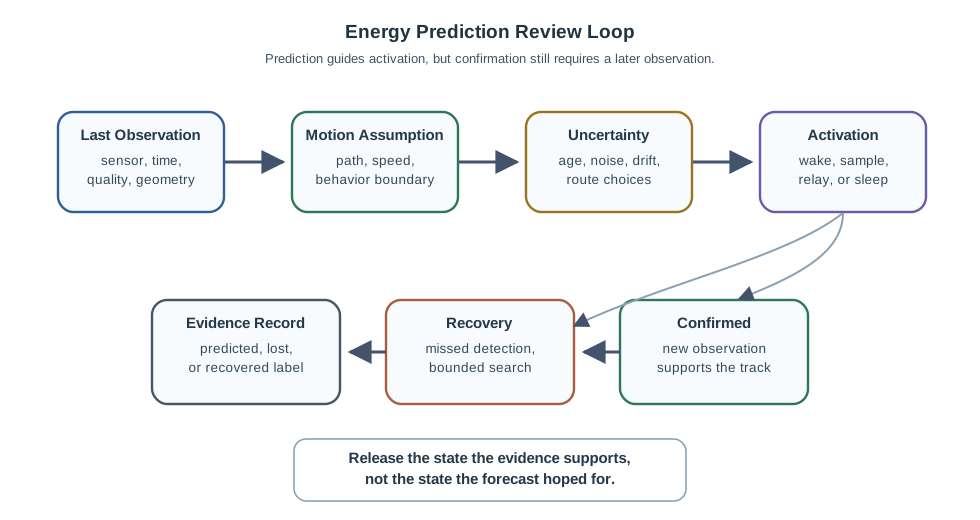
The last sighting keeps source, time, quality, and geometry.
- A route assumption narrows which sensors might wake next, but uncertainty grows as the forecast reaches a junction; the policy may need to activate more candidate branches.
- A later sighting can confirm or reject the forecast, while a missed confirmation starts recovery.
- The predicted position must remain labeled as predicted throughout.
- Energy review also counts wake overhead, relay traffic, and recovery work, so saving energy at one step cannot hide the cost of a missed track.
Major section
Observation Is Not Prediction · Wake Zone Review
Missing observation: If the latest sample is missing, stale, delayed, or inconsistent, the prediction should inherit that limitation.
- Prediction starts after a usable observation.
- Reviewers should ask whether the chapter shows how reliable that starting point is before it extrapolates forward.
- The important requirement is that the activation boundary is explainable and reviewable.
Major section
Energy Evidence Review
A safer review asks which energy terms are included and which are left out.
- Active cost: Sensing, processing, receiving, transmitting, and listening can draw different amounts of energy.
- The chapter should say which state it means.
- Sleep cost: Sleep is not free.
- Timers, memory retention, leakage, wake radios, or sensor warm-up may still matter.
Major section
Energy Evidence Review (continued)
Wake overhead: Waking a node can cost energy and time before the node is ready to detect, classify, or report.
- Recovery cost: Lost-target searches, repeated retries, and wider scans should be counted instead of treated as rare exceptions.
- Relay cost: Selective activation may save sensing energy while shifting communication burden to relays or cluster heads.
- An energy claim is only meaningful when the measurement scope is visible. "Fewer active sensors" is not the same as "lower system energy" if wake overhead, retransmissions, recovery, or gateway delay dominate the real workload.
Major section
Prediction Energy Ledger
A prediction-driven activation review should turn each wake decision into an energy ledger.
- The ledger does not need fabricated current draws or vendor numbers, but it must name the terms included in the claim.
- If the chapter claims per-cycle savings, the ledger must include one prediction cycle from last observation through release label.
- For review, keep the expected-cycle frame explicit: routine region cost plus the probability of loss times recovery cost.
Major section
Prediction Energy Ledger (continued)
If it claims route-level savings, the ledger must include the repeated cycle count, battery rotation, and local depletion caused by repeatedly waking the same nodes.
- A missed target has an uncertain cost because recovery may widen the region, wake extra relays, wait for a mobile sink, or publish a degraded label that forces operator review.
- Increasing the region raises routine activation energy, but it can reduce loss probability by covering more uncertainty.
- Decreasing the region saves planned energy, but it can increase loss probability and force expensive reacquisition.
Major section
Uncertainty and Retirement · Recovery Review
Prediction uncertainty grows when the model moves farther away from confirmed observations or when target behavior changes.
- A review should make that growth visible without pretending the same formula fits every deployment.
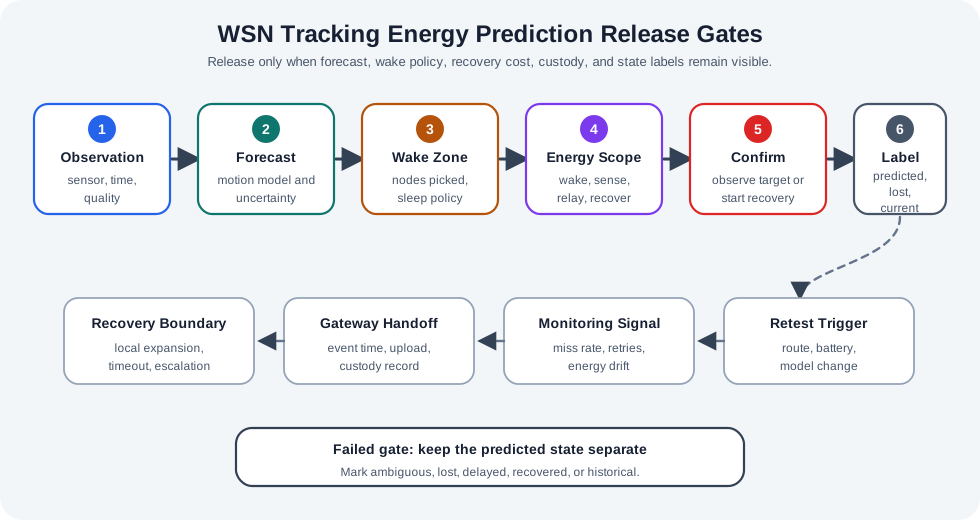
- Prediction label rule: A predicted target state should carry its last observation time, forecast horizon, uncertainty boundary, activation policy, and retirement condition.
- If confirmation does not arrive before the retirement condition, the state becomes stale, ambiguous, lost, or historical.
Major section
Warehouse Forklift Tracking · Worked Review: Perimeter Sector Tracker
A single-path prediction can hide ambiguity at aisle junctions.
- When one sector fires, the system predicts which neighboring sectors should wake next.
- Acceptable evidence: The record preserves sector id, trigger source, time window, neighboring sectors selected, missed-sector rule, and false-trigger conditions.
- Energy review: The system should show whether repeated false triggers wake the same sectors often enough to drain local nodes.
Major section
Worked Review: Mobile Sink Summary · Key Takeaway
The gateway reconstructs where a target probably moved while the sink was out of contact.
- Acceptable evidence: The record separates event time, local processing time, mobile-sink contact time, upload time, buffer state, and any missing interval.
- WSN Tracking Energy Prediction Review should connect tracking models, prediction, localization, handoff, sampling rate, energy cost, uncertainty, and deployment evidence before accepting a design.
- Energy review: Prediction may reduce local transmissions, but buffering, retries, sink rendezvous, and summary upload still need evidence.
Major section
Common Energy Prediction Mistakes · Readiness Checklist
The motion assumption and the conditions under which it is valid.
- Wake zone has no evidence: Sensors are selected by a neat diagram, but the chapter does not justify the motion assumption or uncertainty boundary.
- Recovery has no bound: The page says the system searches again, but it does not define timeout, escalation, energy cost, or lost-target label.
- The wake, sample, listen, relay, sleep, and recovery states included in the energy claim.
Major section
Summary · Concept Relationships
Prediction can make WSN target tracking more energy-aware by limiting activity to the most useful next sensors.
- The quality risk is that prediction can also make uncertainty invisible.
- A strong chapter keeps the last observation, forecast, wake policy, energy scope, recovery action, and release label separate.
- The safest release rule is simple: prediction may guide activation, but only a later observation can confirm the target state.
Deck summary
Key takeaways
A duty cycle is the share of time a device stays active.
- This moving-animal story cannot choose the motion rule or prove battery life.
- Prediction helps a wireless sensor network spend energy where the next observation is most likely to matter.
- Prediction estimates where a target may be next; it does not confirm that the target is there.
- The last sighting keeps source, time, quality, and geometry.
Retrieval practice
Recall check 1 of 4

Packet Pete says: answer from memory, then check your reasoning.
Q1Predictive wake-up activates sensors ahead of a target's expected path to save energy. What must the design still guarantee?
Show answer
Answer: C Predictive activation still requires real measurement confirmation and a recovery path when the prediction is wrong.
Retrieval practice
Recall check 2 of 4
Packet Pete says: answer from memory, then check your reasoning.
Q2A WSN page plots a moving target marker based only on a forecast from the last observation. No later sensor has confirmed the target. What should the review require?
Show answer
Answer: A A prediction is an inferred state.
Retrieval practice
Recall check 3 of 4
Packet Pete says: answer from memory, then check your reasoning.
Q3A chapter claims selective activation saves energy because fewer sensors are awake, but it ignores wake overhead, retransmissions, relay load, and lost-target recovery. How should reviewers assess the selective-activation energy claim?
Show answer
Answer: A Energy prediction review should count system-level costs, including wake overhead, communication, relay load, recovery, and gateway handoff.
Retrieval practice
Recall check 4 of 4
Packet Pete says: answer from memory, then check your reasoning.
Q4A tracker narrows its wake region to save routine energy, but each miss triggers a wide recovery scan. What should the review require?
Show answer
Answer: B A narrow wake region is not automatically better.
Print reference
Answers
Answer key.
- C · Predictive activation still requires real measurement confirmation and a recovery path when the prediction is wrong.
- A · A prediction is an inferred state.
- A · Energy prediction review should count system-level costs, including wake overhead, communication, relay load, recovery, and gateway handoff.
- B · A narrow wake region is not automatically better.