Wireless Sensor Networks · Study deck
WSN Tracking Algorithm Components
Imagine three small nodes sense motion near a warehouse door but do not agree on the target's path.
Packet Pete is your guide for this deck.
After studying this chapter
Learning objectives
You will be able to:
- Review the major components of a WSN target-tracking algorithm without relying on unsupported performance promises.
- Separate detection, measurement, localization, association, prediction, activation, and recovery evidence.
- Identify when node cooperation improves a track and when it hides latency, stale data, or weak geometry.
- Explain why predicted paths need uncertainty labels, fallback behavior, and retest triggers.
Major section
Build a Defensible Target Track
The system must decide whether it saw one target, where it went, and what to wake next.
- A gateway is a device that links one network or system to another.
- Latency means the wait from an event to a useful result.
- A new sighting should not silently revive a track that was already uncertain.
Major section
Build a Defensible Target Track (continued)
The warehouse nodes first detect motion; then the system must decide whether those sightings belong to one target.
- Location requires geometry and timing, while a track also needs a rule for updating, predicting, and declaring the target lost.
- Detection, location, and continuous tracking are different claims.
- If two candidate paths are plausible, keep the ambiguity visible.
Major section
Start With the Field Story · In 60 Seconds
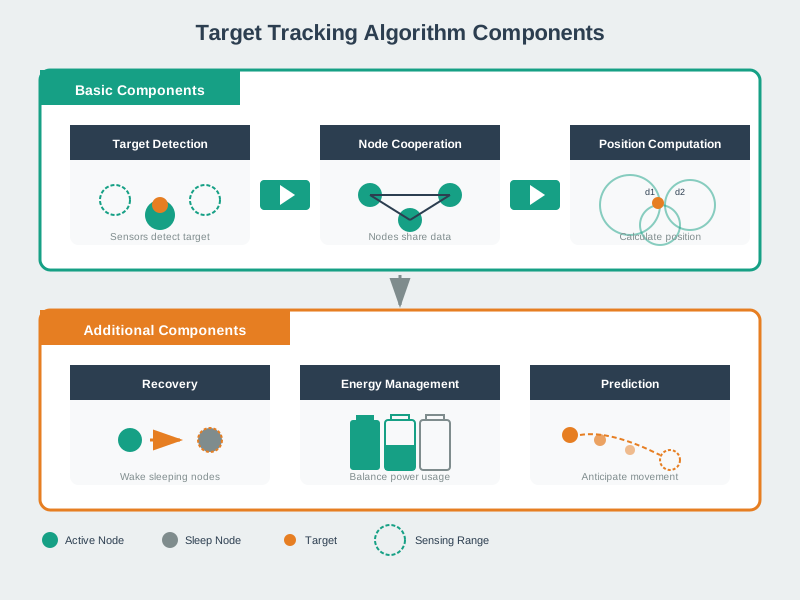
A tracking algorithm is a chain of smaller promises: detect the target, share useful observations, associate readings, predict movement, wake the right nodes, and recover from mistakes.
- Target tracking algorithms in a wireless sensor network are not a single formula.
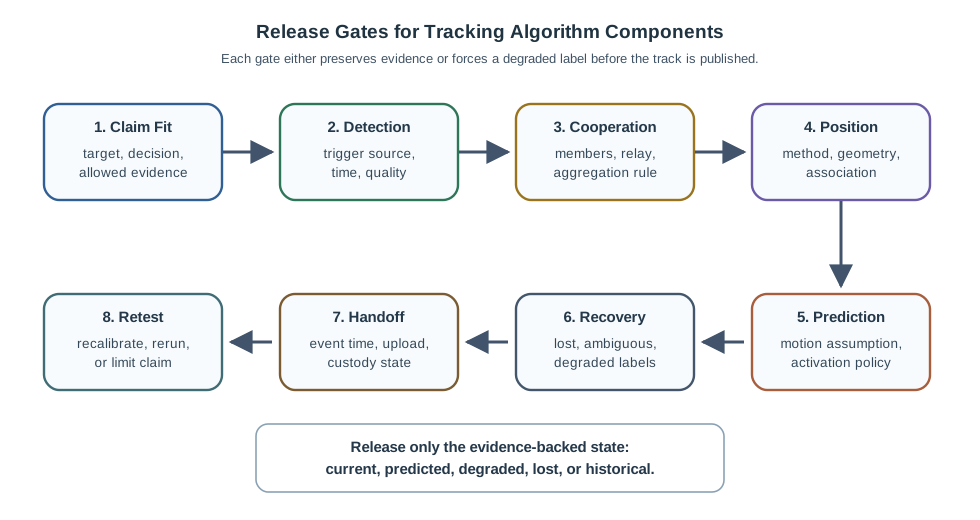
- A tracking algorithm should preserve the evidence path from detection trigger to track label.
- Detection is not the same as location.
- Recovery is part of the algorithm, not an afterthought.
Major section
Component Review Map · Implementation Selection Guardrail
If a new trigger matches, the track can update after association.
- The next Component Review Map step depends on WSN target tracking algorithm components.
- In its warehouse-door example, three nodes sense motion and need geometry and timestamps before a position estimate is credible.
- The accepted algorithm should name its operating boundary.
Major section
Component Edge Audit
Most bad tracking reviews fail at the boundary between components rather than inside one named algorithm.
- The detector may be honest, but local aggregation can hide a missing node.
- The position estimate may be plausible, but the association step can choose one target when two identities are still possible.
- This edge audit also keeps energy claims defensible.
Major section
Component Edge Audit (continued)
Prediction may be useful for waking sensors, but the dashboard can still display it as an observation.
- Prediction may save wake time, but a wrong prediction can force recovery scans.
- Gateway summarization may reduce traffic, but it can erase which node changed the label.
- The minimum useful track state is more than a coordinate.
Major section
Component Edge Audit (continued)
It should carry observation time, processing time, upload time, source node or cluster, measurement quality, participating-node set, association decision, prediction horizon, missed-detection count, owner, recovery action, and release label.
- Those fields let the algorithm keep a target record alive without pretending every state is current.
- Event time says when the target evidence was observed.
- If those clocks collapse into one timestamp, a historical or delayed record can look live.
Major section
Detection and Measurement Review
Detection starts the tracking chain, but a detection is only a candidate event.
- A review should ask whether the trigger can be tied to the target definition and whether the measurement is strong enough for the next component.
- A single source watching a single target mostly needs a clean trigger record.
- A single source seeing multiple targets needs an association rule before the readings become separate tracks.
Major section
Node Cooperation Review · Position and Association Review
Cooperation can reduce duplicate reporting and improve context, but it also creates review obligations.
- Many WSN tracking algorithms use nearby nodes as a temporary team.
- A clean review separates cooperation from correctness.
- A cluster head, relay, or aggregator can make communication more orderly, but it can also hide weak members, late measurements, or conflicting observations.
Major section
Prediction and Activation Review · Recovery and Degraded Labels
Prediction estimates where the target may be next.
- Prediction rule: A predicted track is not a confirmed observation.
- It should carry a prediction label, uncertainty boundary, timestamp, retirement condition, and recovery action.
- Prediction quality depends on the target, environment, and evidence cadence.
- Cooperation then identifies the node that aggregated reports and what it dropped.
Major section
Gateway Handoff Review · Worked Review: Warehouse Asset Tag
The tracking algorithm may run partly on sensor nodes, a cluster head, a mobile sink, an edge gateway, or a cloud service.
- Handoff can change the meaning of a target record.
- Gateway handoff should preserve evidence rather than flattening every state into "tracked." A delayed summary may still be useful, but it should not look identical to a current observation.
- A warehouse system reports that an asset tag is moving through storage aisles.
Major section
Worked Review: Perimeter Motion Tracker · Worked Review: Mobile Collector Handoff
A perimeter network uses motion and vibration sensors to follow a possible intruder along a fence line.
- Acceptable evidence: The record preserves trigger source, sector id, participating nodes, prediction boundary, activation policy, and missed-sector recovery rule.
- A mobile sink visits sensor clusters and receives delayed target summaries.
- The gateway reconstructs a route after the collector reconnects.
Major section
Common Tracking Algorithm Mistakes · Readiness Checklist
Detection becomes proof: A trigger is treated as a confirmed target without measurement quality, target definition, or false-trigger review.
- Geometry is hidden: The page names a localization method but does not show whether the participating sensors make a useful estimate possible.
- Prediction looks current: Predicted locations are displayed like observations, so stale or uncertain states are not visible.
- Gateway summaries flatten state: Current, delayed, predicted, ambiguous, and historical records appear identical after upload.
Deck summary
Key takeaways
The system must decide whether it saw one target, where it went, and what to wake next.
- The warehouse nodes first detect motion; then the system must decide whether those sightings belong to one target.
- A tracking algorithm is a chain of smaller promises: detect the target, share useful observations, associate readings, predict movement, wake the right nodes, and recover from mistakes.
- If a new trigger matches, the track can update after association.
- Most bad tracking reviews fail at the boundary between components rather than inside one named algorithm.
Retrieval practice
Recall check 1 of 4

Packet Pete says: answer from memory, then check your reasoning.
Q1In a WSN tracking pipeline, why is a detection trigger not the same as a position estimate?
Show answer
Answer: C A detection trigger signals change; a position estimate additionally needs measurement quality, geometry, and timestamps.
Retrieval practice
Recall check 2 of 4
Packet Pete says: answer from memory, then check your reasoning.
Q2A WSN tracking page says a target is confirmed whenever one motion sensor fires, then immediately plots a precise marker on the map. How should reviewers assess the confirmed-target marker from one motion trigger?
Show answer
Answer: A A detection trigger begins the tracking chain.
Retrieval practice
Recall check 3 of 4
Packet Pete says: answer from memory, then check your reasoning.
Q3A predictive tracking algorithm wakes sensors along a likely path, but the target turns unexpectedly and no confirming observation arrives. Which dashboard label best preserves quality?
Show answer
Answer: D A predicted state must be separated from an observed state.
Retrieval practice
Recall check 4 of 4
Packet Pete says: answer from memory, then check your reasoning.
Q4A WSN tracker shows one timestamped coordinate after filtering, association, prediction, recovery, and gateway upload. What is the main review problem?
Show answer
Answer: A Tracking review needs state fields for timing, ownership, uncertainty, recovery, and release labels.
Print reference
Answers
Answer key.
- C · A detection trigger signals change; a position estimate additionally needs measurement quality, geometry, and timestamps.
- A · A detection trigger begins the tracking chain.
- D · A predicted state must be separated from an observed state.
- A · Tracking review needs state fields for timing, ownership, uncertainty, recovery, and release labels.