Wireless Sensor Networks · Study deck

Underwater Acoustic WSN Tracking

Imagine a buoy waits for a slow sound pulse from a tag below rough water.

Packet Pete is your guide for this deck.

target-trackingunderwater-acoustic-networksacoustic-localization
iotclass.org

After studying this chapter

Learning objectives

You will be able to:

  • Review underwater acoustic WSN tracking claims without turning channel assumptions into proof.
  • Identify the evidence needed for acoustic path, localization, timing, drift, and gateway custody.
  • Separate local detections, acoustic ranges, track estimates, and operations labels.
  • Evaluate underwater worked scenarios for stale evidence, ambiguous localization, degraded gateways, and fallback behavior.
Virtual underwater layers governed by custody time.
iotclass.org

Major section

Bound the Underwater Fix · Start With the Field Story

The team must decide whether the late signal can support a safe location claim.

  • Bandwidth means how much data a link can carry in a set time.
  • A gateway is a device that links one network or system to another.
  • An acoustic fix cannot inherit a radio timing or path-loss assumption.

Key terms

If one of these
If one of these is missing, mark the location uncertain rather than drawing a precise point.
Underwater acoustic tracking
Underwater acoustic tracking is a specialized WSN vertical where the network cannot assume ordinary radio behavior, stable node placement, or immediate gateway contact.
iotclass.org

Major section

In 60 Seconds · Phoebe's Field Notes: Why This Chapter Cannot Reuse the Radio Path-Loss Formula

Acoustic evidence needs timing, sound-speed, multipath, Doppler, depth, clock, and path-quality context before it can support a track.

  • Node position is part of the evidence.
  • Anchors, buoys, AUVs, drifting sensors, and moored sensors can all move or become uncertain.
  • With illustrative source and noise levels, the acoustic link has 60.7 dB SNR and 50.7 dB detection margin.

Why it matters

Gateway custody matters because an underwater observation may be summarized by a buoy, carried by a vehicle, or uploaded after the tracked state has changed.

iotclass.org

Major section

Underwater Evidence Map · Acoustic Path Review
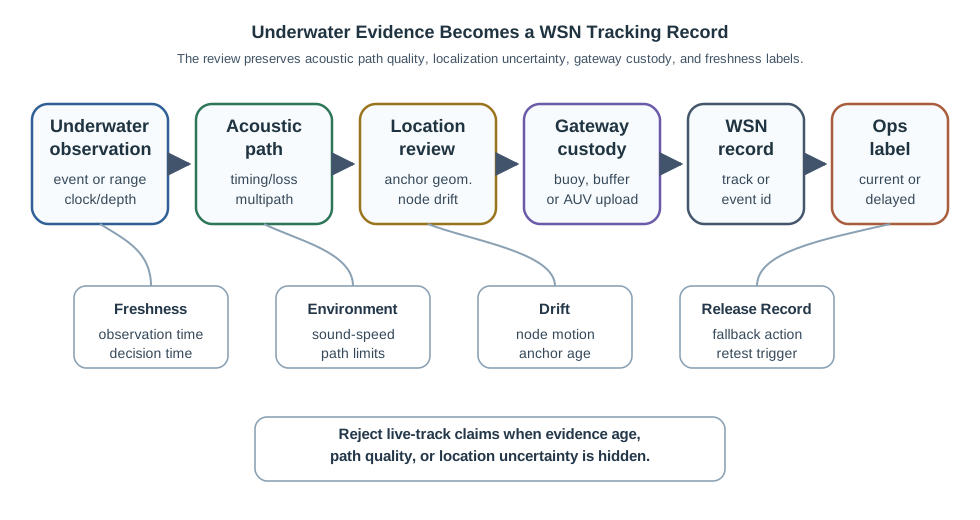
The practical question in underwater evidence map is where observation hands responsibility to event or range.

  • It therefore connects this diagram directly to the chapter's treatment of underwater evidence map.
  • The map separates observation, acoustic path, localization, gateway custody, and operations label.
  • Underwater tracking often starts with acoustic communication or acoustic ranging.

Key terms

Path quality evidence
Path quality evidence Are missed packets, multipath, weak signal, ambiguous arrival times, and one-way versus two-way ranging assumptions visible?
No acoustic path
No acoustic path is automatically release-ready.
Underwater acoustic tracking evidence map.
iotclass.org

Major section

Timing and Freshness · Localization and Drift · Localization Pattern Examples

Underwater evidence can be valuable even when it is not live.

  • The problem is presenting old evidence as current.
  • The review should reject any design that updates a live track with delayed underwater evidence without showing freshness and uncertainty.
  • Underwater tracking depends on knowing both the target evidence and the observing node positions.

Why it matters

Anchor economy: Schemes that reduce the number of anchors must show what replaces the missing geometry: mobility prediction, repeated passes, pressure-derived depth, or delayed confirmation.

iotclass.org

Major section

Gateway Custody Review · Error Budget and State Labels

The underwater gateway path may be live, intermittent, mobile, or delayed.

  • The custody record should explain what happened to the evidence after it was observed.
  • Output record: Track id or event id, lifecycle label, freshness, confidence, custody, environment limits, and operator-facing warning.
  • Fallback state: Request confirmation, mark delayed, widen the search area, hold the decision, schedule a collection pass, or retire the track.

Why it matters

That ledger prevents a late high-quality packet, a fresh low-quality buoy relay, or an anchor-position update from silently overwriting the supported label.

iotclass.org

Major section

Release Gates · Mooring Field Asset Tracking
Its worked case gives a 2.00 km path and 1.33 s travel time, but it does not quantify multipath or the location error bound.

  • The gateway must keep timing, path quality, and uncertainty through handoff.
  • Link calculations alone cannot justify a precise fix.
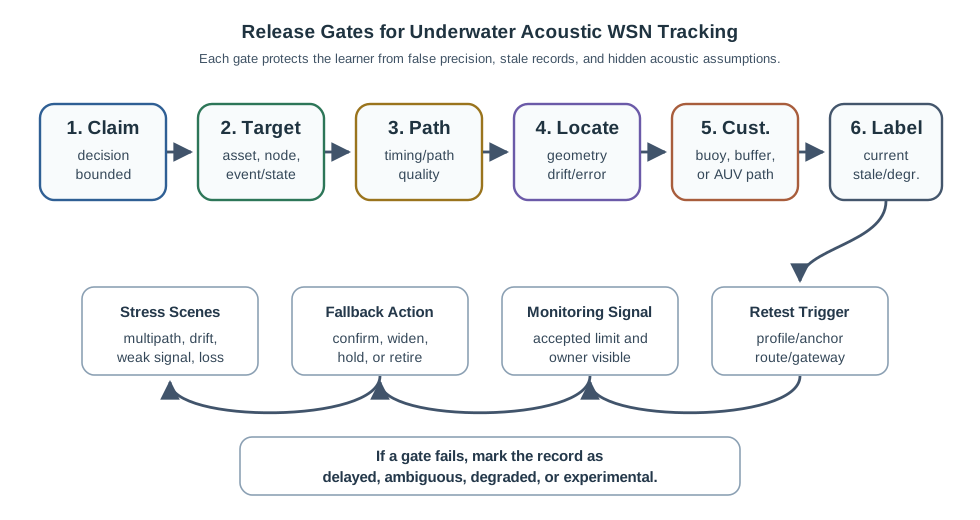
  • Evidence for Release Gates starts in the Release gates for underwater acoustic WSN tracking diagram.
  • Figure the Release gates for underwater acoustic WSN tracking diagram tests a location claim against acoustic evidence before release.
Release gates for underwater acoustic WSN tracking.
iotclass.org

Major section

Worked Review: AUV Data Collection · Worked Review: Coastal Event Detection

Evidence that supports release: The system marks uploaded records as historical or delayed, preserves node buffer custody, AUV route, collection time, and gateway upload time.

  • Separate live state from historical detections, and expose collection custody before using the records for operational tracking.
  • A coastal sensor line reports acoustic events that may indicate vessel activity, equipment movement, or environmental noise.
  • Evidence that supports release: The record separates detection from classification, preserves background-noise state, path quality, confidence, and confirmation status.
iotclass.org

Major section

Common Underwater Tracking Mistakes · Readiness Checklist

Channel assumption becomes proof: The design assumes one acoustic delay, range, or bandwidth value and does not show measured environment evidence.

  • Node position is treated as fixed: Sensors, buoys, or anchors move, but the tracking record does not carry position age or uncertainty.
  • Multipath is hidden: Reflections, ambiguous arrivals, or poor geometry are converted into a clean location without a quality warning.
  • Fallback is not defined: The system does not say what to do when a gateway disappears, a node drifts, or an acoustic path becomes unreliable.
Opportunistic underwater localization evidence.
iotclass.org

Major section

Figure Review: Localization Under Motion · Summary

A silent node can localize without transmitting when the moving AUV leaves a sufficiently diverse, time-aligned trail of position evidence.

  • The dashed loop asks whether geometry and uncertainty meet the acceptance rule before the node uses that estimate.
  • The AUV carries the active position work; the underwater node spends receive energy.
  • When several assets are already moving through the water column, localization can be opportunistic rather than organized around a dedicated anchor pass.

Key terms

Underwater acoustic tracking
Underwater acoustic tracking is a WSN vertical where acoustic path evidence, localization uncertainty, gateway custody, and operations labels are central to the tracking claim.
AUV-assisted silent localization cycle.
iotclass.org

Major section

Key Takeaway · Concept Relationships

Underwater Acoustic WSN Tracking Review should adapt tracking assumptions to the vertical's sensing physics, communication limits, localization uncertainty, energy budget, and deployment evidence.

  • Tracking fundamentals WSN Tracking: Fundamentals provides the vocabulary behind observations, estimates, uncertainty, and evidence records.
  • Energy prediction WSN Tracking: Energy Prediction Review explains why observation age, wake decisions, and evidence freshness must stay visible.
  • Production framework WSN Tracking Implementation Framework Review defines release records, validation gates, and retest triggers reused here.
iotclass.org

Deck summary

Key takeaways

The team must decide whether the late signal can support a safe location claim.

  • Acoustic evidence needs timing, sound-speed, multipath, Doppler, depth, clock, and path-quality context before it can support a track.
  • The practical question in underwater evidence map is where observation hands responsibility to event or range.
  • Underwater evidence can be valuable even when it is not live.
  • The underwater gateway path may be live, intermittent, mobile, or delayed.
iotclass.org

Retrieval practice

Recall check 1 of 4

Packet Pete says: answer from memory, then check your reasoning.

Q1Why can't a single underwater acoustic detection give a precise, trustworthy target position on its own?

AAcoustic signals travel instantly, making timing useless.
BGPS works underwater, making acoustic estimates redundant.
CUnderwater sensors cannot detect a target in any conditions.
DAcoustic evidence needs propagation and timing context.
Show answer

Answer: D Underwater acoustic position needs sound-speed, multipath, Doppler, and anchor context, so one detection is not enough.

iotclass.org

Retrieval practice

Recall check 2 of 4

Packet Pete says: answer from memory, then check your reasoning.

Q2A buoy reports a buffered acoustic range after the anchor position changed and the sound-speed profile is stale, but the dashboard shows a precise current point. What should the review require?

AKeep historical and environment limits visible, with widened uncertainty.
BKeep the current precise label because packet delivery proves freshness.
CHide profile and anchor-age fields so learners focus only on the coordinate.
DDelete every delayed underwater observation because history is never useful.
Show answer

Answer: A Underwater tracking records need a ledger for timing, environment, geometry, custody, and uncertainty so delayed or weak evidence cannot be released as precise current state.

iotclass.org

Retrieval practice

Recall check 3 of 4

Packet Pete says: answer from memory, then check your reasoning.

Q3An underwater tracking prototype shows a precise current target point from acoustic detections, but it does not preserve observation time, sound-speed assumption, multipath quality, or anchor-position age. How should reviewers handle the precise target point from this prototype?

AApprove a lower-resolution target marker to reflect acoustic uncertainty.
BReplace the acoustic path with vehicle-based collection before retesting.
CRequire timing, path, uncertainty, and anchor-age evidence.
DHide the acoustic assumptions so the final location marker looks precise.
Show answer

Answer: C Underwater tracking review checks whether acoustic path evidence, localization uncertainty, timing, and anchor or node position state survive into the final record.

iotclass.org

Retrieval practice

Recall check 4 of 4

Packet Pete says: answer from memory, then check your reasoning.

Q4An AUV uploads buffered underwater detections after surfacing. The observed state may have changed before the upload reached the dashboard. Which label best protects tracking quality?

ACurrent and confirmed, because surfacing proves live state.
BDiscarded, because delayed detections have no value.
CPrivate debug state, because custody does not matter.
DHistorical or delayed, with the observation time clear.
Show answer

Answer: D Underwater systems must separate observation time, acoustic or collection delay, gateway upload time, and decision time so stale evidence is not presented as live tracking.

iotclass.org

Print reference

Answers 1 of 2

Answer key.

  1. D · Underwater acoustic position needs sound-speed, multipath, Doppler, and anchor context, so one detection is not enough.
  2. A · Underwater tracking records need a ledger for timing, environment, geometry, custody, and uncertainty so delayed or weak evidence cannot be released as precise current state.
  3. C · Underwater tracking review checks whether acoustic path evidence, localization uncertainty, timing, and anchor or node position state survive into the final record.
iotclass.org

Print reference

Answers 2 of 2

Answer key.

  1. D · Underwater systems must separate observation time, acoustic or collection delay, gateway upload time, and decision time so stale evidence is not presented as live tracking.
iotclass.org
