Wireless Sensor Networks · Study deck
Nanoscale WSN Tracking
A gateway is a device that joins one kind of network to another.
Packet Pete is your guide for this deck.
After studying this chapter
Learning objectives
You will be able to:
- Explain: Evidence that supports further study: The concept records target marker, local medium, detection confidence, timing uncertainty, containment assumptions, gateway custody, and an experimental label.
- Explain: Nanoscale tracking is a WSN vertical where local observation, communication path, gateway translation, and operations labels matter as much as the target itself.
- Explain: Nanoscale WSN Tracking Review should adapt tracking assumptions to the vertical's sensing physics, communication limits, localization uncertainty, energy budget, and deployment evidence.
- Explain: The gateway is not just a relay; it is the point where scale, timing, aggregation, and custody become visible or get lost.
Major section
Start With the Field Story
A chemical signal may spread through a fluid.
- A gateway is a device that joins one kind of network to another.
- In a nanoscale tracking idea, it may turn tiny local signs into a record that normal computers can store and show.
- A very small radio may send an electric wave.
Major section
Start With the Field Story (continued)
It may be a small particle, a cell event, a chemical change, or a group of tiny devices.
- A larger device may carry or relay the sign.
- Each path changes the time, range, and doubt in the final record.
- It should also state the safe limit and the amount of doubt.
Major section
Start With the Field Story (continued)
If the gateway turns many small signs into one total, keep the rule used to make that total.
- Real nano links may fade, drift, react, or arrive in groups.
- Under the Hood records timing, calibration, custody, and uncertainty at each handoff.
- A model can show that an idea may work.
Major section
Start With the Field Story (continued)
A lab can show that a part worked in set conditions.
- That honest limit is more useful than a strong claim built from a weak sign.
- Nanoscale tracking is a specialized WSN vertical where the target, sensor, message, and gateway may sit at very different scales.
- The review question is not whether nanoscale communication is exciting.
Major section
Nanoscale Evidence Map
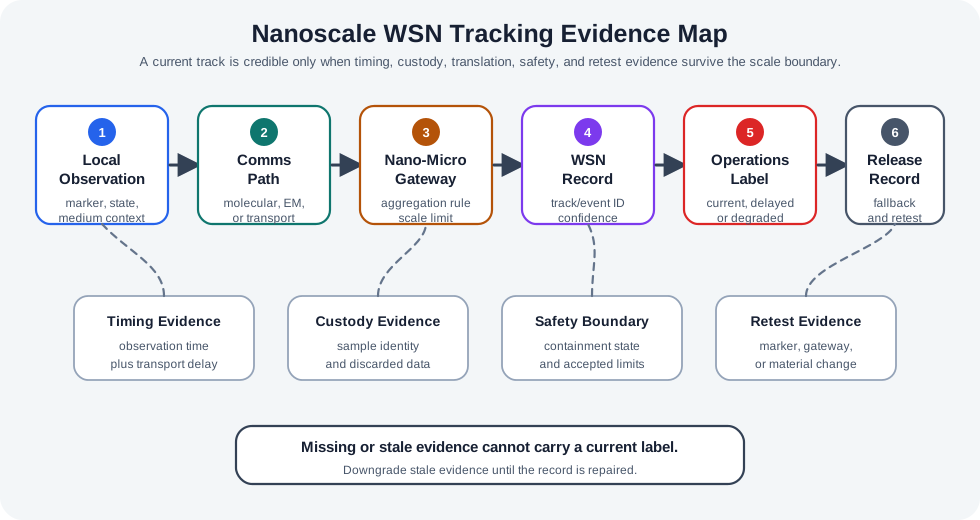
The observation needs marker, state, and medium context.
- The gateway may alter what reaches the WSN record.
- Timing, sample identity, discarded data, and custody must survive that handoff.
- Safety limits, fallback, and retest fields guard the final decision.
- A stale or missing link in this chain cannot support a current track label.
Major section
Nanoscale Evidence Map (continued)
The map separates local sensing from system-level tracking.
- The gateway is not just a relay; it is the point where scale, timing, aggregation, and custody become visible or get lost.
- Local observation: Records target marker, sensor state, local medium, calibration, contamination risk, and detection confidence.
- Communication path: Records whether evidence moved by molecular, electromagnetic, physical transport, or hybrid relay behavior.
Major section
Communication Path Review
A review should focus less on buzzwords and more on evidence consequences.
- The review should preserve timing uncertainty, medium state, degradation, and local false-positive risk.
- The review should preserve path loss, absorption, heating or safety boundaries, fabrication assumptions, and energy state.
- Physical transport path: Evidence may move with flow, carriers, swabs, lab chips, mobile readers, or collection devices.
Major section
Communication Path Review (continued)
The review should preserve custody and collection time.
- Hybrid gateway path: Many practical concepts use local nanoscale sensing plus a micro or macro gateway.
- The review should show what the gateway summarized, filtered, or discarded.
- No communication path is automatically best.
- The right path is the one whose limits are visible enough for the supported decision.
Major section
Scale and Safety Boundaries · Gateway Handoff Review
Nanoscale tracking concepts can cross into biological, chemical, medical, environmental, or regulated domains.
- The chapter does not provide safety approval.
- It identifies what a technical review must not hide.
- If safety or containment assumptions are missing, the track should be labeled experimental, not production-ready.
- It must preserve enough evidence for later review.
Major section
Release Gates
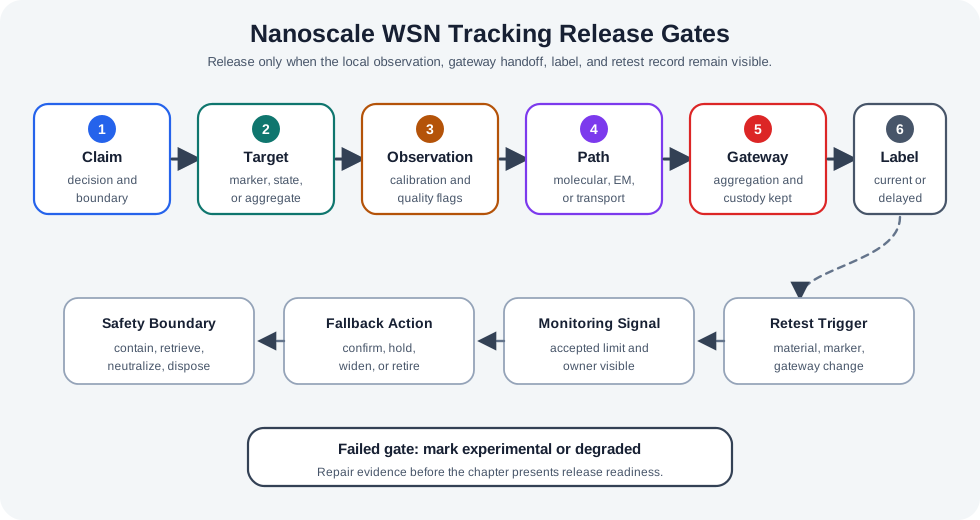
The gateway must keep the source and custody record.
- The output label must say whether the track is current or delayed.
- Safety boundaries include containment, retrieval, neutralization, and disposal, while fallback can confirm, hold, widen, or retire the claim.
- A retest trigger names changes that reopen review.
Major section
Release Gates (continued)
If any gate lacks evidence, the result stays experimental or degraded until the record is repaired.
- Claim fit: The target, environment, communication path, gateway, and supported decision are narrow enough to verify.
- Stress scenes: Background signal, delayed transport, weak gateway contact, marker ambiguity, contamination, and environment change are tested.
- Operations label: Users can distinguish current, delayed, aggregated, ambiguous, degraded, experimental, and retired records.
- Retest trigger: Material, marker, medium, gateway, calibration, containment, firmware, or dashboard-schema changes trigger review.
Major section
Worked Review: In-Body Concept Boundary · Common Nanoscale Tracking Mistakes
A research concept uses local marker detection and gateway reporting to describe a possible in-body tracking workflow.
- The review stays technical and does not treat the concept as clinical approval.
- Evidence that supports further study: The concept records target marker, local medium, detection confidence, timing uncertainty, containment assumptions, gateway custody, and an experimental label.
- Safety boundary is implicit: Containment, retrieval, neutralization, exposure, or disposal assumptions are missing from the tracking record.
Major section
Summary
Nanoscale tracking is a WSN vertical where local observation, communication path, gateway translation, and operations labels matter as much as the target itself.
- A nanoscale marker, particle, or device signal is not automatically a current track.
- It becomes useful only when timing, calibration, custody, aggregation, safety boundary, and uncertainty survive into the system-level record.
- The right review posture is conservative.
Major section
Key Takeaway · Concept Relationships
Nanoscale WSN Tracking Review should adapt tracking assumptions to the vertical's sensing physics, communication limits, localization uncertainty, energy budget, and deployment evidence.
- Tracking fundamentals WSN Tracking: Fundamentals provides the tracking vocabulary behind local observations, estimates, and evidence records.
- Energy prediction WSN Tracking: Energy Prediction Review explains why observation age, path delay, and evidence freshness must stay visible.
- Production framework WSN Tracking Implementation Framework Review defines release records, validation gates, and retest triggers reused here.
Deck summary
Key takeaways
A chemical signal may spread through a fluid.
- It may be a small particle, a cell event, a chemical change, or a group of tiny devices.
- If the gateway turns many small signs into one total, keep the rule used to make that total.
- A lab can show that a part worked in set conditions.
- The observation needs marker, state, and medium context.
Retrieval practice
Recall check 1 of 4

Packet Pete says: answer from memory, then check your reasoning.
Q1A nanoscale sensor detects a local marker. Why is that not automatically a current system-level track?
Show answer
Answer: B A local nanoscale detection needs gateway handoff with freshness and translation labels before it is a current track.
Retrieval practice
Recall check 2 of 4
Packet Pete says: answer from memory, then check your reasoning.
Q2A nanoscale gateway reports an aggregated batch after the sample moved, and the dashboard marks a current confirmed track while hiding calibration and discarded-evidence fields. What should the review require?
Show answer
Answer: B A nanoscale gateway should not upgrade delayed or aggregated evidence into a current track unless timing, calibration, discarded evidence, and containment limits support that label.
Retrieval practice
Recall check 3 of 4
Packet Pete says: answer from memory, then check your reasoning.
Q3A nanoscale tracking concept says it can detect a local marker and therefore provides a current system-level target track. The gateway only reports an aggregated batch summary and does not preserve observation time, calibration state, or discarded evidence. How should reviewers assess the claimed current target track from this gateway?
Show answer
Answer: D A nanoscale tracking review checks whether local observation, timing, calibration, aggregation, custody, and gateway translation survive into the system-level record.
Retrieval practice
Recall check 4 of 4
Packet Pete says: answer from memory, then check your reasoning.
Q4A nanoscale system uses slow local signaling and a later nano-micro gateway upload. Which dashboard label best protects tracking quality when the upload arrives after the observed state may have changed?
Show answer
Answer: D Nanoscale tracking systems must separate observation time, transport time, gateway upload time, and decision time so old evidence is not presented as live state.
Print reference
Answers 1 of 2
Answer key.
- B · A local nanoscale detection needs gateway handoff with freshness and translation labels before it is a current track.
- B · A nanoscale gateway should not upgrade delayed or aggregated evidence into a current track unless timing, calibration, discarded evidence, and containment limits support that label.
- D · A nanoscale tracking review checks whether local observation, timing, calibration, aggregation, custody, and gateway translation survive into the system-level record.
Print reference
Answers 2 of 2
Answer key.
- D · Nanoscale tracking systems must separate observation time, transport time, gateway upload time, and decision time so old evidence is not presented as live state.