Wireless Sensor Networks · Study deck
Mobile Sink Production Deployment
Imagine a service vehicle gathers stored readings from remote nodes on a fixed route.
Packet Pete is your guide for this deck.
After studying this chapter
Learning objectives
You will be able to:
- review mobile sink and Data MULE deployment as an operating system rather than a path-planning puzzle
- define route, contact, buffer, custody, data-age, upload, fallback, and retest evidence for mobile collection
- compare fixed-route, adaptive-route, opportunistic, partitioned, and coordinated mobile-collector strategies without overclaiming their fit
- identify production drift caused by missed contacts, route changes, stale buffers, collector faults, upload failures, and ownership gaps
Major section
Release a Tested Collection Route
The operator must decide whether each visit keeps the data fresh enough for the real task.
- A gateway is a device that links one network or system to another.
- A service vehicle becomes a useful mobile sink only when its route reaches the remote nodes often enough for their readings to remain fresh.
- A drive-by collection claim fails when a node is missed or its data ages out before upload.
Major section
Start With the Field Story · In 60 Seconds
A mobile sink is useful only if its route and custody promises are real.
- A mobile sink is not just a moving gateway.
- In production it is a data-collection service with a route owner, contact windows, buffer rules, custody evidence, collector health, upload path, fallback action, and retest trigger.
- A good plan proves that delayed collection still supports the monitoring decision and that missed contact becomes visible uncertainty instead of silent data loss.
Major section
Mobile Sink Review Scope · Mobile Sink Evidence Map
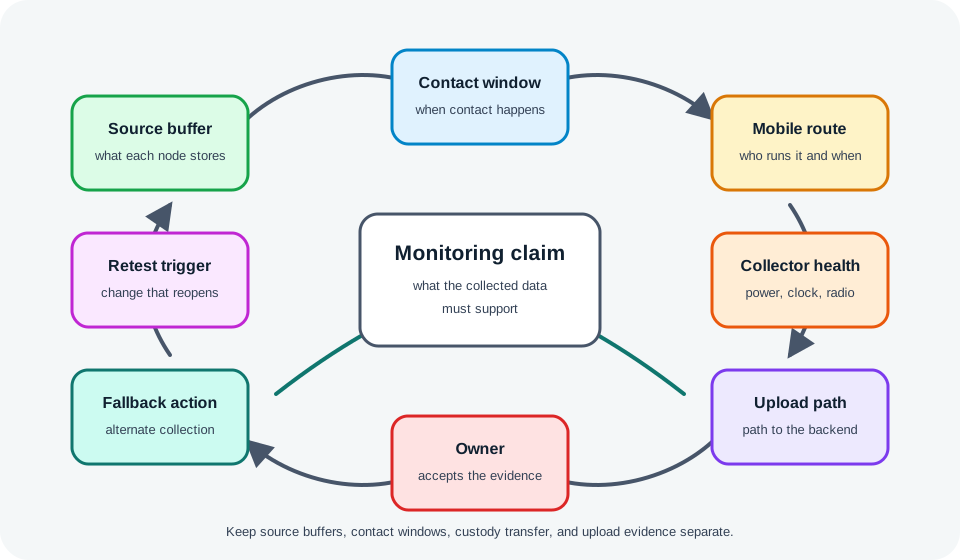
Production review asks whether mobile collection can support the monitoring claim after field conditions and operating schedules change.
- In the worked ledger, a source has an eight-hour buffer limit and the worst next pass occurs after six hours, leaving two hours at contact.
- Evidence for Mobile Sink Evidence Map starts in the Worked mobile-sink contact ledger follows a service vehicle from source buffer through a six-hour wait, custody handoff, and four-hour upload, exposing a ten-hour end-to-end age against an eight-hour time-to-live value diagram.
- The contact must prove what was offered, accepted, or left partial; the backend must confirm arrival.
Major section
Strategy Selection
Validate route execution, data age, missed-contact handling, and route-change ownership.
- Validate priority rules and make sure replanning does not hide skipped sources.
- It gives a known visit plan, but needs a repair rule when a pass is missed.
- The next route changes in response to fresh facts.
- A route name alone does not prove a sound service.
Major section
Strategy Selection (continued)
That may help reach more nodes, though new plans cost time and make delay less clear.
- The third choice reuses trips that already take place, so reach and data age may vary.
- A group of collectors can split the field, but each handoff needs a clear owner.
- The contract becomes auditable when each promise has a visible test.
Major section
Strategy Selection (continued)
For all four, test reach, age of queued data, sensor power, and repair.
- A fixed route contract says when each source is visited and what delay is acceptable.
- An adaptive route contract says which priority rule may skip a source and how that skipped source is reported.
- Reachability is tested with source lists and route logs.
Major section
Strategy Selection (continued)
An opportunistic route contract says how variable trips are bounded and when coverage is too uncertain.
- A multi-collector contract says which collector owns each source, how handoff works near boundaries, and how duplicate or partial custody records are reconciled.
- Freshness is tested with oldest accepted data and dashboard age labels.
- Custody is tested with source-side and collector-side receipts.
- Recovery is tested by forcing a missed pass, a partial transfer, and a delayed upload.
Major section
Strategy Selection (continued)
Those tests make the mobile-sink claim specific enough to release, limit, or reject.
- The contract should also state what the route is not allowed to prove.
- A collector that passes near a field once per day may support trend review but not safety alarms.
- The production claim is valid only inside the route's proven service envelope.
Major section
Route and Contact Evidence · Buffer and Custody Review
A contact is successful only when the source and collector can prove what happened.
- Route planning should show what is reachable and what remains at risk.
- Mobile-sink systems often fail quietly when source buffers are treated as unlimited or when custody transfer is not visible.
- Discovery alone is not enough.
Major section
Multi-Collector Coordination · Movement Cost and Feasibility
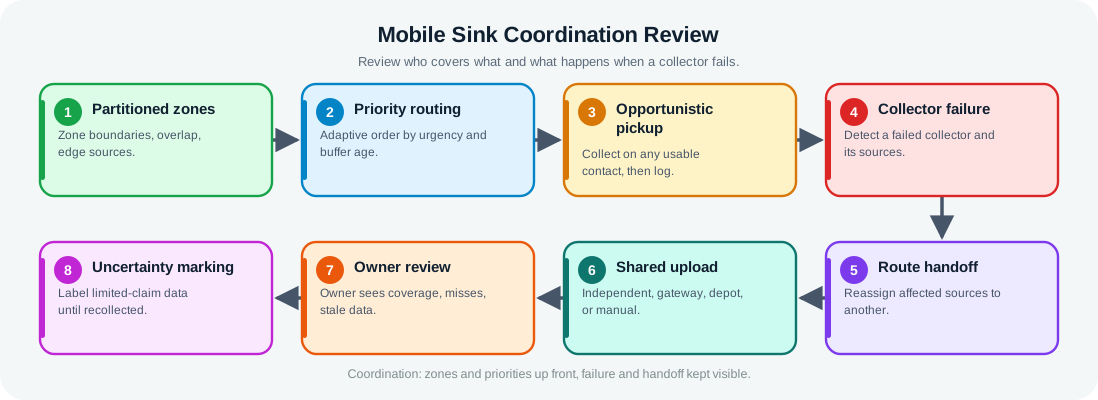
The timeline keeps the source buffer limit, route interval, contact, and possible upload delay visible.
- The two-hour arithmetic margin between the eight-hour buffer limit and six-hour interval is only a simplified bound; transfer and upload add time.
- Coordination needs current route, custody, and freshness evidence before either zone's claim is released.
- Figure the Mobile sink coordination review showing partitioned zones, adaptive priority routing, opportunistic collection, collector failure, route handoff, shared upload, owner review, and uncertainty marking diagram shows two partitioned collection zones and the sources near their boundary.
- Movement cost should be reviewed as an operating constraint rather than as a generic claim about robots, vehicles, or aircraft.
Major section
Aerial Inspection Collector · Worked Review: Facility Robot Collector
Scenario: A mobile collector gathers data from remote sources where fixed relays are not practical.
- Claim: Remote source data can support inspection review only when collection route, reserve, upload, and data age are proven.
- Route evidence: Validate access, safety, weather constraints, contact windows, reserve behavior, and what locations are outside the claim.
- Retest trigger: Retest after flight path, route owner, weather policy, collector maintenance, firmware, upload, or safety-rule changes.
Major section
Common Mistakes · Mobile Sink Readiness Checklist
Optimizing routes without claims: A short route is not enough.
- The route must support freshness, custody, uncertainty, and fallback for the monitoring claim.
- Assuming movement is free: Existing vehicles, robots, aircraft, or people still have availability, safety, power, access, and owner constraints.
- Overcomplicating coordination: Multiple collectors need clear partitions, handoff rules, failure behavior, and ownership.
Major section
Summary · Key Takeaway · Concept Relationships
Mobile sink production deployment is an evidence problem.
- A moving collector is useful only when route ownership, contact windows, buffer custody, data age, collector reliability, upload proof, fallback behavior, and retest triggers support the monitoring claim.
- The production record should make uncertainty visible.
- Mobile WSN Fundamentals Review explains contact windows, buffers, data age, custody, and disconnected collection.
Deck summary
Key takeaways
The operator must decide whether each visit keeps the data fresh enough for the real task.
- A mobile sink is useful only if its route and custody promises are real.
- Production review asks whether mobile collection can support the monitoring claim after field conditions and operating schedules change.
- Validate route execution, data age, missed-contact handling, and route-change ownership.
- That may help reach more nodes, though new plans cost time and make delay less clear.
Retrieval practice
Recall check 1 of 5

Packet Pete says: answer from memory, then check your reasoning.
Q1A mobile sink misses a scheduled contact with a node during its collection route. What should a well-designed system do?
Show answer
Answer: A A missed mobile-sink contact should become visible uncertainty with a retry, never a silent data loss.
Retrieval practice
Recall check 2 of 5

Packet Pete says: answer from memory, then check your reasoning.
Q2A collector rides an existing service route that often changes. Which plan fits?
Show answer
Answer: B Variable trips need bounded data age and a recovery plan.
Retrieval practice
Recall check 3 of 5

Packet Pete says: answer from memory, then check your reasoning.
Q3A mobile sink route runs every six hours, but source buffers expire after eight hours and upload can be delayed four more hours. What should the production review do?
Show answer
Answer: D Mobile-sink production readiness depends on a shared timing budget: route interval, buffer TTL, contact transfer, upload SLA, and accepted freshness must fit together.
Retrieval practice
Recall check 4 of 5

Packet Pete says: answer from memory, then check your reasoning.
Q4A mobile sink route is shorter after optimization, but the review record does not show missed-contact behavior, buffer age, upload proof, or fallback ownership. What should the production review do?
Show answer
Answer: B Mobile sink production readiness depends on route execution, contact, buffer, custody, upload, fallback, owner, and retest evidence, not route length alone.
Retrieval practice
Recall check 5 of 5

Packet Pete says: answer from memory, then check your reasoning.
Q5A service vehicle acting as a Data MULE misses a scheduled pass. Several sources still have data, but the dashboard continues showing the last uploaded values as normal. What is the best production response?
Show answer
Answer: C Missed-contact handling should protect buffers, show data age, alert the owner, activate fallback, and record whether the monitoring claim remains valid.
Print reference
Answers 1 of 2
Answer key.
- A · A missed mobile-sink contact should become visible uncertainty with a retry, never a silent data loss.
- B · Variable trips need bounded data age and a recovery plan.
- D · Mobile-sink production readiness depends on a shared timing budget: route interval, buffer TTL, contact transfer, upload SLA, and accepted freshness must fit together.
- B · Mobile sink production readiness depends on route execution, contact, buffer, custody, upload, fallback, owner, and retest evidence, not route length alone.
Print reference
Answers 2 of 2
Answer key.
- C · Missed-contact handling should protect buffers, show data age, alert the owner, activate fallback, and record whether the monitoring claim remains valid.
