Wireless Sensor Networks · Study deck

MWSN Environments and Carriers

Imagine a sensor rides on a bus while another drifts below the sea.

Packet Pete is your guide for this deck.

mobile-wsnmobile-entitiesplatform-selection
iotclass.org

After studying this chapter

Learning objectives

You will be able to:

  • distinguish underwater, terrestrial, aerial, human-carried, vehicle-based, robot-based, and animal-borne mobile sensing contexts
  • separate mobile sensor, mobile sink, mobile relay, and Data MULE roles before choosing a platform
  • review platform fit using contact evidence, buffer evidence, freshness limits, sensing meaning, operations limits, and maintenance ownership
  • identify when uncontrolled mobility, controllable mobility, or scheduled mobility is appropriate
iotclass.org

Major section

Match the Carrier to Its Claim

The team must decide whether each moving carrier can support the same kind of claim.

  • A bus sensor follows a schedule, while an underwater carrier may drift or need a planned mission.
  • Both move, yet their route, contact, power, position, and recovery evidence support different promises.
  • The same sensor reading may have different meaning on a scheduled bus and a drifting carrier.
iotclass.org

Major section

In 60 Seconds

Mobile wireless sensor networks use moving platforms to sense, carry data, relay traffic, or collect readings from fixed nodes.

  • Mobile-entity review should not start with a favorite platform.
  • It starts with the sensing claim, environment, movement pattern, role, contact opportunity, data custody, freshness limit, safety constraint, privacy boundary, maintenance route, fallback action, and retest trigger.
  • A platform is a good fit only when those items are visible in the evidence record.
iotclass.org

Major section

Mobile Entity Evidence Map
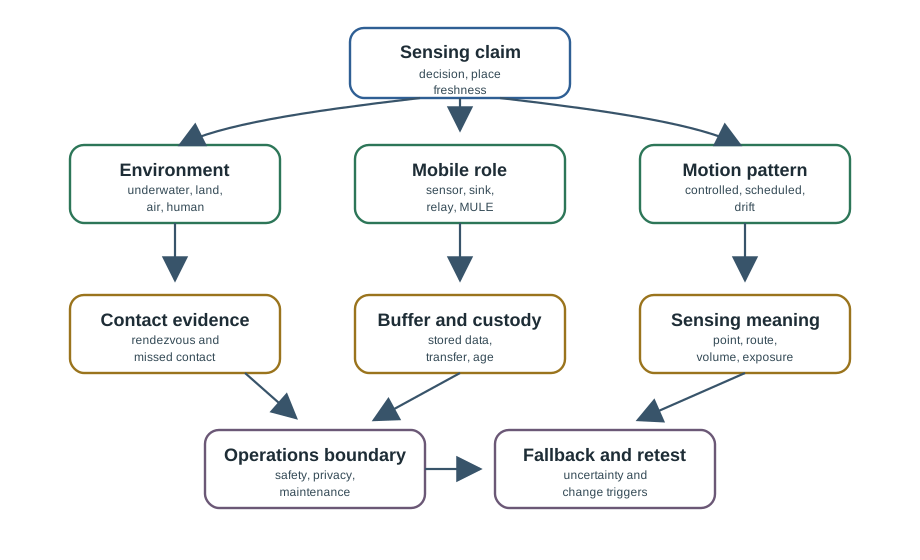
Its freshness checkpoint sets the timing constraint, before: Environment adds a distinct review condition.

  • That sequence gives the visual its meaning: Mobile WSN entity evidence map connecting sensing claim, environment, mobile role, motion pattern, contact evidence, buffer evidence, data custody, freshness limit, operations boundary, fallback, and retest trigger.
  • A drone, bus, phone, robot, animal tag, or underwater vehicle can be useful only when its movement produces the right evidence at the right time.
  • If contact, buffer, ownership, safety, privacy, or fallback behavior is missing, the platform choice is still unreviewed.

Why it matters

The map prevents platform-first drift.

Mobile WSN entity evidence map connecting sensing claim, environment, mobile role, motion pattern, contact evidence, buffer evidence, data custody, freshness limit, operations boundary, fallback, and retest trigger.
iotclass.org

Major section

Entity Roles Before Platforms

An entity type is not enough.

  • A bus carrying an air sensor is a mobile sensor; a bus collecting packets from roadside nodes is a Data MULE; a drone bridging a disconnected area is a mobile relay.
  • Mobile sensor: The platform carries the sensing instrument.
  • Mobile sink: The platform receives data from other nodes and may upload later.

Key terms

Evidence must show what
Evidence must show what is collected, when it is collected, where it is uploaded, how duplicates are handled, and what data can expire.
iotclass.org

Major section

Entity Roles Before Platforms (continued)

Evidence must show where the reading is valid, how mounting changes the measurement, and how the route affects coverage.

  • Evidence must show contact windows, missed-contact behavior, buffer depth, data age, and custody transfer.
  • Evidence must show when the relay is present, whether routes recover, and what happens when the relay leaves.
  • Data MULE: The platform stores, carries, and forwards readings.
iotclass.org

Major section

Movement Patterns

Movement pattern determines coverage, repeatability, delay, and bias.

  • Controlled movement: Robots, planned UAV missions, and planned AUV missions can be sent to specific places.
  • Scheduled movement: Buses, trains, service vehicles, and inspection rounds repeat routes.
  • Opportunistic movement: Phones, personal vehicles, and volunteer carriers can provide broad coverage but uneven sampling.
iotclass.org

Major section

Carrier Control and Stack Evidence

Opportunistic, drifting, and animal-driven carriers need discovery, buffering, custody transfer, duplicate handling, stale-data marking, and a clear uncertainty boundary.

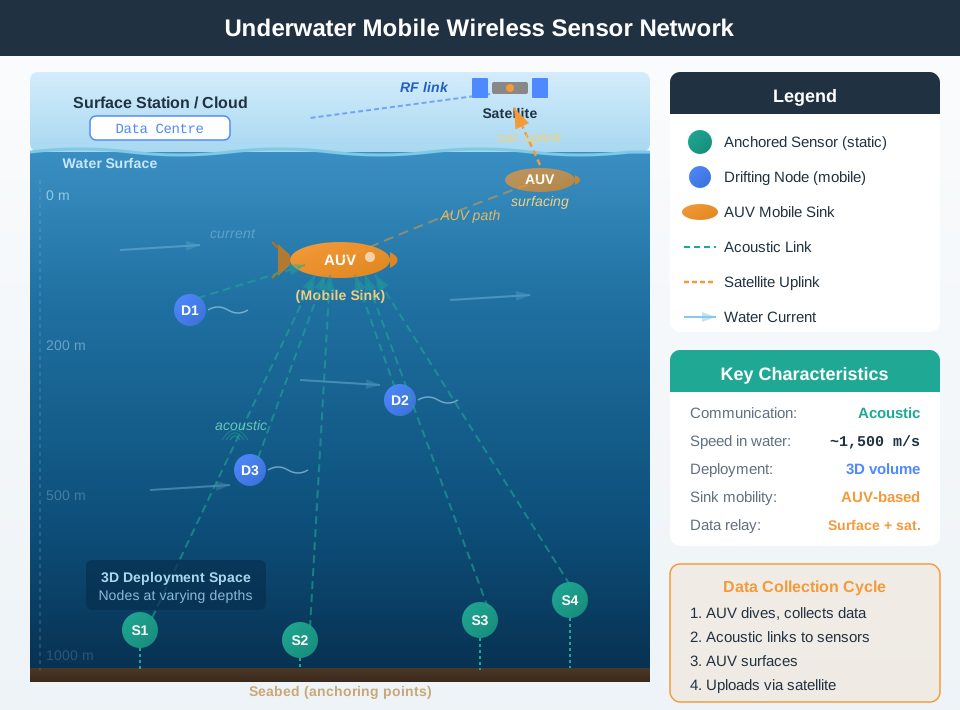
  • A controlled robot, UAV, or AUV can be sent toward a rendezvous area, so sources can use planned wake windows, bounded buffers, missed-visit alarms, and explicit recovery rules.
  • Anchored and drifting nodes sense below the surface; acoustic contact lets the controlled collector take custody.
  • Each handoff needs proof.

Why it matters

Carrier control changes the wireless stack because it changes the probability of contact.

Underwater mobile WSN with anchored sensors, drifting nodes, an AUV mobile sink, acoustic links, a surfacing upload path, and a surface/cloud path.
iotclass.org

Major section

Carrier Control and Stack Evidence (continued)

A scheduled bus or inspection round may be predictable enough for guard windows, but the WSN does not own the route, so skipped service and route changes must stay visible.

  • Contact can fail, stored readings can age, and a missed visit needs a recovery rule.
  • The section's carrier table explains why controlled movement can support planned wake windows while drift requires stronger discovery, custody, and uncertainty evidence.
  • Carrier control changes the wireless stack because it changes the probability of contact.
iotclass.org

Major section

Platform Fit Evidence Record

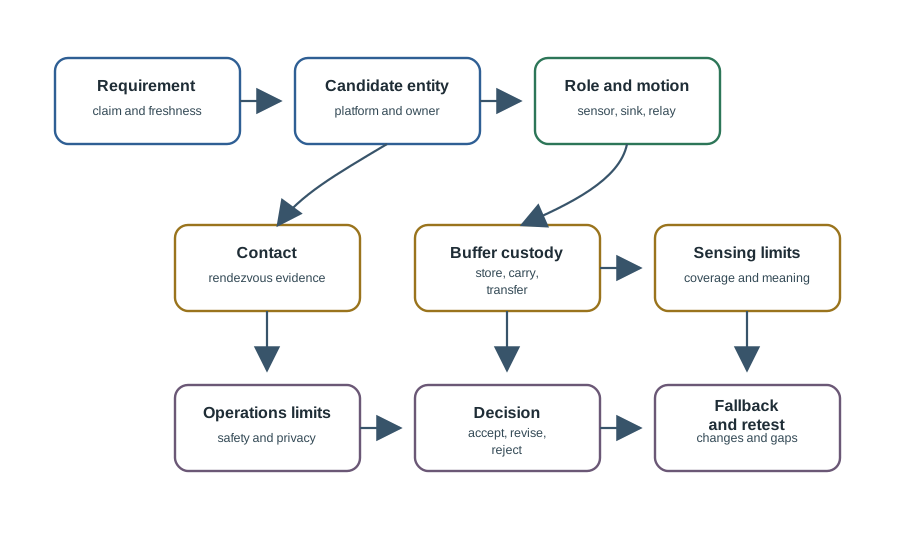
Its mobility and contact pattern determine when data can move; buffer evidence shows whether it survives the gaps.

  • The decision must preserve a fallback for missed contact, overflow, or loss of the mobile entity.
  • Retest trigger: Retest when routes, schedules, payloads, carriers, firmware, gateways, weather exposure, privacy rules, or maintenance ownership changes.
  • Sensing limits and operational limits come next because a feasible route can still fail the measurement or maintenance need.

Why it matters

Sensing limits and operational limits come next because a feasible route can still fail the measurement or maintenance need.

Mobile WSN platform fit evidence record from requirement and candidate entity through role, mobility pattern, contact and buffer evidence, sensing limits, operations limits, decision, fallback, and retest trigger.
iotclass.org

Major section

Common Mistakes

Overclaiming aerial systems: Aerial platforms are strong for targeted reach, inspection, and temporary relay.

  • Confusing mobility with coverage proof: A moving entity visits places; it does not automatically prove that each place was sensed at useful quality or useful freshness.
  • Ignoring missed contacts: Mobile sinks and Data MULEs need explicit rules for missed rendezvous, full buffers, stale readings, duplicate transfer, and custody.
  • They do not remove weather, permission, recovery, payload, or presence limits.
iotclass.org

Major section

Summary

Mobile WSN types and entities are best reviewed as evidence choices.

  • Underwater, terrestrial, aerial, human-carried, vehicle-based, robot-based, and animal-borne platforms each bring different movement patterns, contact opportunities, sensing meanings, and operations limits.
  • The strongest review separates environment, entity role, movement pattern, contact evidence, buffer evidence, data custody, freshness, safety, privacy, maintenance, fallback, and retest trigger.
  • A platform is a good fit only when its movement supports the sensing claim without hiding gaps or changing what the data means.
iotclass.org

Deck summary

Key takeaways

The team must decide whether each moving carrier can support the same kind of claim.

  • Mobile wireless sensor networks use moving platforms to sense, carry data, relay traffic, or collect readings from fixed nodes.
  • Its freshness checkpoint sets the timing constraint, before: Environment adds a distinct review condition.
  • An entity type is not enough.
  • Evidence must show where the reading is valid, how mounting changes the measurement, and how the route affects coverage.
iotclass.org

Retrieval practice

Recall check 1 of 4

Packet Pete says: answer from memory, then check your reasoning.

Q1A WSN relies on tagged animals to carry data past a gateway only when they happen to wander near it. Which mobility type is this?

AControlled mobility, since the route is planned in advance.
BStatic placement, since the gateway remains in one location.
COpportunistic mobility, since animal movement controls contact.
DGuided mobility, since the network steers tagged animals.
Show answer

Answer: C When data carriers move unpredictably and contact is not directed, the mobility is opportunistic.

iotclass.org

Retrieval practice

Recall check 2 of 4

Packet Pete says: answer from memory, then check your reasoning.

Q2A planned delivery robot and GPS-collared animals both carry WSN data. What evidence difference matters most?

AThey use the same proof because any moving carrier guarantees coverage, freshness, custody transfer, and delivery timing.
BThe animal-carried design can schedule exact rendezvous times, while the robot must wait for random contact.
CThe robot can use planned contacts; animal-carried data needs discovery, buffers, custody, and stale-data rules.
DOnly radio frequency matters; movement control does not change discovery, buffering, routing, or custody.
Show answer

Answer: C Carrier control is decisive: controlled carriers allow planned contact windows, bounded latency, and missed-visit alarms, while uncontrolled carriers require opportunistic discovery, buffering, custody tracking, and stale-data rules.

iotclass.org

Retrieval practice

Recall check 3 of 4

Packet Pete says: answer from memory, then check your reasoning.

Q3A bus carries an air-quality sensor, records readings along its route, and uploads data at the depot. What should the review decide first?

ADecide whether the bus senses, carries data, or does both.
BAssume buses always beat fixed sensors for every city use.
CJudge only whether the route spans enough area on the map.
DInstall without assigning calibration or maintenance owners.
Show answer

Answer: A Mobile WSN review starts by separating entity roles, then checking the evidence required for each role.

iotclass.org

Retrieval practice

Recall check 4 of 4

Packet Pete says: answer from memory, then check your reasoning.

Q4A phone-based sensing project receives many readings from busy downtown routes but almost none from residential side streets. How should the project describe coverage across the unevenly sampled routes?

ATreat every city block as covered because phones can move across town.
BDiscard every phone reading because volunteer movement is uncontrolled.
CHide the side-street gaps so the map looks complete to readers.
DShow the bias, limit claims to observed routes, or add targeted collection for gaps.
Show answer

Answer: D Opportunistic sensing must be interpreted through observed coverage, sampling bias, consent, and uncertainty boundaries.

iotclass.org

Print reference

Answers

Answer key.

  1. C · When data carriers move unpredictably and contact is not directed, the mobility is opportunistic.
  2. C · Carrier control is decisive: controlled carriers allow planned contact windows, bounded latency, and missed-visit alarms, while uncontrolled carriers require opportunistic discovery, buffering, custody tracking, and stale-data rules.
  3. A · Mobile WSN review starts by separating entity roles, then checking the evidence required for each role.
  4. D · Opportunistic sensing must be interpreted through observed coverage, sampling bias, consent, and uncertainty boundaries.
iotclass.org