Wireless Sensor Networks · Study deck

Stationary WSN Fundamentals

A wireless sensor network (WSN) joins sensors that share readings over wireless links.

Packet Pete is your guide for this deck.

stationary-wsnfixed-placementcoverage-review
iotclass.org

After studying this chapter

Learning objectives

You will be able to:

  • Explain when a stationary WSN is a good fit and when movement should be considered.
  • Review fixed node placement for sensing meaning, coverage, links, energy, and maintenance.
  • Identify energy holes, busy relays, coverage holes, and broken-network risks without brittle number shortcuts.
  • Build a stationary WSN record with accepted limits, fallback actions, an owner, and reasons to test again.
iotclass.org

Major section

In 60 Seconds

A gateway is a device that passes data to another network.

  • Fixed places make coverage, routes, maintenance, and sensor checks easier to plan.
  • They also make placement mistakes last.
  • A missed area, weak link, busy relay, blocked case, or unreachable node remains a problem until someone changes the site.
  • Stationary WSN review is a check of fixed places.
iotclass.org

Major section

Fixed Placement Evidence Map
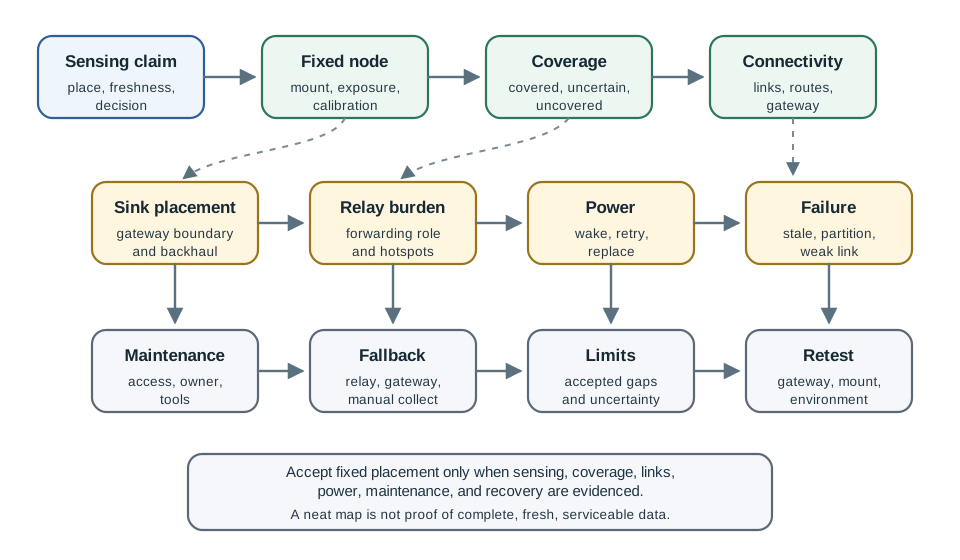
Sensing claim states what the network must prove: Fixed node records where a sensor supports that claim.

  • It then records visible failures, maintenance access, a fallback, accepted limits, and reasons to test again.
  • The final decision says whether the fixed design supports the claim.
  • Fixed topology makes evidence easier to collect, but it also makes failures persistent.

Why it matters

The map prevents a common mistake: treating stationary placement as finished once the nodes are installed.

Stationary WSN fixed-placement evidence map connecting sensing claim, fixed node placement, coverage evidence, connectivity evidence, sink placement, relay burden, power evidence, failure visibility, maintenance access, fallback action, accepted limits, and retest trigger.
iotclass.org

Major section

Fixed Placement Evidence Map (continued)
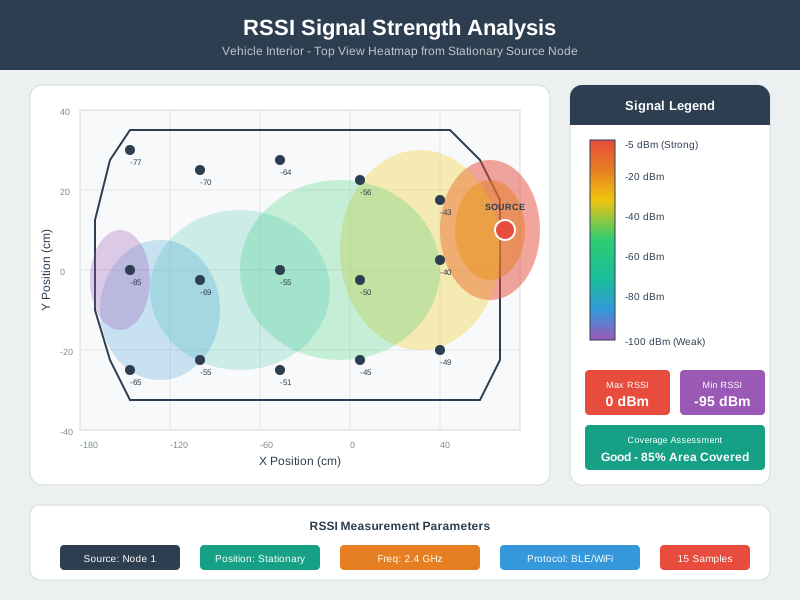
If a relay hotspot, coverage hole, obstructed sensor, or inaccessible battery is not visible in the record, the deployment can look stable while its data quality is drifting.

  • Figure Figure: Stationary-source RSSI heatmap showing signal-strength variation around a adds measured signal variation to the fixed placement review.
  • This helps the team find weak positions.
  • Yet RSSI alone does not prove packet delivery or a safe reverse path.
Stationary-source RSSI heatmap showing signal-strength variation around a fixed source node and a coverage assessment boundary.
iotclass.org

Major section

Fixed Placement Evidence Map (continued)

The map prevents a common mistake: treating stationary placement as finished once the nodes are installed.

  • The section's fixed-placement record also needs gateway reach, relay burden, power, failure visibility, and maintenance access.
  • A node may stay in the same place while enclosure exposure, obstruction, traffic, or gateway position changes its usable link, so later field measurements can reopen acceptance.
  • The fixed map is an index into evidence, not the evidence itself.
iotclass.org

Major section

Stationary Design Proof Limits

Predictable topology: Fixed nodes can make routes easier to inspect.

  • They do not prove reliability unless link quality, reverse paths, retry behavior, and route repair are recorded.
  • Repeatable sensing: A fixed sensor can compare the same place over time.
  • It still needs mounting, exposure, calibration, drift, and physical access evidence.
  • Maintenance planning: Known locations can simplify replacement.

Why it matters

Coverage planning: Planned placement can reduce blind spots.

iotclass.org

Major section

Evidence Record

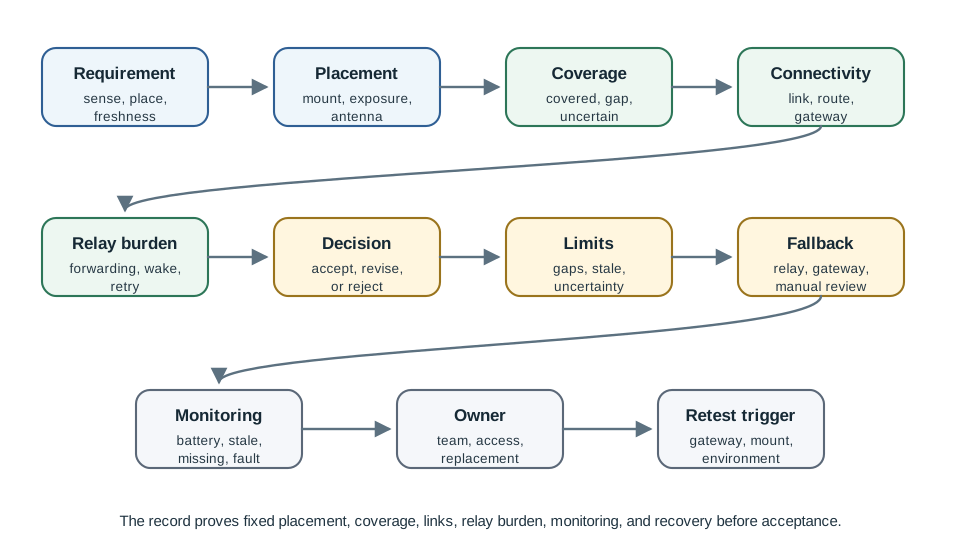
The practical question in evidence record is where sense, place, hands responsibility to freshness.

  • The path then checks coverage, links, relay work, limits, and the decision.
Stationary WSN evidence record from requirement and placement assumptions through coverage evidence, connectivity evidence, relay burden, decision, accepted limits, fallback, monitoring owner, and retest trigger.
iotclass.org

Major section

Reviewing Connectivity and Relay Burden

Stationary WSNs often use fixed multi-hop paths or stable neighbor sets.

  • That stability can make operations easier, but it can also hide relay pressure.
  • The strongest records separate planned topology from observed topology.
  • The acceptance decision should cite the observed topology.
  • Energy-hole risk: Energy-hole review is about role and evidence, not a fixed multiplier.
iotclass.org

Major section

Common Mistakes

Ignoring gateway-side burden: Nodes close to a sink or gateway may become relay chokepoints even when their own sensing workload is small.

  • Assuming fixed means reliable: Stable topology can hide stale readings, weak reverse links, inaccessible batteries, and persistent coverage holes.
  • Overclaiming coverage: Sensor range, radio range, and meaningful measurement range are different.
  • The review must preserve those boundaries.
iotclass.org

Major section

Summary

Stationary WSNs are fixed-placement sensing systems.

  • Their strength is repeatable location-specific measurement, predictable topology, and planned maintenance.
  • Their risk is that bad placement, weak links, overloaded relays, inaccessible nodes, and stale readings can persist unnoticed.
  • The accepted record must prove the sensing claim, placement, coverage, links, relay work, power state, and maintenance route.
iotclass.org

Deck summary

Key takeaways

A gateway is a device that passes data to another network.

  • Sensing claim states what the network must prove: Fixed node records where a sensor supports that claim.
  • If a relay hotspot, coverage hole, obstructed sensor, or inaccessible battery is not visible in the record, the deployment can look stable while its data quality is drifting.
  • The map prevents a common mistake: treating stationary placement as finished once the nodes are installed.
  • Predictable topology: Fixed nodes can make routes easier to inspect.
iotclass.org

Retrieval practice

Recall check 1 of 4

Packet Pete says: answer from memory, then check your reasoning.

Q1In a stationary multi-hop WSN, why do nodes near the sink tend to form an 'energy hole'?

AThey are assigned smaller batteries because they sit near the gateway
BThey sample local conditions more often than distant leaf nodes
CThey work harder because they are farthest from sensing targets
DThey relay many leaf-node packets on the path toward the sink
Show answer

Answer: D Sink-adjacent nodes carry the most relay traffic, so they deplete first, forming an energy hole.

iotclass.org

Retrieval practice

Recall check 2 of 4

Packet Pete says: answer from memory, then check your reasoning.

Q2A team shows a neat grid of fixed sensors and says the stationary WSN is ready. What should the review ask before accepting the design?

AWhether each sensor is equally distant from the gateway.
BWhether maintenance access can be skipped with a tidy grid.
CWhether coverage, links, relay load and access support the claim.
DWhether fixed nodes remove holes and relay hotspots by default.
Show answer

Answer: C Stationary WSN acceptance requires evidence for the installed physical design, not just a planned placement diagram.

iotclass.org

Retrieval practice

Recall check 3 of 4

Packet Pete says: answer from memory, then check your reasoning.

Q3A fixed WSN has several nodes near the gateway that forward data for many other nodes. How should reviewers assess the forwarding load near the gateway?

AReview relay load, retries, power, access, repair, and fallback.
BIgnore it because stationary nodes never change route roles.
CAssume identical hardware means identical lifetime for every node.
DRemove health monitoring because every node location is known.
Show answer

Answer: A Energy-hole risk comes from relay role, link behavior, wake schedule, retries, and replacement access, not from a fixed multiplier.

iotclass.org

Retrieval practice

Recall check 4 of 4

Packet Pete says: answer from memory, then check your reasoning.

Q4Why can a stationary WSN reuse TDMA schedules and surveyed node positions, and what limitation does that same stationarity create?

AStatic nodes have unlimited energy, making schedules free.
BFixed nodes use higher power with no placement tradeoff.
CStationarity lets sensors reposition to heal new holes.
DStable neighbours aid reuse, but holes and relay loads persist.
Show answer

Answer: D A fixed topology can make schedules, surveyed positions, and route evidence reusable, but it can also preserve fixed relay burden, weak links, and coverage holes.

iotclass.org

Print reference

Answers

Answer key.

  1. D · Sink-adjacent nodes carry the most relay traffic, so they deplete first, forming an energy hole.
  2. C · Stationary WSN acceptance requires evidence for the installed physical design, not just a planned placement diagram.
  3. A · Energy-hole risk comes from relay role, link behavior, wake schedule, retries, and replacement access, not from a fixed multiplier.
  4. D · A fixed topology can make schedules, surveyed positions, and route evidence reusable, but it can also preserve fixed relay burden, weak links, and coverage holes.
iotclass.org