Wireless Sensor Networks · Study deck
Mobile WSN Fundamentals
Imagine a service cart passes a set of crop sensors once each morning.
Packet Pete is your guide for this deck.
After studying this chapter
Learning objectives
You will be able to:
- explain the design reasons for adding mobility to a WSN
- distinguish mobility of the sensor, sink, carrier, target, gateway, and maintenance route
- review mobility trade-offs across coverage, contact, energy, latency, custody, and operations
- identify when mobility creates new failure modes instead of solving stationary WSN problems
Major section
Check the Cart Visit Schedule · Start With the Field Story · In 60 Seconds
Link the planned route to actual contacts, stored readings, upload time, and missed stops.
- The team must decide whether that moving visit can collect each reading in time.
- A gateway is a device that links one network or system to another.
- Mobility is not automatically an improvement.
Major section
Mobility Review Scope · Mobility Fit Map
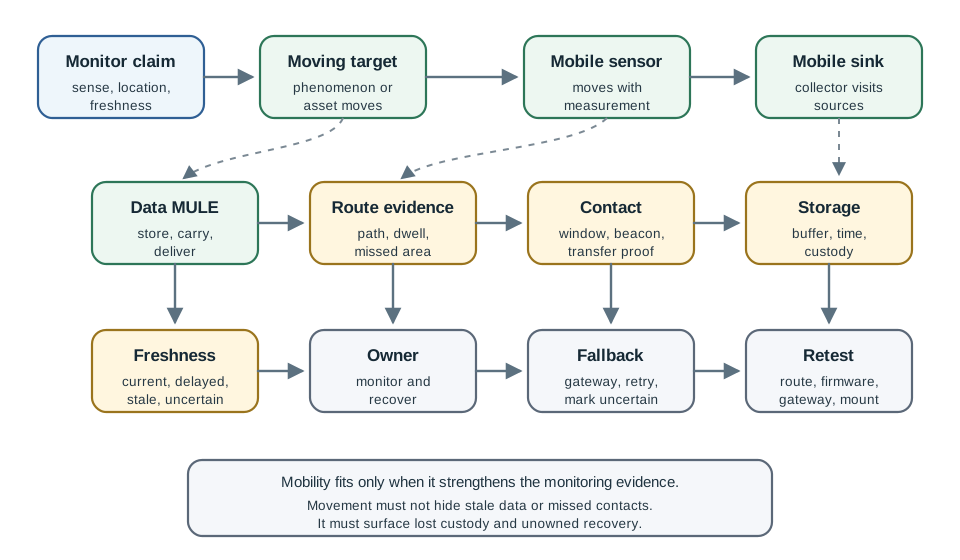
MWSN review starts with the reason for mobility.
- Movement should solve a named evidence problem, not just make the architecture look advanced.
- Sensing reason: The phenomenon moves, the asset moves, or the best sensing position changes over time.
- Operations reason: A service route, inspection path, carried device, or maintenance tool already reaches useful contact points.
Major section
Mobility Topology Evidence
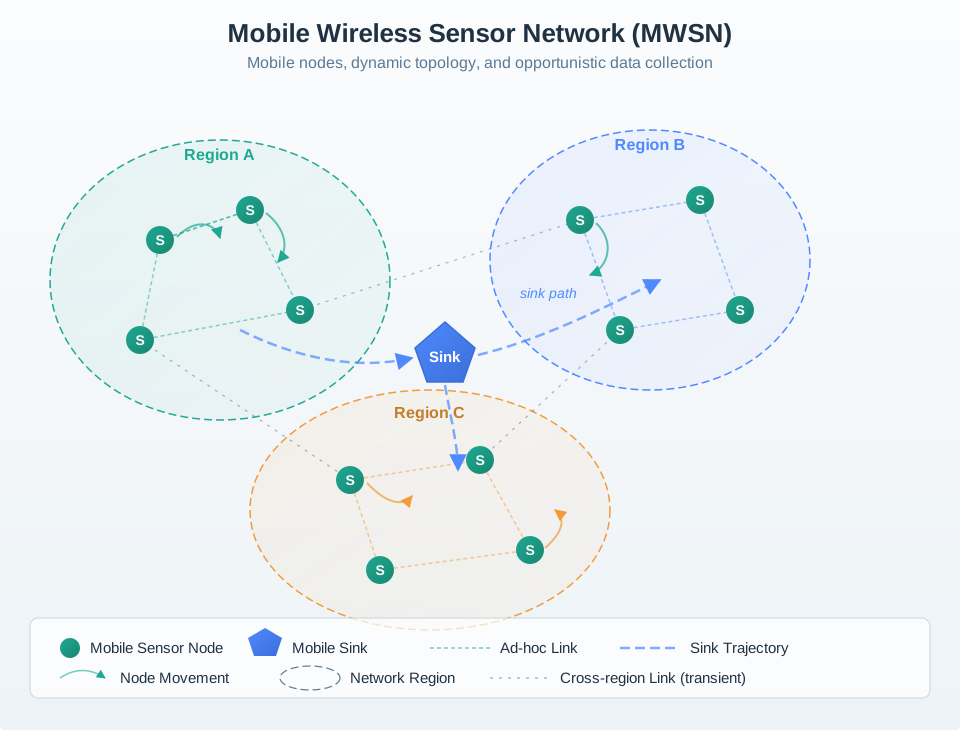
Mobile WSN review changes the unit of evidence from a static topology to a time-ordered sequence of contacts.
- The useful proof is the path, contact window, transient link, custody transfer, and freshness state, not just the final delivered packet.
- The Mobility Topology Evidence claim needs a visual check.
- A final topology snapshot cannot establish those earlier states.

Major section
Mobility Topology Evidence (continued)
: Self-CHOP translates autonomous behavior into testable mobile-network records.
- That physical arrangement is why a useful mobile-WSN record must bind measurements to platform pose and time, and must distinguish a planned service-cart route from opportunistic movement.
- For planned movement, the team can compare visits with a route and log missed contacts.
- The properties can conflict.
Major section
Mobility Topology Evidence (continued)
In Figure: Mobile wireless sensor network with moving sensor regions, Mobile Wireless Sensor Network (MWSN) sits with: Region A to clarify the evidence behind Mobility Topology Evidence.
- The sink trajectory and node movement show why a delivered packet is only the end of a changing contact history.
- For opportunistic movement, it must preserve the contacts that actually happened.
- A human-carried phone, animal tag, drifting sensor, or moving asset is different.
Major section
Mobility Topology Evidence (continued)
When that gateway moves out of range it self-heals by expiring the stale parent and buffering records while seeking another.
- A planned inspection robot, service cart, or mobile sink can be scheduled; nodes can wake before the expected visit, and missed visits can be logged against a planned route.
- Mobility is useful only if movement makes the monitoring claim more trustworthy.
- Self-CHOP is a four-part operational model for that autonomy.
Major section
Mobility Topology Evidence (continued)
The system may not control the path, speed, dwell time, or contact order, so the record must preserve what actually happened rather than what the design hoped would happen.
- If it hides stale data, ambiguous location, missed custody, or unowned recovery, it has made the design harder to audit.
- A mobile WSN inherits a MANET problem: movement invalidates topology faster than a human operator can repair every link.
- It self-optimizes only after enough evidence shows that a different wake interval or transmit level improves delivery per joule.
Major section
Stationary, Mobile, and Hybrid Fit · What Mobility Can and Cannot Prove
When the fit is unclear, narrow the claim before adding motion.
- Mobile review should preserve the stationary baseline instead of treating mobility as a default upgrade.
- The question is whether movement improves the evidence record for the claim.
- Mobility should make uncertainty easier to see, not easier to ignore.
Major section
Evidence Record · Reviewing the Mobility Purpose
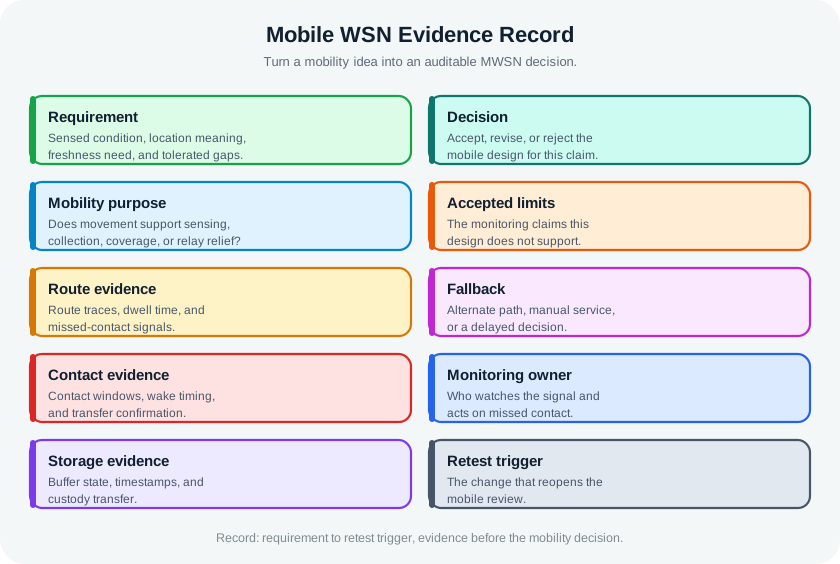
Requirement and mobility purpose say what must be sensed, where location applies, why movement helps, and how much delay is allowed.
- The decision can accept, revise, or reject the design for that claim.
- Accepted limits and a fallback show what happens outside it, while the monitoring owner and retest trigger keep missed visits visible.
- Evidence for Evidence Record starts in the Mobile WSN evidence record from requirement and mobility purpose through route evidence, contact evidence, storage evidence, decision, accepted limits, fallback, monitoring owner, and retest trigger diagram.
- The record connects a moving component to an operating decision rather than a role name.
Major section
Controlled and Opportunistic Mobility · Contact, Storage, Freshness
Different mobility patterns need different evidence.
- Controlled motion can be scheduled; opportunistic motion must be observed and labelled after the fact.
- Those models are useful only when the review connects them to operations evidence.
- The practical test is to ask what the receiver can prove after a batch arrives.
Major section
Neighbour Discovery Under Motion
Nodes duty-cycle radios to save energy, so they are off much of the time.
- Motion makes the contact window temporary, so two nodes may be in range only briefly.
- For a transfer to happen, the radios must overlap during that brief window, discover each other, negotiate enough link state, and move the data before range, interference, or path direction changes.
- Beaconing more often improves discovery and transfer confirmation, but it burns energy and can increase contention.
Major section
Neighbour Discovery Under Motion (continued)
A deterministic schedule can guarantee overlap when the path is controlled, but it costs planned awake time and fails if the route slips.
- A probabilistic wake scheme can help when encounters are uncertain, but it accepts missed contacts as a probability problem.
- The reviewer should ask how many useful contacts were exploited, how many were missed, how much data aged in buffers, and whether recovery was automatic or manual.
- A mobile sink that delivers a large batch once per day may be excellent for trend monitoring and unacceptable for a real-time alarm.
Major section
Reviewing Energy and Topology Claims · Worked Review: Greenhouse Service Cart · Worked Review: Moving Asset Monitor
Mobility can reduce some energy burden, but it can also add wake time, retries, scanning, propulsion, handoff work, and operations effort.
- Scenario: A greenhouse has stationary environmental nodes.
- A service cart already moves through aisles and can collect buffered readings while workers inspect plants.
- Scenario: Reusable shipping containers carry sensor nodes that record shock, temperature, and opening events while moving through a facility.
Major section
Common Mistakes · Review Checklist
Mobility-first design: Choosing mobile nodes or mobile sinks before stating the sensing claim creates complex designs without proof that movement helps.
- Unproven route assumptions: Routine movement, worker paths, service vehicles, animal paths, and drones need observed contact evidence and missed-contact handling.
- Energy overclaim: Removing relay work does not prove an energy win if scanning, wake time, retries, storage, propulsion, or maintenance cost is ignored.
- Location ambiguity: A mobile reading may describe the node, the carried asset, the route segment, a nearby area, or an inferred location.
Major section
Match Mobility Claims to Evidence · Order a Mobile WSN Review · Summary
Mobile WSNs use movement as a design tool, not as a decoration.
- Movement may support sensing, collection, coverage, relay relief, disconnected delivery, or operations access.
- The accepted design should prove why mobility is needed, what moves, how readings remain meaningful, when contact occurs, how data is transferred, what delay is acceptable, how missed contacts are detected, and which change forces retesting.
- A mobile WSN improves quality only when it makes the monitoring evidence stronger than the stationary alternative.
Deck summary
Key takeaways
Link the planned route to actual contacts, stored readings, upload time, and missed stops.
- MWSN review starts with the reason for mobility.
- Mobile WSN review changes the unit of evidence from a static topology to a time-ordered sequence of contacts.
- : Self-CHOP translates autonomous behavior into testable mobile-network records.
- In Figure: Mobile wireless sensor network with moving sensor regions, Mobile Wireless Sensor Network (MWSN) sits with: Region A to clarify the evidence behind Mobility Topology Evidence.
Retrieval practice
Recall check 1 of 4

Packet Pete says: answer from memory, then check your reasoning.
Q1When is adding mobility to a wireless sensor network actually justified?
Show answer
Answer: D Mobility is justified only when movement serves the sensing goal and data remains meaningful, not automatically.
Retrieval practice
Recall check 2 of 4

Packet Pete says: answer from memory, then check your reasoning.
Q2In a mobile WSN with duty-cycled radios, nodes frequently pass within range but fail to exchange data. What is the fundamental problem and the trade involved in fixing it?
Show answer
Answer: C In mobile duty-cycled WSNs, two nodes must be awake during a brief contact to discover each other; better schedules raise contact utilization but cost more awake energy.
Retrieval practice
Recall check 3 of 4

Packet Pete says: answer from memory, then check your reasoning.
Q3A team proposes a mobile sink because it sounds more advanced than a fixed gateway. What should the review ask first?
Show answer
Answer: C MWSN review starts with the reason for mobility and verifies the evidence needed to trust the mobile design.
Retrieval practice
Recall check 4 of 4

Packet Pete says: answer from memory, then check your reasoning.
Q4A mobile WSN collects sensor batches whenever a service route passes. Which design issue is most likely if the receiving dashboard does not show data age?
Show answer
Answer: A Mobile and delay-tolerant designs must preserve freshness context so delayed data is not mistaken for current data.
Print reference
Answers
Answer key.
- D · Mobility is justified only when movement serves the sensing goal and data remains meaningful, not automatically.
- C · In mobile duty-cycled WSNs, two nodes must be awake during a brief contact to discover each other; better schedules raise contact utilization but cost more awake energy.
- C · MWSN review starts with the reason for mobility and verifies the evidence needed to trust the mobile design.
- A · Mobile and delay-tolerant designs must preserve freshness context so delayed data is not mistaken for current data.
