Wireless Sensor Networks · Study deck
MWSN Nodes, Sinks, and Data MULEs
Imagine field nodes save readings until a service van drives past and takes a copy.
Packet Pete is your guide for this deck.
After studying this chapter
Learning objectives
You will be able to:
- distinguish mobile sensor nodes, mobile sinks, Data MULEs, rendezvous points, gateways, and stationary sources
- review how each component changes latency, energy use, buffer risk, route state, and maintenance ownership
- identify when mobility helps a WSN and when it hides missing data or stale readings
- build a component evidence record for contact windows, storage, transfer, data custody, and retest triggers
Major section
Assign the Mobile Network Roles
The team must decide which part senses, which part stores, and which part carries the data onward.
- Latency means the wait from a real event to the result that a person or machine receives.
- A collected reading is not yet delivered until the next handoff is confirmed.
- Missing contact receipts should reveal which node still holds data.
Major section
Component Review Scope
MWSN component review starts with the monitoring claim and the mobility assumption.
- A route, animal path, vehicle schedule, drone flight, user movement pattern, or maintenance visit is not evidence until it is observed, bounded, and tied to a recovery action.
- Freshness and latency: Separate "eventually collected" data from data that must be acted on quickly.
- Not every mobility pattern supports urgent decisions.
Major section
Component Role Map
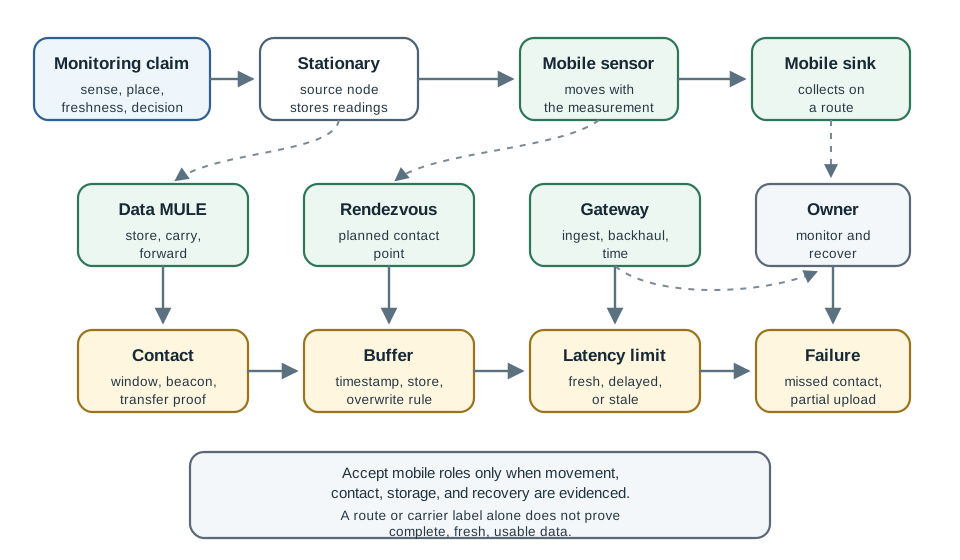
It then separates stationary sources, moving sensors, mobile sinks, Data MULEs, rendezvous points, and gateways by what each does with readings.
- Contact windows and transfer proof show whether movement actually delivered data; buffer timestamps and overwrite rules show what was retained.
- An owner must monitor and recover from those failures.
- Each role change reopens the evidence record.
Major section
Component Role Map (continued)
The role map prevents component drift.
- A vehicle used as a Data MULE can become a mobile sink if it actively schedules collection.
- A mobile sensor node can become a relay if it forwards for other nodes.
- A reading may be measured by one device, stored by another, carried by a vehicle or human, transferred at a rendezvous point, and ingested later by a gateway.
Major section
Evidence Record
Its sense, location, and freshness labels identify the conditions that must be checked together.
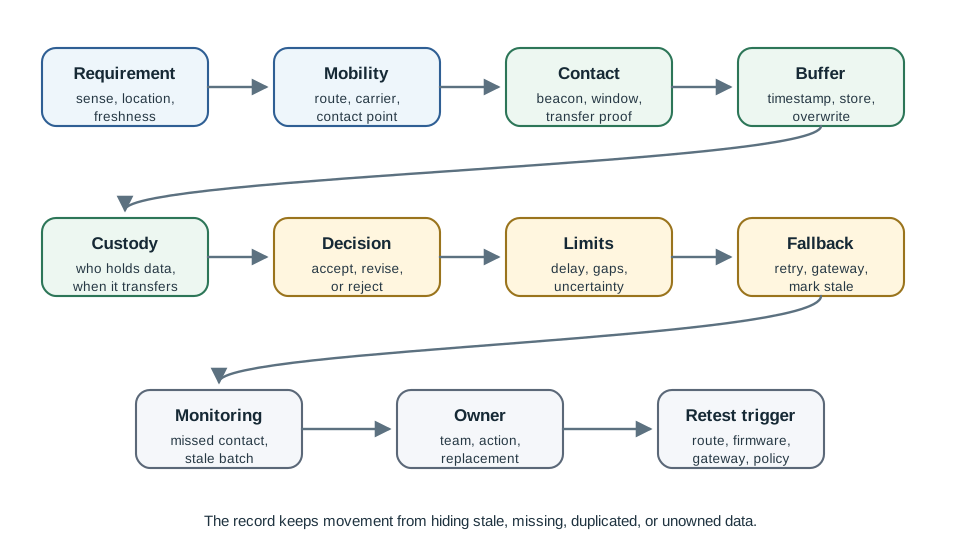
- The transition explains the caption's core point — mWSN component evidence record from requirement and mobility assumption through contact evidence, buffer evidence, custody, decision, accepted limits, fallback, monitoring, owner, and retest trigger.
- That point is the next premise in evidence record.
Major section
Reviewing Data MULEs
Data MULEs carry data between disconnected or weakly connected parts of the system.
- Protocol behavior: Delay-tolerant forwarding, controlled replication, custody transfer, acknowledgments, and expiry rules must match storage and contact evidence.
- Failure visibility: Operations must see missed contacts, stale batches, repeated partial transfers, duplicate uploads, and gateway ingestion failures.
- A quick budget check keeps the trade visible.
Major section
Reviewing Data MULEs (continued)
In a static multi-hop network, nodes near the sink may relay traffic for many sources and die first.
- With a MULE-style path, each source can make a short transfer to the passing carrier, return to sleep, and avoid serving as a permanent relay.
- That helps lifetime uniformity only when the contact plan and buffer plan are honest about the delay they create.
- The budget explains why component roles cannot be reviewed in isolation.
Major section
Reviewing Data MULEs (continued)
A mobile sink may lower relay energy but raise buffer pressure.
- A source that produces r bytes per second and may wait T seconds between successful contacts needs more than r * T usable buffer after metadata, retries, compression overhead, and safety margin are counted.
- A Data MULE may make a sparse deployment practical but make urgent action impossible.
- A rendezvous point may improve discovery while creating a single place where missed meetings accumulate.
Major section
Farm Service Vehicle Collector
Scenario: Soil-moisture nodes are spread across a farm.
- A service vehicle passes each field during routine inspection and can collect buffered readings.
- Mobility assumption: The service route passes each field often enough for the planned decision, and field nodes can detect the collector before their buffers become risky.
- Evidence: Route traces, contact logs, transfer confirmations, buffer-state reports, low-battery signal, gateway upload record, and missed-field alert.
Major section
Common Mistakes
Calling delay a feature without proving tolerance: Delayed data can be useful for trend review, but urgent control decisions need a stronger path.
- Ignoring missed contact: If the system cannot tell when a sink or MULE missed a node, the data record may look healthy while readings are stale.
- Trusting route labels "Routine route" or "regular movement" is not enough.
- The review needs observed contact evidence and a fallback when movement changes.
Major section
Summary
MWSN components are design roles that must be accepted with evidence.
- Mobile sensor nodes, mobile sinks, Data MULEs, rendezvous points, gateways, and stationary sources all change the data path.
- They also change latency, energy, storage, contact, custody, and operations risk.
- The accepted design should show how movement supports the monitoring claim, how contact is detected, how buffers and timestamps are protected, how custody transfers, what happens when contact is missed, and which change would force retesting.
Deck summary
Key takeaways
The team must decide which part senses, which part stores, and which part carries the data onward.
- MWSN component review starts with the monitoring claim and the mobility assumption.
- It then separates stationary sources, moving sensors, mobile sinks, Data MULEs, rendezvous points, and gateways by what each does with readings.
- The role map prevents component drift.
- Its sense, location, and freshness labels identify the conditions that must be checked together.
Retrieval practice
Recall check 1 of 4

Packet Pete says: answer from memory, then check your reasoning.
Q1A Data MULE on a vehicle route collects readings from fixed nodes and later drops them at a gateway. Which limit must the review record?
Show answer
Answer: D A Data MULE's delayed collection makes contact windows, data age, and buffer custody the limits to record.
Retrieval practice
Recall check 2 of 4

Packet Pete says: answer from memory, then check your reasoning.
Q2A sparse, delay-tolerant sensor field uses a Data MULE instead of multi-hop routing to a fixed sink. What is the core trade, and why can it help lifetime uniformity?
Show answer
Answer: B A Data MULE trades delayed delivery and buffering for lower, more uniform source-node energy by replacing repeated relay forwarding with short collection contacts.
Retrieval practice
Recall check 3 of 4

Packet Pete says: answer from memory, then check your reasoning.
Q3A maintenance vehicle collects readings from stationary soil sensors during a planned service route. What evidence is most important before accepting it as a mobile collection component?
Show answer
Answer: C Mobile collection is accepted by evidence: contact, transfer, buffer, freshness, failure visibility, and fallback action.
Retrieval practice
Recall check 4 of 4

Packet Pete says: answer from memory, then check your reasoning.
Q4A Data MULE design collects bridge vibration summaries whenever a service vehicle happens to pass. Which requirement would force a different or additional communication path?
Show answer
Answer: D Data MULEs fit delayed collection.
Print reference
Answers
Answer key.
- D · A Data MULE's delayed collection makes contact windows, data age, and buffer custody the limits to record.
- B · A Data MULE trades delayed delivery and buffering for lower, more uniform source-node energy by replacing repeated relay forwarding with short collection contacts.
- C · Mobile collection is accepted by evidence: contact, transfer, buffer, freshness, failure visibility, and fallback action.
- D · Data MULEs fit delayed collection.