Wireless Sensor Networks · Study deck
WSN Trickle Dissemination
Picture a set of small nodes that all hear the same update.
Packet Pete is your guide for this deck.
After studying this chapter
Learning objectives
You will be able to:
- explain Trickle's consistency, suppression, interval growth, and reset behavior in WSN terms
- review whether Trickle evidence supports a dissemination or route-maintenance claim
- distinguish version metadata, route-control metadata, payload delivery, and security validation
- identify parameter and topology conditions that make suppression unsafe or noisy
Major section
Start With the Field Story
A silent node may be saving work, not missing data.
- Fast repeats can spread change, yet they spend power and airtime.
- Slow repeats save both, yet they can leave old state in place for longer.
- The later timelines and limits show when the rule holds.
Major section
In 60 Seconds
Trickle is a controlled dissemination pattern for low-power wireless networks.
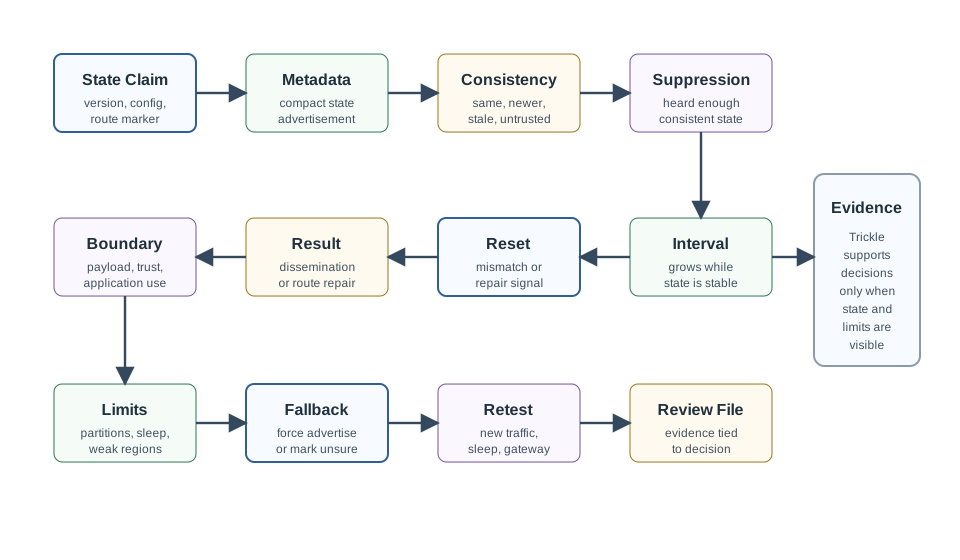
- A node announces a compact version or route-state summary only when that announcement is likely to add useful information.
- When nearby nodes already agree, it can stay quiet.
- When it hears a different version, route state, or repair signal, it returns to a short interval so the new information can spread.
Major section
Evidence Map
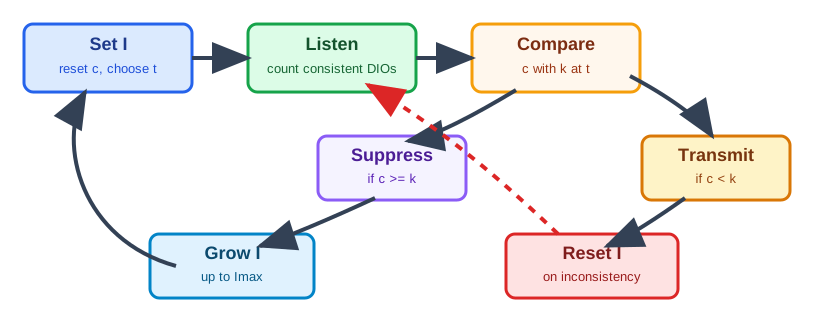
In the worked k = 1 case, hearing one consistent message gives c = 1, so a node suppresses at its own turn.
- When consistency holds through the interval, the next shown interval grows from I to 2I; a mismatch, repair event, policy change, or operator action returns the node to a short interval.
- Trickle can help distribute compact evidence that something changed.
Major section
What Trickle Can and Cannot Prove
RPL DIO behavior: Trickle can control how often RPL route information is advertised.
- Version or route metadata: Metadata can show that a neighbor advertises a version, rank, DODAG state, or configuration marker.
- Interval growth: Longer intervals can show stable local agreement.
- Low steady chatter: Quiet periods can be healthy when the network is consistent.
Major section
Evidence Record
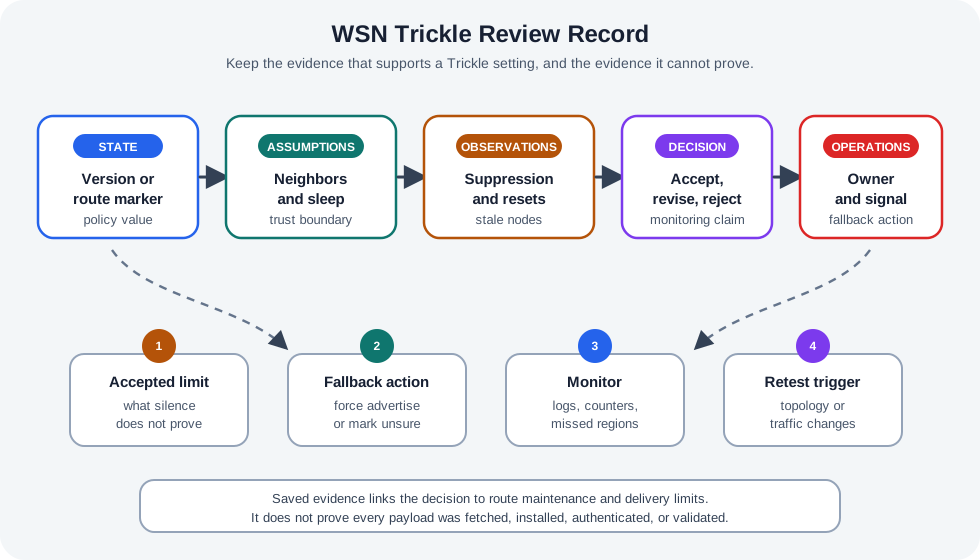
Their relationship shows which part of the claim still needs evidence.
- The next checkpoint, policy value, adds a distinct review condition, while: ASSUMPTIONS adds a distinct review condition.
- Together those labels show that wSN Trickle review record connecting state, assumptions, observations, decision, operations, accepted limits, fallback action, monitor signal, retest trigger, and saved evidence.
Major section
Reviewing Consistency and Suppression
Suppression is useful only when silence still leaves the network observable.
- A short timeline makes the counter-and-threshold mechanics concrete before the parameter table below turns them into review fields.
- Second interval: The interval doubles in length (no inconsistency reset the timer, so the interval grows), and this time node 2 transmits.
- Trickle parameters are review promises.
Major section
Reviewing Consistency and Suppression (continued)
The pattern is suppression: the first node to reach its scheduled transmit time can speak, and neighbors that heard it stay quiet when k = 1.
- Each node resets its counter and chooses a fresh random transmit time in each interval, so the same node may speak again; Trickle does not enforce turn-taking.
- The next Worked Timeline: Three Neighbors, Threshold k = 1 step depends on the relationship behind Worked Timeline: Three Neighbors, Threshold k = 1.
- In the first interval node 1 transmits; nodes 2 and 3 hear one consistent message and suppress their own turns.
- The result depends on mutual hearing.
Major section
Reviewing Consistency and Suppression (continued)
If node 3 misses node 1, its count may stay zero and it may transmit, so the deployment needs reception evidence rather than assuming the drawing's topology.
- The timeline above only works because all three nodes are mutual neighbors -- each one's transmission is heard by both others.
- If node 3 cannot hear node 1, its counter may remain zero and it can transmit at its own scheduled time.
- The review must then check whether the nodes that depend on node 3 actually hear it; silence or a transmission alone does not prove delivery to a weak area.
Major section
Interval Growth and Resets
Trickle tuning is a risk decision.
- Short intervals make changes more visible but add channel pressure.
- The node sets interval I, resets its consistency count, and chooses a transmit time.
- At the chosen time it transmits when the count is below k and suppresses when it reaches k.
Major section
Interval Growth and Resets (continued)
Long intervals reduce routine announcements but can leave stale or partitioned state visible later.
- Those steps make minimum and maximum intervals review promises: a short reset can add channel load, while a long quiet interval can delay visible state.
- The reviewer should reject settings that are justified only by formula examples.
- The accepted record must show the monitored workload, topology, link quality, reset cause, and fallback behavior.
Major section
Payload, Security, Route Limits
Firmware or configuration update: Trickle may announce that a new version exists.
- The review still needs evidence for payload download, chunk recovery, authentication, installation, rollback, and post-update health.
- RPL route maintenance: Trickle may pace DIO advertisements.
- The review still needs parent-change evidence, rank behavior, loop checks, link-quality evidence, and repair outcomes.
Major section
Worked Review: RPL Route Maintenance
Scenario: A low-power mesh uses RPL, and DIO advertisements are paced by Trickle while nodes occasionally change parents after link degradation.
- Assumptions: Parent changes and local repairs create visible inconsistency, but routine stable periods should not flood the channel.
- Evidence: DIO interval state, reset events after repair, parent-change logs, route traces before and after repair, link-quality evidence, and missed-child visibility.
- The timer loop can show that compact metadata was paced efficiently.
Major section
Common Mistakes
Treating metadata as completion: Hearing a version marker does not prove the payload was fetched, installed, authenticated, or used by the application.
- Ignoring partitions: Long quiet intervals can look healthy while a partition, sleepy group, or weak region remains stale.
- The review needs burst evidence, not only steady-period evidence.
- Security by repetition: Repeated metadata is not a trust decision.
Deck summary
Key takeaways
A silent node may be saving work, not missing data.
- Trickle is a controlled dissemination pattern for low-power wireless networks.
- In the worked k = 1 case, hearing one consistent message gives c = 1, so a node suppresses at its own turn.
- RPL DIO behavior: Trickle can control how often RPL route information is advertised.
- Their relationship shows which part of the claim still needs evidence.
Retrieval practice
Recall check 1 of 5

Packet Pete says: answer from memory, then check your reasoning.
Q1In Trickle dissemination, what causes a node to reset back to its short broadcast interval?
Show answer
Answer: D Trickle resets to a short interval when it hears inconsistency, so new information spreads quickly; consistency lets it stay quiet.
Retrieval practice
Recall check 2 of 5

Packet Pete says: answer from memory, then check your reasoning.
Q2Nodes advertise a new firmware version through Trickle. Which conclusion is justified by that advertisement alone?
Show answer
Answer: C The advertisement establishes only that neighbors announced the version marker.
Retrieval practice
Recall check 3 of 5

Packet Pete says: answer from memory, then check your reasoning.
Q3A WSN review says Trickle is working because most nodes stayed silent during a stable period. What evidence is still needed before accepting that claim?
Show answer
Answer: D Trickle review must connect silence, suppression, interval state, and reset behavior to the actual dissemination or route-maintenance claim.
Retrieval practice
Recall check 4 of 5

Packet Pete says: answer from memory, then check your reasoning.
Q4A node hears metadata that conflicts with its current route-maintenance state and resets to a short interval. Why is this not enough evidence that the repair succeeded?
Show answer
Answer: B Trickle reset evidence shows that a mismatch was noticed.
Retrieval practice
Recall check 5 of 5

Packet Pete says: answer from memory, then check your reasoning.
Q5A dense WSN relay hears enough consistent Trickle messages to suppress its own send, but it is the only node that reaches a sleepy corridor. What should the reviewer do?
Show answer
Answer: D Suppression needs coverage evidence.
Print reference
Answers
Answer key.
- D · Trickle resets to a short interval when it hears inconsistency, so new information spreads quickly; consistency lets it stay quiet.
- C · The advertisement establishes only that neighbors announced the version marker.
- D · Trickle review must connect silence, suppression, interval state, and reset behavior to the actual dissemination or route-maintenance claim.
- B · Trickle reset evidence shows that a mismatch was noticed.
- D · Suppression needs coverage evidence.