Wireless Sensor Networks · Study deck

Link Quality and Route Repair

Imagine three sensors sending an alarm to one sink.

Packet Pete is your guide for this deck.

routing-link-qualitylink-estimationroute-traces
iotclass.org

After studying this chapter

Learning objectives

You will be able to:

  • explain why hop count and signal strength alone are weak routing evidence in WSNs
  • distinguish delivery evidence, reverse acknowledgment evidence, signal indicators, and route-state evidence
  • use ETX, MIN-T, WMEWMA, RSSI, LQI, and probe results as bounded review inputs
  • review link-quality route traces for stale state, relay pressure, repair behavior, and missing-data visibility
iotclass.org

Major section

Start With the Field Story

Received signal strength is a radio reading that hints at received power.

  • A strong reading from one moment may hide motion, noise, or a weak return path.
  • Under the Hood explains estimators, moving signals, reverse links, and cost updates.
  • Those details can improve the route choice.
  • A packet leaves the source.
Matched RSSI axes compare a stable stationary link with a moving link that suffers rapid fades and recoveries.
iotclass.org

Major section

Start With the Field Story (continued)

Link-quality review starts with delivery evidence, reverse acknowledgments, sample age, traffic type, and repair behavior so hop count does not hide an unreliable path.

  • They do not make a fresh signal sample proof of future delivery.
  • A retry shows extra work.
  • A relay may carry too much.
  • Route state can grow old.
A worked graph with sink S, candidates A, B, C, D, E, and edge costs, showing D's routing table choosing the cheaper two-hop path through A over the direct, costlier link through B.
iotclass.org

Major section

Link Quality Review Scope · Evidence Map
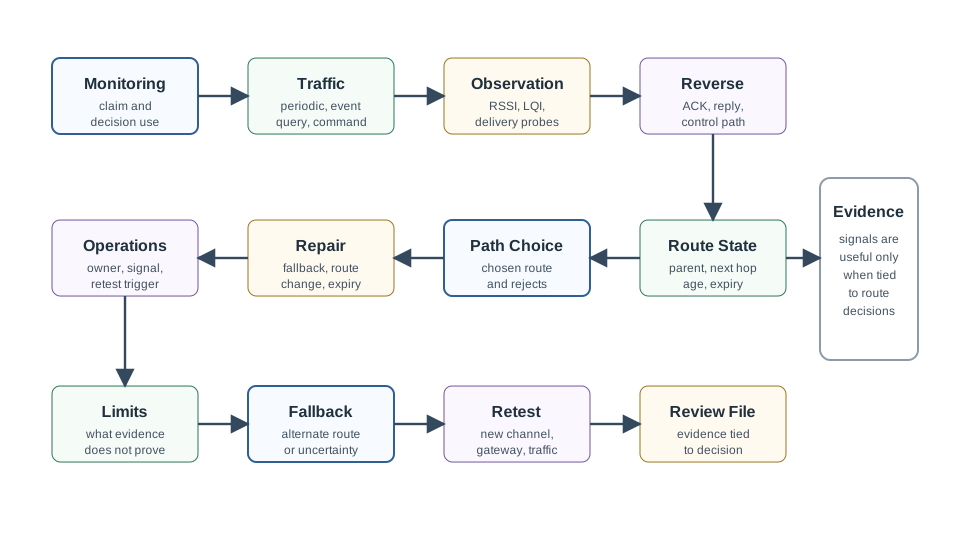
Link quality review starts with the application decision, not with a metric formula.

  • The Evidence Map claim needs a visual check.
  • The ledger uses forward and reverse delivery together; the relay path totals 2.22 expected transmissions against 2.60 for the direct link.
  • In the WSN routing link quality evidence map connecting monitoring claim, traffic, link observation, reverse evidence, route state, path choice, repair evidence, and operations review diagram, Monitoring sits with claim and to clarify the sequence behind Evidence Map.
  • Hop count alone would select the direct route, while this delivery evidence favors the relay.

Why it matters

The choice still needs repair and fallback evidence, because a measured link can age or fail.

WSN routing link quality evidence map connecting monitoring claim, traffic, link observation, reverse evidence, route state, path choice, repair evidence, and operations review.
iotclass.org

Major section

Measurement Proof Limits · Evidence Record
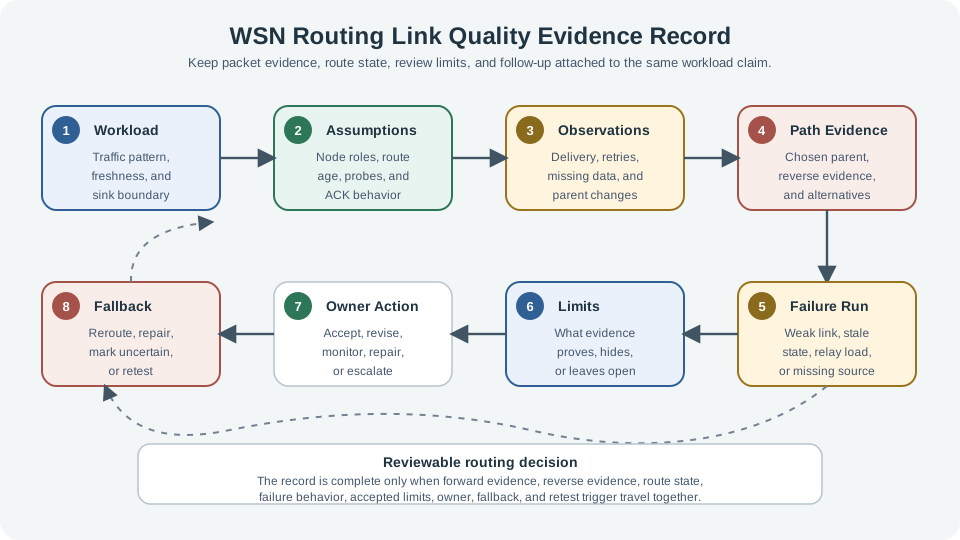
RSSI: Signal strength can indicate whether a received packet arrived strongly or weakly.

  • LQI and radio indicators: Hardware indicators can help detect link health, but their meaning depends on radio, firmware, channel, and environment.
  • ETX or MIN-T: Expected-transmission style metrics help compare links and paths when forward and reverse delivery evidence is current and representative.
  • It must be reviewed with missing-data, freshness, relay-pressure, and repair evidence.

Why it matters

WMEWMA-style estimation: Blending recent delivery evidence with longer-term smoothing can reduce noise, but the window, decay, and expiry rules must be visible.

Worked WSN link-quality comparison selects route D-to-A-to-S by lower named cost, then shows how bidirectional delivery and retry burden can make a reliable three-hop path outperform a directer two-hop path.
iotclass.org

Major section

Reviewing Hop Count Against Link Quality · Reverse Links and ACKs
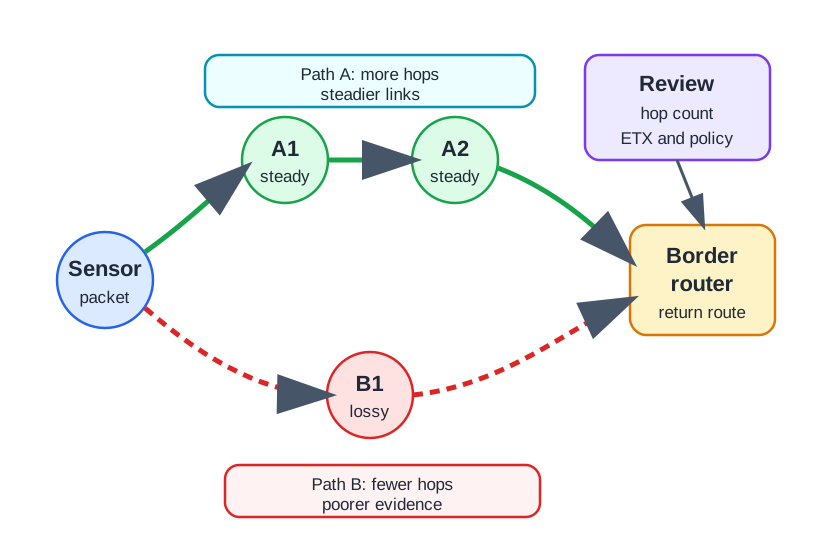
Hop count is a topology clue, not a routing acceptance test.

  • A path with fewer hops can be worse when a link is lossy, asymmetric, stale, overloaded, or hard to repair.
  • A path with more hops can be better when each hop has current delivery evidence, reverse evidence, and repair visibility.
  • Path A has more hops but steadier links; Path B has fewer hops and a lossy link.

Why it matters

The return route is shown because acknowledgements and control traffic must work in the reverse direction.

Routing metric comparison where Path A uses more hops with steadier links, Path B uses fewer hops with poorer evidence, and the border-router review checks hop count, ETX, policy, and return route.
iotclass.org

Major section

Reviewing Estimation Windows · Reviewing Path Cost

Link estimation needs a memory of recent behavior, but stale memory can keep bad links in service.

  • The review should make estimator behavior visible without overfitting to one fixed parameter.
  • The empirical line jumps and dips; WMEWMA follows the broad shifts with a lag while damping short-lived changes.
  • The reverse term is not optional bookkeeping.

Key terms

Traffic match
Traffic match Are probes representative of the actual data size, timing, direction, and channel conditions?

Why it matters

The contrast matters because an average calibrated on the stationary trace can stay reassuring long after the mobile link has entered a fade.

A noisy empirical reception-probability trace against a smoothed WMEWMA estimate over 30 minutes: the estimate follows real shifts with a lag while damping short-lived noise.
iotclass.org

Major section

Worked Review: Building Sensor Route · Worked Review: Event Query Route

Evidence: Parent changes, retry evidence, probe age, acknowledgments, missing-source evidence, and relay pressure near the gateway.

  • Retest trigger: Gateway relocation, channel change, new obstruction, firmware change, or repeated parent churn.
  • The response must show which sources matched, which were missing, and whether results were fresh.
  • Decision: Revise if link quality looks acceptable for probes but late responses, missing sources, or stale route state change the decision.
MIN-T compares a lossy two-hop route with a reliable three-hop route using forward and reverse delivery probabilities on every link.
iotclass.org

Major section

Common Mistakes · Review Checklist

Stale estimates: Old probe history can keep a failing route alive after topology, traffic, channel, or interference changes.

  • Signal strength as proof: RSSI or a hardware indicator can support review, but it does not replace delivery, reverse, freshness, and repair evidence.
  • No retest trigger: Link quality is environmental.
  • The record should say what change invalidates the route evidence.
iotclass.org

Major section

Summary · Key Takeaway

WSN routing link quality is a review discipline, not a single number.

  • Strong review connects signal indicators, delivery evidence, reverse acknowledgments, route-state age, relay pressure, freshness, repair behavior, and operations ownership.
  • Metrics such as ETX, MIN-T, and WMEWMA are useful only when their assumptions and limits are visible.
  • WSN Routing Link Quality Review should balance path reliability, link quality, energy cost, latency, aggregation, topology change, control overhead, and deployment evidence.
iotclass.org

Deck summary

Key takeaways

Received signal strength is a radio reading that hints at received power.

  • Link-quality review starts with delivery evidence, reverse acknowledgments, sample age, traffic type, and repair behavior so hop count does not hide an unreliable path.
  • Link quality review starts with the application decision, not with a metric formula.
  • RSSI: Signal strength can indicate whether a received packet arrived strongly or weakly.
  • Hop count is a topology clue, not a routing acceptance test.
iotclass.org

Retrieval practice

Recall check 1 of 4

Packet Pete says: answer from memory, then check your reasoning.

Q1Why can a WSN route with the fewest hops still be a poor choice?

ABecause fewer hops always guarantee minimum delivery latency.
BBecause long weak links can cause retries, loss and energy drain.
CBecause hop count already includes measured link quality.
DBecause low-power radio standards reject shorter routes.
Show answer

Answer: B Fewest-hop routes can rely on weak long links whose retries hurt delivery and energy, so link quality matters.

iotclass.org

Retrieval practice

Recall check 2 of 4

Packet Pete says: answer from memory, then check your reasoning.

Q2A team chooses a WSN route because it has the fewest hops and strong RSSI during one setup test. What should the reviewer ask for before accepting the route?

AOnly the setup RSSI and hop count, because a strong first sample proves the path.
BBidirectional delivery, retries, route age, relay pressure, freshness, limits, owner, and fallback.
COnly the exact radio distance, without delivery, reverse acknowledgments, repair, or relay evidence.
DChoose a different protocol name because a newer routing label establishes better workload delivery.
Show answer

Answer: B A link-quality route is accepted only when the evidence record covers delivery, reverse behavior, route state, relay pressure, repair, limits, and operations ownership.

iotclass.org

Retrieval practice

Recall check 3 of 4

Packet Pete says: answer from memory, then check your reasoning.

Q3A route shows good forward data delivery, but acknowledgments and route replies often fail. Why is this a link-quality problem?

ABecause reverse traffic never matters when sensors mainly send data upward.
BBecause reverse failures can break ACKs, replies, repair, and freshness while data arrives.
CBecause the shortest path always fixes reverse replies and acknowledgments.
DBecause RSSI alone can repair missing acknowledgments and route replies.
Show answer

Answer: B Forward delivery and reverse acknowledgment behavior can differ.

iotclass.org

Retrieval practice

Recall check 4 of 4

Packet Pete says: answer from memory, then check your reasoning.

Q4How should reviewers choose between these two parent routes?

APrefer A because fewer hops always reduce radio work
BPrefer B unless a workload limit makes the extra hop unacceptable
CUse RSSI only because ACK records are protocol noise
DAccept both without retest because similar RSSI makes them equivalent
Show answer

Answer: B Link-quality review accepts the route whose current evidence supports the workload and repair behavior, not the route with the fewest hops or the strongest single signal.

iotclass.org

Print reference

Answers

Answer key.

  1. B · Fewest-hop routes can rely on weak long links whose retries hurt delivery and energy, so link quality matters.
  2. B · A link-quality route is accepted only when the evidence record covers delivery, reverse behavior, route state, relay pressure, repair, limits, and operations ownership.
  3. B · Forward delivery and reverse acknowledgment behavior can differ.
  4. B · Link-quality review accepts the route whose current evidence supports the workload and repair behavior, not the route with the fewest hops or the strongest single signal.
iotclass.org
