Wireless Sensor Networks · Study deck
WSN Directed Diffusion Routing
Trace one complete request.
Packet Pete is your guide for this deck.
After studying this chapter
Learning objectives
You will be able to:
- Explain: Matching rule: The source must show why its data matches the interest and whether stale, partial, or low-quality data should still respond.
- Explain: A node may hear the same interest from several neighbors and keep candidate gradients while exploratory data proves which route should be reinforced.
- Explain: Duplicate suppression: Duplicate interests and duplicate data should be controlled, but not in a way that hides source diversity or multiple valid alarms.
- Explain: Over-suppressing duplicates: Duplicate control is useful, but it must not hide multiple valid sources, alarms, or source diversity that the sink needs.
Major section
Start With the Field Story
A base station wants reports only from an area where smoke may be rising.
- An interest is a request for named data from a place and time.
- That memory gives possible directions back.
- These directions are called gradients.
- A source that matches the interest can send data along them.
Major section
Start With the Field Story (continued)
Under the Hood examines gradient state, reinforcement, duplicate data, and the costs hidden by the simple request-and-return story.
- At first, several paths may carry reports.
- The base station can strengthen the path that works well.
- This step is reinforcement.
- Other paths may remain as choices or fade away.
Major section
In 60 Seconds
Directed Diffusion is a data-centric WSN routing pattern.
- A sink expresses an interest, nodes record gradients back toward the interest source, matching sensors send data along those gradients, and the sink can reinforce the path or paths that best satisfy the application evidence.
- The important review question is not whether Directed Diffusion sounds efficient.
- The question is whether the interest, gradient state, matching rule, reinforcement rule, aggregation boundary, expiry, duplicate handling, and monitoring evidence are explicit.
Major section
What Directed Diffusion Means
It may include rate, expiry, quality, and duplicate policy.
- Directed Diffusion routes by the requested data attributes rather than by a permanent destination address for each sensor.
- The sink asks a question, the network sets up reverse direction state, and matching data flows back.
- The match rule must be explicit enough to avoid false or stale responses.
Major section
Interest and Gradient Flow
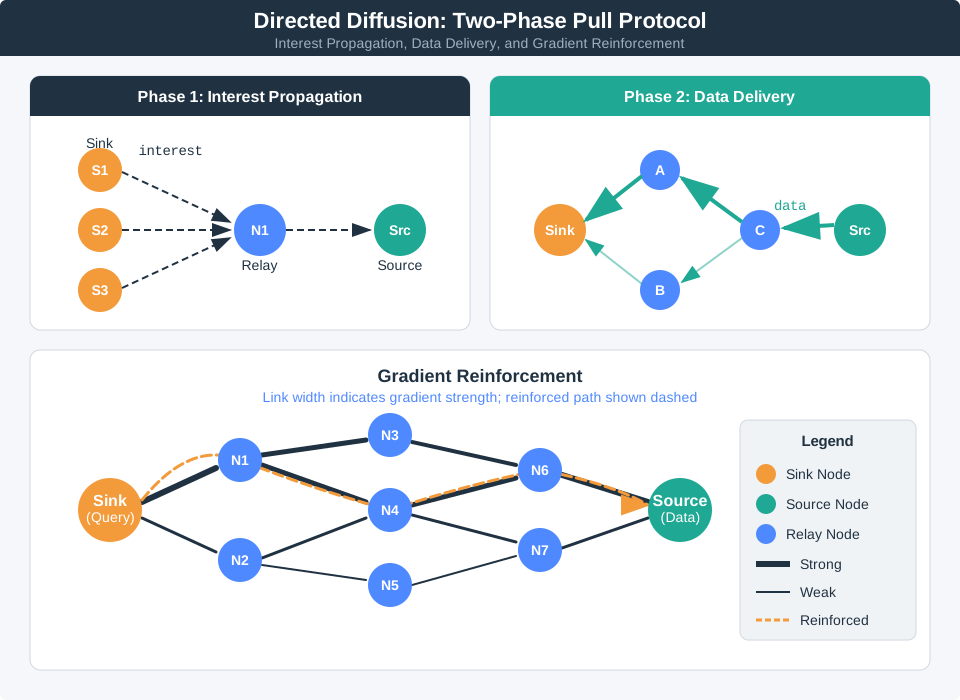
Matching sources then return exploratory reports along those gradients.
- After comparing path evidence, the sink may reinforce a useful path, rate, or source; other paths may remain or fade.
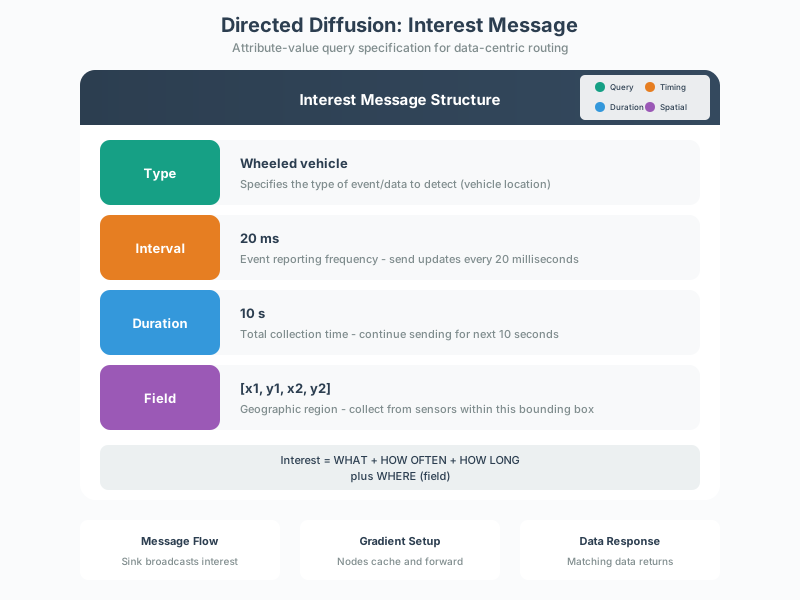
- The example interest includes a type, interval, duration, and field, showing why scope and expiry matter.
- The sink compares the evidence and may reinforce one path, multiple paths, a rate, or an expiry rule.
Major section
Interest Evidence
Those fields decide which nodes may match, which relays may forward, and when stale route state must disappear.
- An interest should be specific enough to route useful data and bounded enough to avoid stale or excessive route state.
- Matching data travels along those gradients, where useful paths can be reinforced.
- A well-written interest also defines the silence case.
Major section
Scope, Push Variants, and Limits
The first cost to control is interest flooding.
- Geographic scope, source class, event type, duration, and refresh rate should narrow which nodes carry the request.
- Directed Diffusion examples are often taught as clean protocol sketches.
- A deployable review must add the field evidence those sketches can hide: link stability, link load, parent changes, duty-cycle rendezvous, and whether forwarding nodes are actually awake when the interest or data arrives.
Major section
Gradient State Evidence
Gradient state is the local memory that makes Directed Diffusion work.
- It must be bounded, inspectable, and repairable.
- Direction: Which neighbor forwarded the interest and therefore appears to be a route back toward the sink.
- Expiry: When the gradient should be removed if the interest is not refreshed, reinforced, or still relevant.
- Gradient state is not free.
Major section
Gradient State Evidence (continued)
If the review cannot explain how it expires, repairs, and avoids duplicates, the design is not ready for acceptance.
- A node may hear the same interest from several neighbors and keep candidate gradients while exploratory data proves which route should be reinforced.
- The ledger gives support staff a debug handle.
- Neither choice is automatically correct.
Major section
Exploratory Data and Reinforcement
Exploratory data helps the sink compare paths before selecting reinforced behavior.
- Reinforcement should be based on measured evidence, not on the first packet that arrives.
- Retest condition: Re-evaluate reinforcement after source movement, sink movement, firmware changes, sampling changes, link changes, or site changes.
- Without that evidence, reinforcement becomes a hidden preference.
Major section
Data, Aggregation, Duplicates
Matching rule: The source must show why its data matches the interest and whether stale, partial, or low-quality data should still respond.
- Aggregation boundary: A relay may combine matching data only when completeness, freshness, missing-member evidence, and outlier behavior remain visible.
- Duplicate suppression: Duplicate interests and duplicate data should be controlled, but not in a way that hides source diversity or multiple valid alarms.
- The review must tie the data behavior to the interest.
Major section
Directed Diffusion Evidence Record
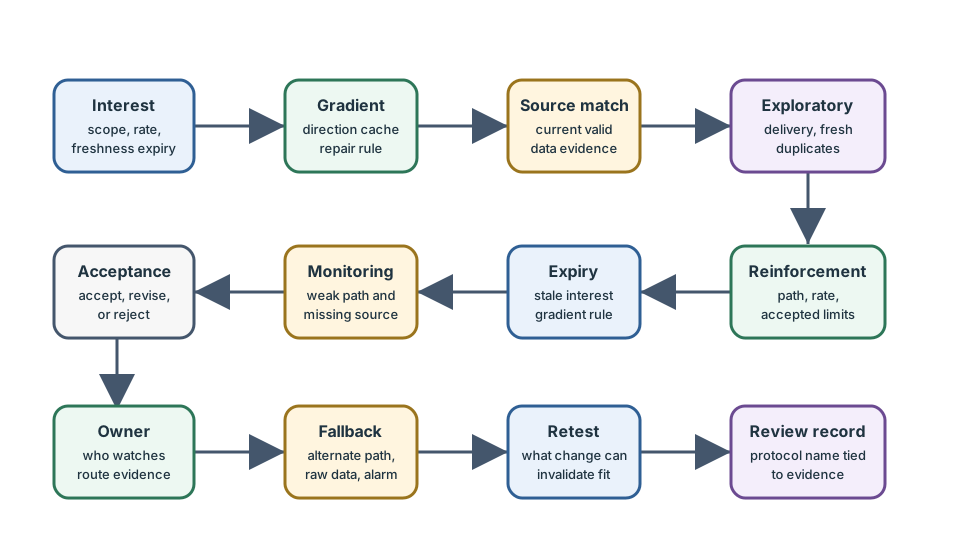
Gradient state keeps direction, cache, duplicate policy, and repair behavior.
- Source match shows which nodes qualify.
- It also checks whether their data is current.
- Early reports show delivery, freshness, duplicate traffic, relay pressure, and source visibility.
Major section
Common Mistakes
Treating Directed Diffusion as magic: The protocol name does not prove efficiency, reliability, or fit.
- The interest and gradient evidence must be reviewed.
- Unbounded interests: Interests without scope, duration, expiry, duplicate policy, or refresh behavior can become persistent control traffic.
- Reinforcing the first packet: The first arrival may not be the best route.
Major section
Common Mistakes (continued)
Stale gradients: Gradient state that does not expire or repair can keep forwarding data toward a weak path or old sink condition.
- Reinforcement should use delivery, freshness, reliability, relay pressure, and data meaning.
- Over-suppressing duplicates: Duplicate control is useful, but it must not hide multiple valid sources, alarms, or source diversity that the sink needs.
- Hiding data with aggregation: Aggregation must preserve the interest's decision evidence: missing members, freshness, outliers, quality, and source coverage.
Major section
Concept Relationships
Protocol classification: Directed Diffusion is a data-centric family example, not a universal answer.
- Data aggregation: In-network aggregation can help only when it preserves the interest's decision evidence.
- Routing challenges: Gradients and reinforcement must still expose relay pressure, weak links, stale state, and missing sources.
- Link quality: Reinforcement should consider measured delivery, retries, parent changes, and route stability.
Deck summary
Key takeaways
A base station wants reports only from an area where smoke may be rising.
- Under the Hood examines gradient state, reinforcement, duplicate data, and the costs hidden by the simple request-and-return story.
- Directed Diffusion is a data-centric WSN routing pattern.
- It may include rate, expiry, quality, and duplicate policy.
- Matching sources then return exploratory reports along those gradients.
Retrieval practice
Recall check 1 of 4

Packet Pete says: answer from memory, then check your reasoning.
Q1In Directed Diffusion, after exploratory data reveals which paths perform best, what does the sink do next?
Show answer
Answer: C The sink reinforces the best-performing gradient so subsequent data follows that path.
Retrieval practice
Recall check 2 of 4
Packet Pete says: answer from memory, then check your reasoning.
Q2In Directed Diffusion, what does a gradient primarily represent?
Show answer
Answer: D Gradients are local reverse-path records created when interests propagate through the network.
Retrieval practice
Recall check 3 of 4
Packet Pete says: answer from memory, then check your reasoning.
Q3A sink receives one early response to an interest and immediately reinforces that path. What should the reviewer ask for before accepting the decision?
Show answer
Answer: C Reinforcement should follow exploratory evidence, not a single uncontrolled arrival.
Retrieval practice
Recall check 4 of 4
Packet Pete says: answer from memory, then check your reasoning.
Q4A Directed Diffusion sink reinforces the first path that returns data, but the record has no duplicate count, freshness evidence, source visibility, or relay-pressure comparison. What is the reviewer's best response?
Show answer
Answer: D Directed Diffusion reinforcement should be accepted only after exploratory evidence compares gradients and records the conditions that can downgrade or expire the chosen path.
Print reference
Answers
Answer key.
- C · The sink reinforces the best-performing gradient so subsequent data follows that path.
- D · Gradients are local reverse-path records created when interests propagate through the network.
- C · Reinforcement should follow exploratory evidence, not a single uncontrolled arrival.
- D · Directed Diffusion reinforcement should be accepted only after exploratory evidence compares gradients and records the conditions that can downgrade or expire the chosen path.