Wireless Sensor Networks · Study deck
In-Network Data Aggregation
Picture ten field sensors that report soil moisture to one pump.
Packet Pete is your guide for this deck.
After studying this chapter
Learning objectives
You will be able to:
- Explain: Reviewers should choose the function from the decision, record the aggregation boundary, expose completeness and freshness, preserve alarms and outliers, monitor relay or cluster roles, validate with raw samples, and define retest triggers.
- Explain: A defensible rule keeps the urgent alert on an exception path, uses the collective decision only for the routine group, records eligible and missing contributors, and explains any weighting.
- Explain: A maximum or threshold list keeps alarm evidence; a count answers a membership question; and a histogram or top-k result preserves more of the spread and outliers.
Major section
Start With the Field Story · In 60 Seconds
Sending every reading keeps detail but uses more radio time.
- Sending one local average saves messages but may hide a dry corner.
- One dead sensor, one extreme value, or one late reading can change an average.
- This ten-sensor story cannot choose the best summary for every network.
Major section
What Data Aggregation Means · Aggregation Is a Claim About a Set
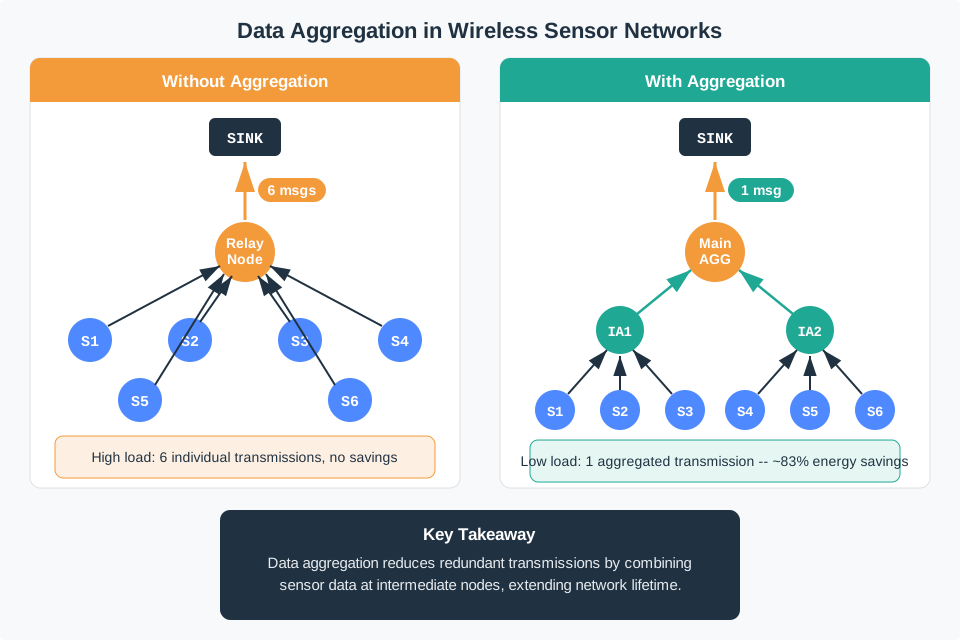
An aggregate is not just a smaller packet.
- Aggregation changes the data that travels through the route.
- A node may combine nearby readings, suppress duplicates, forward only extremes, count events, compress a distribution, or report a summary instead of raw samples.
- A useful aggregate carries four labels.
Major section
Aggregation Function Fit · Function Review Guide
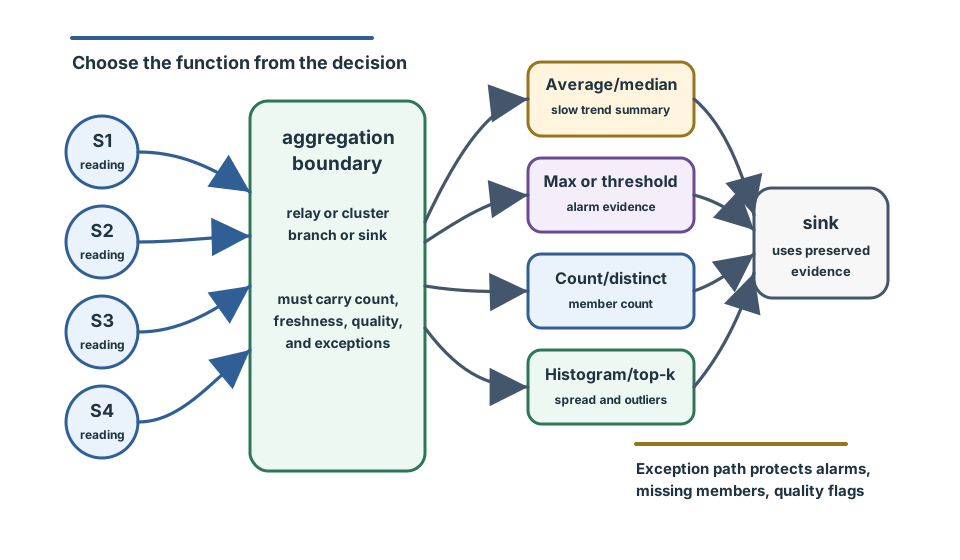
A maximum or threshold list keeps alarm evidence; a count answers a membership question; and a histogram or top-k result preserves more of the spread and outliers.
- Whichever branch is selected, the summary must also carry count, freshness, quality, and exceptions.
- The same raw readings can support different decisions.
- Function choice is an evidence decision.
Major section
Fair Aggregation Is More Than Majority Rule
When nodes contribute decisions rather than interchangeable measurements, aggregation also needs a fairness contract.
- A practical design can form temporary groups around the decision context instead of treating a cluster head as the opinion owner.
- Each group submits an authenticated decision plus freshness and quality state; the aggregation rule combines eligible inputs, and an exception path preserves high-consequence minority reports.
- Ordinary majority voting could erase the case that needs attention most.
Major section
Fair Aggregation Is More Than Majority Rule (continued)
No rule satisfies every fairness goal in every case, so the application must state the trade-off.
- A mobile collection point may receive several local “stable” decisions and one fresh high-criticality alert.
- A defensible rule keeps the urgent alert on an exception path, uses the collective decision only for the routine group, records eligible and missing contributors, and explains any weighting.
- Fairness here does not mean every packet has identical influence; it means that influence follows a declared, auditable rule tied to the care decision rather than network position.
Major section
Completeness, Freshness, Members · Aggregation Evidence Record
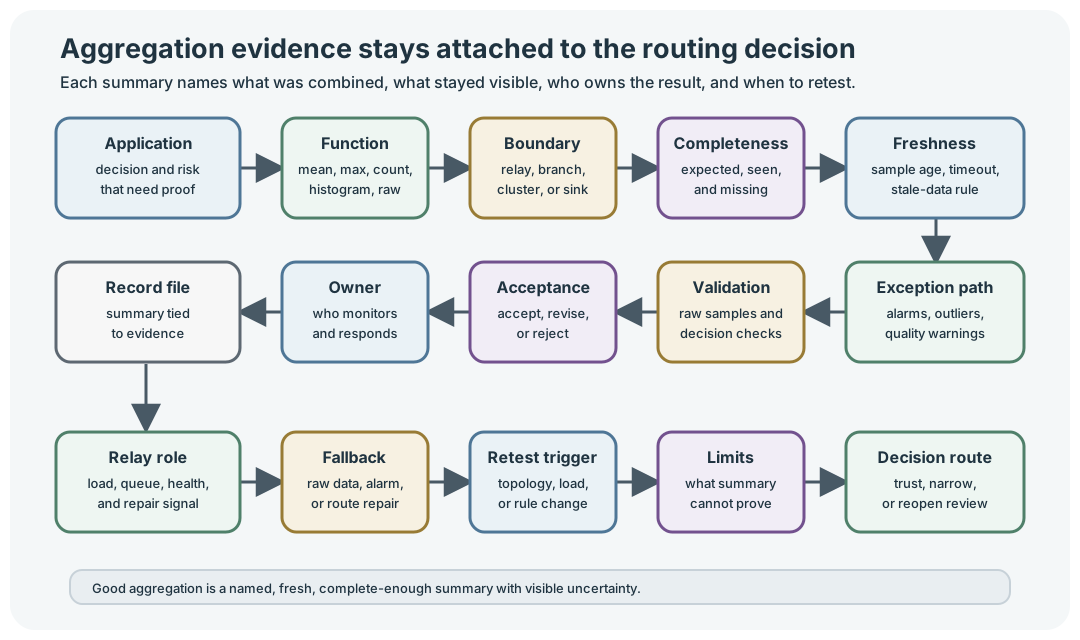
Aggregation is only trustworthy when the sink knows what the summary represents.
- Completeness: An aggregate should carry expected member count, contributing member count, missing-member identity or region, and the rule for accepting partial data.
- Freshness: An aggregate should carry reading age, aggregation time, timeout behavior, and stale-data handling.
- Without these fields, aggregation can turn a sensor failure into an apparently normal average.
- The route may look efficient while the monitoring claim becomes weaker.
Major section
Epoch and Membership Ledger · Where Aggregation Happens
Aggregation usually runs in repeated collection epochs.
- During each epoch, children sample, relay results upward, and the aggregation boundary emits one summary for that window.
- Tree, cluster-head, data-centric, and mobile-collector designs all need this ledger.
- Useful states include complete, partial-accepted, partial-warning, stale, exception-forwarded, rejected, and needs-raw-validation.
Major section
LEACH Cluster Formation and Aggregation · Duplicate Sensitivity and Route Shape
LEACH (Low-Energy Adaptive Clustering Hierarchy) makes the cluster-head boundary concrete.
- A common design target is that about p=0.05 of all nodes become cluster heads in a round.
- During steady state, each member samples and transmits in its slot.
- Rotation prevents the same nodes paying the head cost forever.
Major section
LEACH Threshold Application · Accuracy and Validation
Aggregation accuracy is not only a math property.
- It depends on missing data, link behavior, sensor quality, time alignment, location meaning, and the function being used.
- Retest after change: Sampling interval, gateway placement, routing parent, cluster role, firmware, sensor calibration, or site condition changes can invalidate the aggregate.
- An aggregate is acceptable when it preserves the evidence required by the decision and exposes enough uncertainty for operations to act safely.
Major section
Greenhouse Trend Monitoring · Worked Review: Equipment Heat Alarm
Boundary: Aggregation at a relay or zone head is acceptable only if relay health and missing children are visible.
- Scenario: A greenhouse uses many temperature and humidity sensors to watch slow environmental trends.
- The operator needs zone-level conditions and missing-zone visibility.
- One hot reading can matter even if nearby sensors are normal.
Major section
Common Mistakes · Review Checklist
Aggregating before defining the decision: A traffic-saving summary is not useful if it does not preserve the evidence the sink or operator needs.
- Using average for alarms: Average can hide rare but important events.
- Alarms often need maximum, threshold, top-k, or raw exception forwarding.
- Dropping missing-member evidence: A normal-looking summary from partial data can be worse than no summary if it hides a failed sensor or region.
Major section
Summary · Key Takeaway
WSN data aggregation can make routing more efficient only when it preserves the evidence the application needs.
- Reviewers should choose the function from the decision, record the aggregation boundary, expose completeness and freshness, preserve alarms and outliers, monitor relay or cluster roles, validate with raw samples, and define retest triggers.
- Good aggregation is not just fewer packets; it is a trustworthy summary with visible uncertainty.
- WSN Routing Data Aggregation Review should balance path reliability, link quality, energy cost, latency, aggregation, topology change, control overhead, and deployment evidence.
Major section
Concept Relationships
Routing challenges: Aggregation can reduce traffic but can also hide relay pressure, missing members, stale readings, and weak links.
- Routing introduction: Aggregation changes what travels along the route, so it must stay tied to source, relay, sink, and route-state evidence.
- Protocol classification: Hierarchical, data-centric, and tree-based families often use aggregation, but each family needs different evidence.
- Link quality: Aggregation boundaries should be reviewed with delivery, retry, parent-change, and relay-health evidence.
Deck summary
Key takeaways
Sending every reading keeps detail but uses more radio time.
- An aggregate is not just a smaller packet.
- A maximum or threshold list keeps alarm evidence; a count answers a membership question; and a histogram or top-k result preserves more of the spread and outliers.
- When nodes contribute decisions rather than interchangeable measurements, aggregation also needs a fairness contract.
- No rule satisfies every fairness goal in every case, so the application must state the trade-off.
Retrieval practice
Recall check 1 of 3

Packet Pete says: answer from memory, then check your reasoning.
Q1A gateway averages a zone's temperatures to save radio traffic, but one sensor has stopped reporting. What is the main aggregation review risk?
Show answer
Answer: B In-network aggregation saves traffic but can hide missing members and mask local alarms.
Retrieval practice
Recall check 2 of 3

Packet Pete says: answer from memory, then check your reasoning.
Q2A WSN monitors equipment for overheating. One sensor reporting a high value should trigger inspection even if nearby sensors are normal. Which aggregation choice is safest?
Show answer
Answer: C Aggregation functions must preserve the evidence required by the decision.
Retrieval practice
Recall check 3 of 3

Packet Pete says: answer from memory, then check your reasoning.
Q3A cluster summary reports a normal average, but only some expected members contributed before timeout. What should the reviewer require?
Show answer
Answer: C Aggregation review must expose completeness and freshness.
Print reference
Answers
Answer key.
- B · In-network aggregation saves traffic but can hide missing members and mask local alarms.
- C · Aggregation functions must preserve the evidence required by the decision.
- C · Aggregation review must expose completeness and freshness.
