Wireless Sensor Networks · Study deck
WSN Routing Fundamentals
Picture soil sensors spread across a farm.
Packet Pete is your guide for this deck.
After studying this chapter
Learning objectives
You will be able to:
- define WSN routing in terms of sources, relays, sinks, gateways, paths, and route state
- explain why WSN routing review starts with traffic direction and monitoring evidence
- separate path reachability from link quality, relay pressure, route repair, and aggregation meaning
- describe the evidence a beginner should collect before naming a routing protocol family
Major section
Start With the Field Story
A reading from the far row must cross three battery nodes before it reaches the sink.
- The network planner must deliver useful data without making the same relays carry every packet until their batteries fail.
- A short route is not always the best route, and a formed route does not prove trusted or fresh data.
- This opening does not pick one routing family.
Major section
In 60 Seconds · Phoebe's Field Notes: Why Multi-Hop Beats One Long Hop
WSN routing is the evidence-backed process of moving sensor readings, alerts, queries, and control traffic between source nodes and a sink or gateway.
- The goal is to learn the routing vocabulary and review record before choosing a protocol family.
- A good routing introduction answer should explain what moves, where it moves, which nodes relay it, what state is stored, what can fail, and what evidence proves the path is still acceptable.
- Relay receive, forwarding, and retry energy still have to be added.
Major section
WSN Routing Introduction · What Routing Means in a WSN
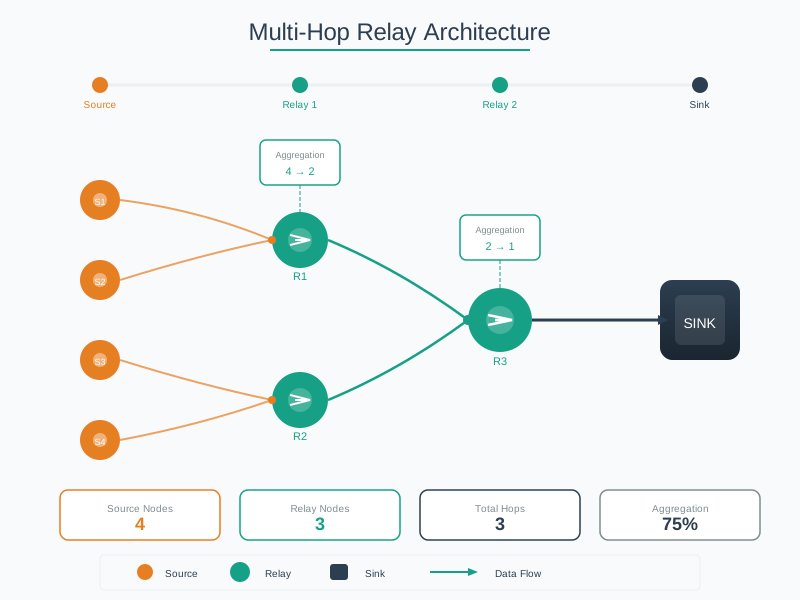
In many WSN deployments, several source nodes report toward one sink, and some nodes forward data for others.
- Relay node: A node that forwards another node's packet.
- Relay work can dominate energy and reliability near sinks, cluster heads, or corridors.
- Sink or gateway: The collection point that receives sensor data or sends queries, commands, schedules, and maintenance traffic.
- A path can be short and still weak if links are lossy or unstable.
Major section
Routing Introduction Scope · Route Anatomy
That load must be visible.
- An introductory routing review should answer six questions before protocol names appear.
- Where must it move?: Most traffic may move toward one sink, but some designs also need local exchange, downlink commands, or multiple gateways.
- Which evidence defines a good link?: RSSI alone is not enough.
Major section
Why WSN Routing Is Different · Scalability and QoS Bounds
Adding nodes expands sensing coverage, but it does not create radio capacity.
- Many-to-one traffic is common: Many nodes may report toward one sink.
- The edge can look quiet while relays near the sink are overloaded or failing.
- Growing to 400 nodes without changing the radio plan gives the estimate.
Major section
Evidence Record
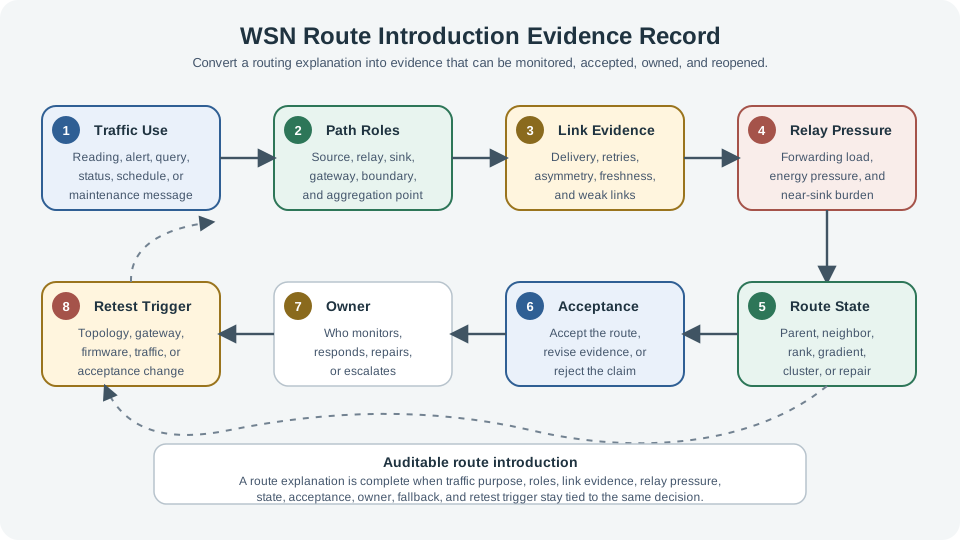
The visual next names: Reading, alert, query, to show where the review identifies the field observation; maintenance message finally assigns operational responsibility.
- They keep evidence record tied to observable evidence.
- At Traffic Use, the Route-state example traces one far-farm sensor reading through three relays and four hops to a sink, then records next hop, hop count, and repair state before choosing a routing protocol diagram adds a distinct review condition.
Major section
Path and Role Evidence · Link Quality and Relay Pressure
A short path with weak links can create repeated retries and repairs.
- Route evidence is strongest when every important role is visible.
- An introductory routing answer should avoid saying "the network is connected" as the final claim.
- A longer path through stable links may be easier to operate.
Major section
Route State and Repair · Aggregation Boundaries
Every routing method stores or infers some state.
- The introductory review should ask what state exists, where it is stored, and what happens when it becomes wrong.
- Parent or next-hop state: A node may remember a preferred relay toward the sink.
- The review should show how that parent was chosen and when it changes.
Major section
Routing Monitoring and Family Fit
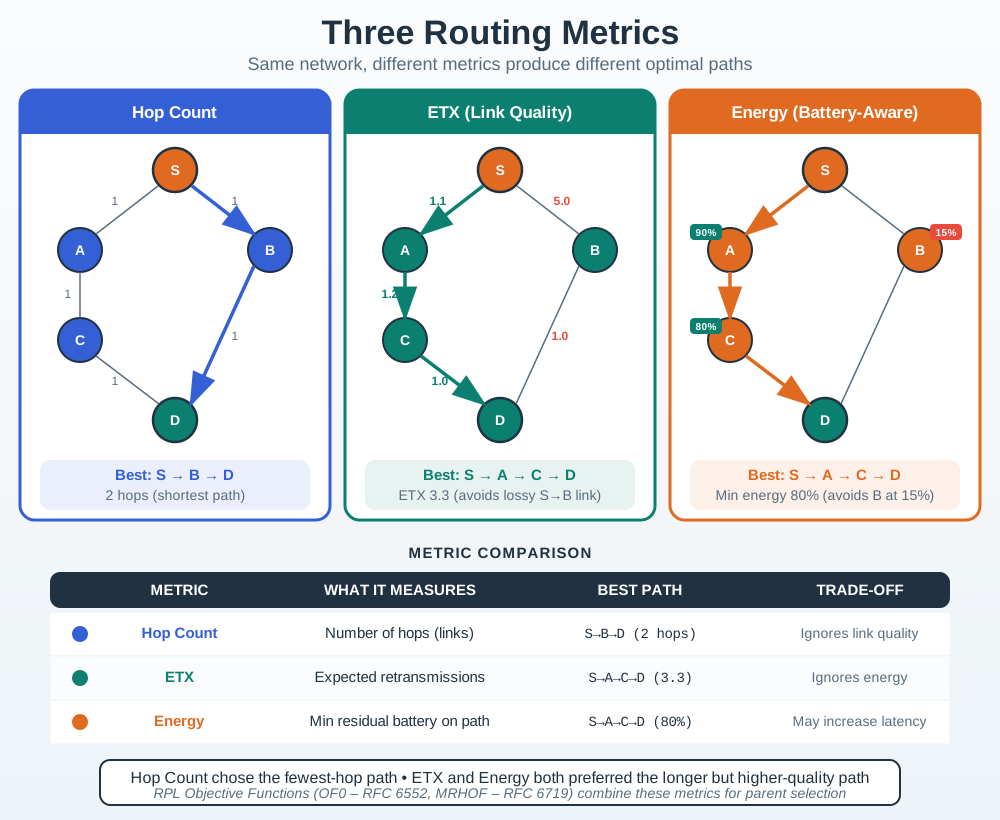
A routing metric is a contract about what the route may optimize and what it may sacrifice.
- Protocol-family names are useful vocabulary only after the route evidence is visible.
- A link-quality metric may spend more energy to avoid lossy hops.
- An energy-aware metric may accept delay or longer paths to protect a critical relay.
Major section
Routing Monitoring and Family Fit (continued)
The energy-aware result protects constrained relays and may accept more hops or delay.
- A beginner review can compare tree or proactive collection, data-centric queries, reactive repair, geographic hints, hierarchical clusters, and dissemination behavior without treating any label as automatic approval.
- Path existence means a packet can traverse the hops.
- Without expiry, stale routes persist.
Major section
Routing Monitoring and Family Fit (continued)
The routing introduction should leave learners with an operations habit: choose routing behavior from the evidence record, monitor the evidence after deployment, and reopen the route decision when the signals drift.
- The ETX result uses expected transmissions, so a longer-looking route can win by avoiding retries.
- Path quality means delivery, retries, repair, and relay load are within accepted limits.
- A route can pass the first test and fail the other two.
Major section
Routing Monitoring and Family Fit (continued)
Two companion rules keep the route from drifting.
- Path meaning means the delivered data is still fresh, attributable, complete enough, and visible to the decision owner.
- Those signals age while routes continue to use them.
- Without hysteresis, tiny measurement noise can cause parent churn, duplicate traffic, routing loops, or repeated repair overhead.
Major section
Worked Review: Building Monitoring · Worked Review: Remote Field Gateway
Scenario: Battery sensors report room temperature and door-state changes to a building gateway.
- Route roles: Some hallway nodes may relay room-node traffic, so their health must be compared with non-relay nodes.
- Evidence needed: Parent changes, retry counts, missing-room visibility, gateway maintenance behavior, and whether local summaries preserve room identity.
- The site has changing moisture, seasonal plant growth, and limited maintenance visits.
Major section
Common Mistakes · Review Checklist
Starting with a protocol name: Directed Diffusion, LEACH, GPSR, RPL, and similar names are useful later.
- They do not replace traffic, role, link, and state evidence.
- A route review must make that load visible.
- Trusting signal strength alone: Signal strength can help diagnosis, but delivery, retries, asymmetry, and route changes are closer to the routing question.
Deck summary
Key takeaways
A reading from the far row must cross three battery nodes before it reaches the sink.
- WSN routing is the evidence-backed process of moving sensor readings, alerts, queries, and control traffic between source nodes and a sink or gateway.
- In many WSN deployments, several source nodes report toward one sink, and some nodes forward data for others.
- That load must be visible.
- Adding nodes expands sensing coverage, but it does not create radio capacity.
Retrieval practice
Recall check 1 of 4

Packet Pete says: answer from memory, then check your reasoning.
Q1Why is WSN routing not simply a shortest-path problem like on a wired network?
Show answer
Answer: C WSN routing weighs relay energy, link quality, and traffic direction, so shortest hop count is not enough.
Retrieval practice
Recall check 2 of 4
Packet Pete says: answer from memory, then check your reasoning.
Q2A WSN route keeps choosing the two-hop path because it has the lowest hop count, but that relay shows rising retries and queue pressure. What should the review require?
Show answer
Answer: B A WSN route metric is evidence-backed only when measurements are current, change thresholds are explicit, and degraded relays trigger repair or fallback.
Retrieval practice
Recall check 3 of 4
Packet Pete says: answer from memory, then check your reasoning.
Q3A team says a WSN route is ready because one test packet reached the gateway. How should reviewers decide whether the route is ready after one packet?
Show answer
Answer: D An introductory WSN routing review turns connectivity into an evidence record: traffic, roles, link quality, route state, monitoring, owner, and retest trigger.
Retrieval practice
Recall check 4 of 4
Packet Pete says: answer from memory, then check your reasoning.
Q4Why can a relay node near a WSN sink be a routing risk even when its own sensor readings look normal?
Show answer
Answer: C Many-to-one traffic can concentrate work near sinks, bridges, or cluster heads.
Print reference
Answers
Answer key.
- C · WSN routing weighs relay energy, link quality, and traffic direction, so shortest hop count is not enough.
- B · A WSN route metric is evidence-backed only when measurements are current, change thresholds are explicit, and degraded relays trigger repair or fallback.
- D · An introductory WSN routing review turns connectivity into an evidence record: traffic, roles, link quality, route state, monitoring, owner, and retest trigger.
- C · Many-to-one traffic can concentrate work near sinks, bridges, or cluster heads.