Wireless Sensor Networks · Study deck
WSN Routing Protocol Classification
Use one short route review.
Packet Pete is your guide for this deck.
After studying this chapter
Learning objectives
You will be able to:
- classify WSN routing approaches by the evidence each family requires
- distinguish data-centric, hierarchical, geographic, reactive, proactive, tree-based, and quality-aware routing fit
- compare protocol-family tradeoffs without relying on brittle lifetime, cost, range, or performance claims
- explain why protocol names such as Directed Diffusion, LEACH, GPSR, AODV, SPEED, and RPL are examples, not automatic answers
Major section
Start With the Field Story
Under the Hood explains control messages, path scores, repair rules, and the cases where neat categories overlap.
- Recheck when movement, load, or node roles change.
- One node reports soil moisture.
- All three need a path to the collection point.
- They do not need the same kind of path.
Major section
In 60 Seconds · WSN Routing Classification Review
WSN routing classification is a decision aid, not a menu of universal answers.
- Data-centric, hierarchical, geographic, reactive, proactive, tree-based, and quality-aware approaches each make different assumptions about traffic, node roles, location knowledge, route state, link quality, aggregation, mobility, reliability, and operations.
- A classification answer should first name the workload and evidence, then choose the family that makes the fewest unsafe assumptions.
- The accepted record should also name why close alternatives were rejected and what would trigger a retest.
Major section
Classification Review Scope
Classification is useful only when it is tied to the application evidence.
- Topology evidence: Static fields, corridors, clusters, mobile collectors, infrastructure-denied areas, and multiple gateways have different route-state needs.
- Node-role evidence: Member nodes, relay nodes, cluster heads, sinks, gateways, mobile collectors, and powered anchors need separate energy and monitoring records.
- Link evidence: Classification must include delivery quality, retries, asymmetry, neighbor stability, measurement age, and route repair cost.
Major section
Classification as an Assumption Contract
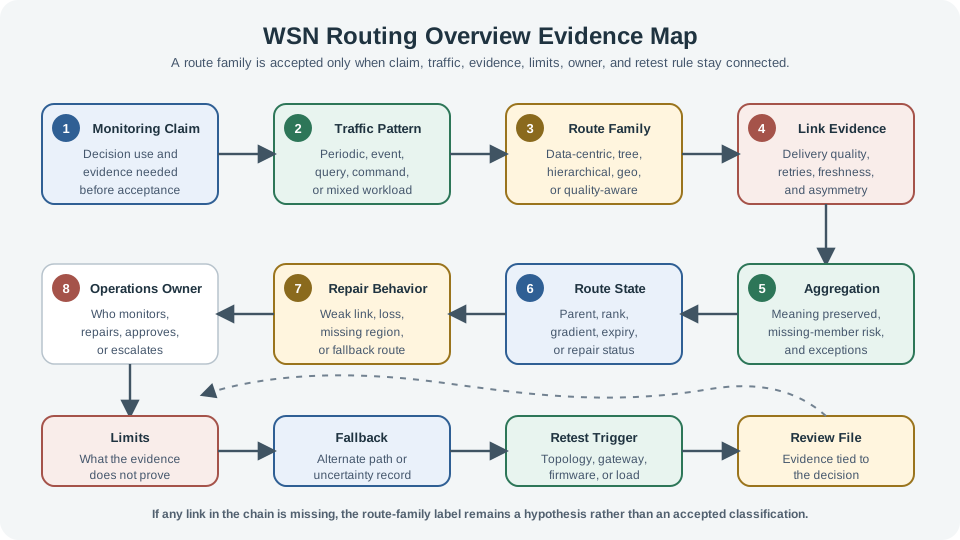
The label should bind a monitoring claim to a traffic pattern, route state, link evidence, repair behavior, and an operations record.
- If any one of those pieces is missing, the label is still a hypothesis rather than an accepted classification.
- Retest when deployment assumptions such as topology, gateway placement, firmware, or mobility change.
- The upper panel follows one soil-moisture report from a source through a relay to the collection point and marks the link evidence that must be measured on each hop.
- The lower panel shows the six pieces that a routing-family label must bind before the classification is accepted.
Major section
Classification as an Assumption Contract (continued)
A useful review separates three statements that are often blurred together.
- The design statement names the family the team intends to use.
- The evidence statement lists the observations that would make that family true for this workload.
- A protocol name may appear in the design statement, but it cannot replace the other two.
Major section
Protocol Families as Evidence Patterns · Family Review Guide
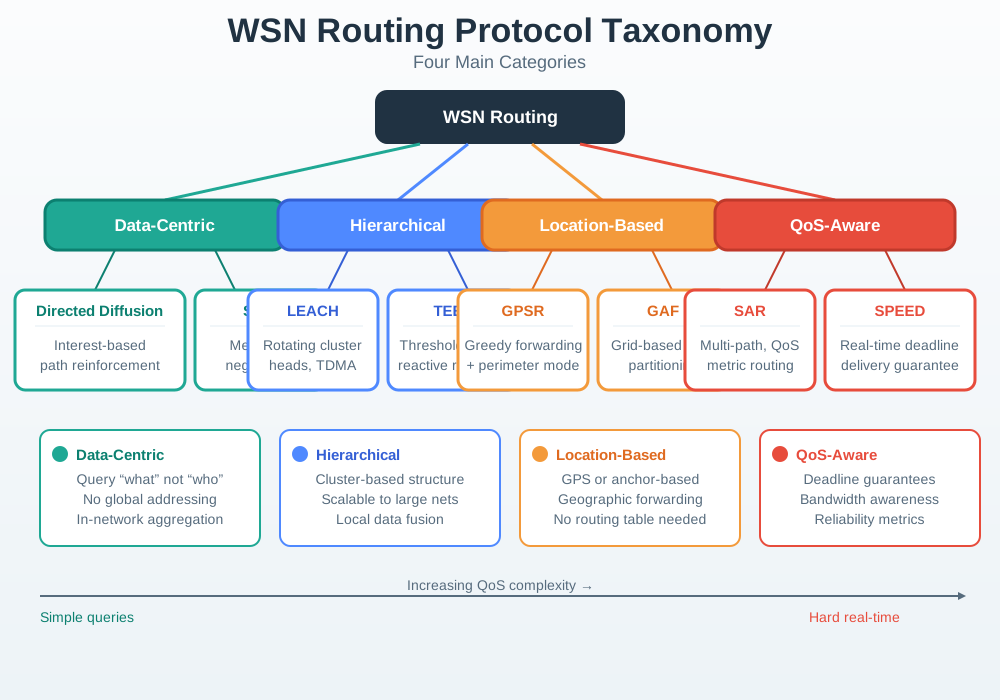
The map sorts families; it does not rank them.
- It uses a query or data name to guide packets, so each node need not have a world-wide address.
- The next group uses cluster roles to join data and cut traffic, but the leaders do more work.
- The family map is not a ranking.
Major section
LEACH-Like Round Review
LEACH is useful as a teaching example because it makes the hierarchical assumptions visible.
- A typical round has a setup phase and a steady-state phase.
- In setup, candidate cluster heads advertise, nearby members choose a cluster, and the cluster head publishes the schedule that members will use.
- A LEACH-like label is not enough by itself.
Major section
Hybrid Family Ledger
Each accepted family needs its own limit, monitor, owner, and retest trigger.
- A quiet environmental network might use a tree for periodic readings, a reactive repair path for temporary outages, and a quality-aware exception route for urgent alarms.
- A cluster head may make energy sense for a room summary, but it can hide which member failed unless the aggregate carries member evidence.
- A cluster summary may reduce upstream traffic but delay a query that needs raw member values.
Major section
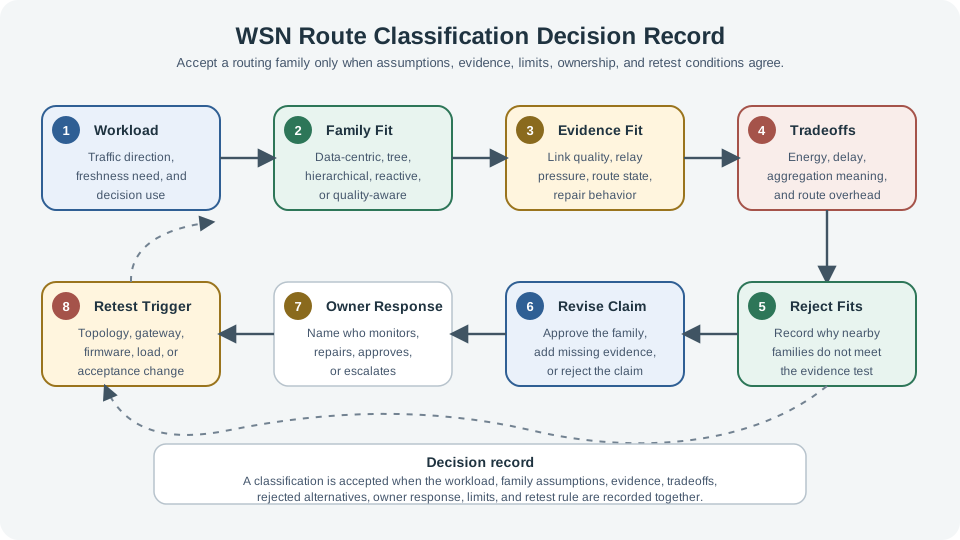
Classification Decision Route
The strip moves from a drawn path, to a comparison grid, to a record that can accept or reject a candidate.
- The first panel states the workload and decision.
- The comparison grid tests route families against link, relay, repair, and monitoring evidence.
- The last panel records rejected alternatives, an owner, and a retest trigger.
Major section
Building Telemetry Classification · Field Event Query Classification
The building has dense walls and occasional gateway maintenance.
- Readings are useful for trend monitoring, not emergency control.
- Evidence needed: Link-quality history, parent changes, retry counts, relay pressure near the gateway, missing-node visibility, and gateway outage behavior.
- The answer is useful only if freshness and duplicate behavior are visible.
Major section
Common Mistakes
Classifying before link review: A family can look correct on paper and still fail if the links, retries, parent changes, or route repairs are not measured.
- Treating names as answers: LEACH, Directed Diffusion, GPSR, AODV, SPEED, and RPL are vocabulary.
- They do not replace workload evidence or route-health review.
- Ignoring family assumptions: Geographic routing needs position evidence.
Major section
Common Mistakes (continued)
Hierarchical routing needs aggregation evidence.
- Reactive routing needs acceptable discovery delay.
- Forgetting operations: A route family that cannot expose missing nodes, weak links, stale routes, gateway loss, or duplicate packets is not ready for acceptance.
- No retest trigger: Topology, gateway placement, firmware, sampling rate, enclosure, mobility, aggregation rule, or reliability requirement changes can invalidate the classification.
Major section
Expiry and Retest Rules · Review Checklist
A sudden rise in parent changes contradicts a stable-tree assumption.
- A classification should expire when the evidence that made it true no longer describes the network.
- One practical implementation is to put an evidence TTL beside every accepted family row.
- Reclassification is a normal maintenance action, not a failure of the original design.
Deck summary
Key takeaways
Under the Hood explains control messages, path scores, repair rules, and the cases where neat categories overlap.
- WSN routing classification is a decision aid, not a menu of universal answers.
- Classification is useful only when it is tied to the application evidence.
- The label should bind a monitoring claim to a traffic pattern, route state, link evidence, repair behavior, and an operations record.
- A useful review separates three statements that are often blurred together.
Retrieval practice
Recall check 1 of 5

Packet Pete says: answer from memory, then check your reasoning.
Q1A field WSN mostly stays quiet and only routes data when an occasional event query arrives. Which routing family fits best?
Show answer
Answer: A Sparse, unpredictable event traffic favors reactive routing that builds routes on demand.
Retrieval practice
Recall check 2 of 5

Packet Pete says: answer from memory, then check your reasoning.
Q2A design names a famous routing protocol before measuring its workload. What should the review do?
Show answer
Answer: D A protocol name is vocabulary until the workload and path evidence support it.
Retrieval practice
Recall check 3 of 5

Packet Pete says: answer from memory, then check your reasoning.
Q3A WSN route review accepts hierarchical routing for room summaries, but a new alarm workflow needs proof of every reporting node within a freshness limit. What should happen to the classification?
Show answer
Answer: B WSN routing classification is conditional.
Retrieval practice
Recall check 4 of 5

Packet Pete says: answer from memory, then check your reasoning.
Q4A WSN gateway asks for readings that match a condition in a region, and only matching sources should respond. Which classification is the best first fit?
Show answer
Answer: C Data-centric routing fits when the sink expresses interest in data attributes, regions, or conditions and matching sources respond.
Retrieval practice
Recall check 5 of 5

Packet Pete says: answer from memory, then check your reasoning.
Q5A team proposes geographic routing for indoor battery sensors, but the review record has no reliable position evidence and no void-handling plan. What should the reviewer do?
Show answer
Answer: D Protocol-family classification is evidence-backed.
Print reference
Answers
Answer key.
- A · Sparse, unpredictable event traffic favors reactive routing that builds routes on demand.
- D · A protocol name is vocabulary until the workload and path evidence support it.
- B · WSN routing classification is conditional.
- C · Data-centric routing fits when the sink expresses interest in data attributes, regions, or conditions and matching sources respond.
- D · Protocol-family classification is evidence-backed.