Wireless Sensor Networks · Study deck

WSN Application Domains

A gateway is the local point that gathers readings and passes them onward.

Packet Pete is your guide for this deck.

application-fitnode-identitychannel-access
iotclass.org

After studying this chapter

Learning objectives

You will be able to:

  • review WSN application fit from sensing goal, event rhythm, placement, gateway path, and operations evidence
  • explain why node identity, time, units, quality state, and location context must survive aggregation and gateway forwarding
  • choose channel-access and collision-control evidence that matches periodic, event-driven, or mixed traffic
  • compare application domains without copying unsupported lifetime, range, cost, or accuracy promises
iotclass.org

Major section

Start With the Field Story

A gateway is the local point that gathers readings and passes them onward.

  • A protocol is a shared set of message rules.
  • Nodes may sleep, collide, lose power, move, or report stale values.
  • Joining readings can hide which place failed.
  • The field story does not prove that one network fits farms, bridges, homes, and clothing.

Check the decision

A field reading is only useful when its place, time, and route to the pump manager remain clear. Which of sleep, collision, lost power, movement, or a stale reading could explain a missing warning, and what would you inspect first?

Why it matters

Saving radio energy can reduce updates.

iotclass.org

Major section

In 60 Seconds

A WSN application is ready for review only when the sensing goal, node identity, channel behavior, gateway meaning, and operating limits all support the same claim.

  • A list of sensors or a protocol name is not enough.
  • The review must show what the network is trying to observe, which node produced each reading, how shared radio access is controlled, what the gateway preserves, and what evidence would make the application acceptable.
  • Application fit is also a scope decision.
iotclass.org

Major section

Application Evidence Map
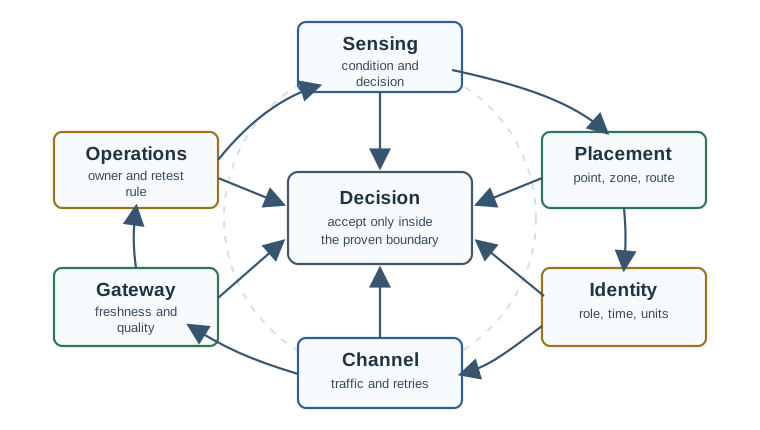
Their relationship shows which part of the claim still needs evidence.

  • The next checkpoint, point, zone, route, fixes the spatial boundary, while: Identity adds a distinct review condition.
WSN field application shows 20 soil sensors across a field sending identifiable readings through a gateway toward a dry-soil warning for a pump manager; the sampling interval remains unspecified.
iotclass.org

Major section

Requirements Shape Behavior

Different applications ask the same WSN building blocks to do different work.

  • Agriculture and greenhouse sensing: Often emphasizes zone meaning, irrigation or climate decisions, seasonal changes, gateway placement, and sensor maintenance.
  • The same application domain can contain several traffic patterns.
  • The channel-access review must handle both rhythms.
iotclass.org

Major section

Delivery, Energy, Routing Evidence

Domain labels do not choose network behavior by themselves.

  • The delivery model does.
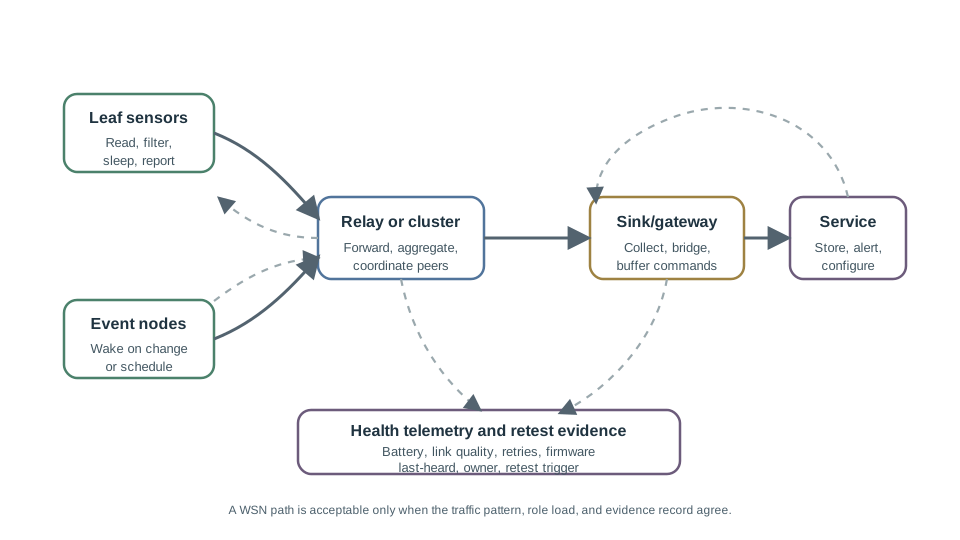
  • A reviewer should state whether the application expects continuous reporting, event-driven alerts, query-driven answers, or a hybrid mix, then check whether energy use, routing state, gateway records, and acceptance limits match that promise.
  • Leaf sensors read, filter, sleep, and report; event nodes wake on change or schedule.
  • A relay or cluster may forward and aggregate their traffic before the sink bridges it to a service that stores, alerts, or configures.
WSN communication pattern map.
iotclass.org

Major section

Question: Event-Driven Energy Tradeoff

Continuous delivery can justify a stable aggregation tree because the setup cost is amortized over many readings.

  • Routing style should be reviewed as a consequence of the delivery model.
  • Event-driven delivery often favours reactive path setup plus fast wake-up because maintaining a permanent tree may waste energy during long quiet periods.
  • Hybrid applications need both routine and exception evidence; a route that is fine for hourly summaries may still be too slow for an alarm.
iotclass.org

Major section

Node Identity Is Application Meaning

Node identity is not only an address used by the radio.

  • Identity that should remain visible node identifier and physical location.
  • dashboards that show a zone value while a node is stale.
  • gateway records that drop units or calibration status.
  • alerts that cannot identify the source node or route context.
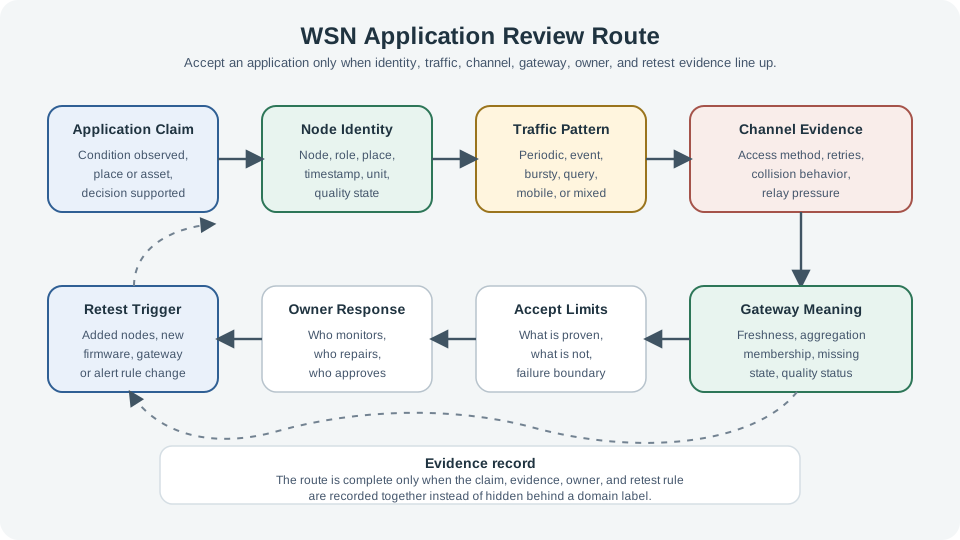
WSN application review route
iotclass.org

Major section

Worked Review: Greenhouse Climate Zones

A greenhouse team wants a WSN to support zone-level climate decisions.

  • The application claim is not "we installed humidity sensors." The claim is that each zone condition can be trusted enough to guide local action.
  • Claim: zone readings can support greenhouse climate decisions without hiding stale, missing, or mislocated sensors.
  • Decision: acceptable only where node identity and missing-node state remain visible after aggregation.
iotclass.org

Major section

Bridge Structural Monitoring

The review must connect physical placement to route and gateway evidence.

  • Claim: structural readings can be associated with asset zones and remain reviewable during a route or relay change.
  • Decision: acceptable only if gateway records show both the measurement meaning and the route-health context.
  • Retest trigger: changed mounting, new gateway location, firmware update, added structural zone, new sampling policy, or maintenance access change.
iotclass.org

Major section

Common Mistakes

Starting with the domain label "Smart city" or "agriculture" does not prove fit.

  • The sensing claim and evidence record must be specific.
  • Treating address size as application readiness: A network can have enough address space and still fail if the gateway mapping, node history, or location context is weak.
  • Ignoring mixed traffic: Routine readings and urgent events may need different channel-access evidence, priority handling, and acceptance limits.

Why it matters

Dropping identity during aggregation: Aggregation can reduce traffic, but it must not hide stale members, missing nodes, units, quality, or source locations.

iotclass.org

Major section

Application Review Checklist

The application claim states the physical condition, decision, user, and acceptance boundary.

  • Node identity, location, role, units, timestamp, quality, and missing-node state remain visible where the application needs them.
  • Placement evidence connects each node to the point, zone, route, barrier, or asset it claims to observe.
  • Aggregation preserves source membership, time window, quality status, and missing-member evidence.

Key terms

Traffic behavior
Traffic behavior is classified as periodic, event-driven, bursty, query-based, mobile-collected, or mixed.
iotclass.org

Deck summary

Key takeaways

A gateway is the local point that gathers readings and passes them onward.

  • A WSN application is ready for review only when the sensing goal, node identity, channel behavior, gateway meaning, and operating limits all support the same claim.
  • Their relationship shows which part of the claim still needs evidence.
  • Different applications ask the same WSN building blocks to do different work.
  • Domain labels do not choose network behavior by themselves.
iotclass.org

Retrieval practice

Recall check 1 of 6

Packet Pete says: answer from memory, then check your reasoning.

Q1A farm pilot met its battery and accuracy goals. What can a bridge project claim from it?

AThe same lifetime and accuracy without bridge measurements.
BThe same network size merely because both sites use sensors.
COnly a reference result; the bridge needs its own limits and tests.
DNo bridge pilot because the radio model remains unchanged.
Show answer

Answer: C Application domains change loads, placement, and the decision supported.

iotclass.org

Retrieval practice

Recall check 2 of 6

Packet Pete says: answer from memory, then check your reasoning.

Q2In reviewing a WSN application, why does node identity matter beyond just being a device address?

AIt detects duplicate messages without identifying measurement meaning.
BIt tells which dashboard user must approve each reading.
CIt lets the cloud bill a device before checking reading quality.
DIt links a reading to the actual source and its application role.
Show answer

Answer: D Node identity gives each reading its application meaning by tying it to a known location and role.

iotclass.org

Retrieval practice

Recall check 3 of 6

Packet Pete says: answer from memory, then check your reasoning.

Q3Why is event-driven delivery energy-efficient but still risky if the sleep policy is too aggressive?

AIt sends more data than continuous reporting when the site is idle.
BIt saves idle traffic, but sleep timing must still catch events.
CIt makes the sink poll every node constantly to detect events.
DIt prevents duty cycling because every radio must remain on.
Show answer

Answer: B Event-driven delivery saves energy by reducing idle traffic, but the sleep and wake policy must still catch the event quickly enough for the application.

iotclass.org

Retrieval practice

Recall check 4 of 6

Packet Pete says: answer from memory, then check your reasoning.

Q4Why does the data-delivery model strongly influence which routing style a WSN application should use?

ABecause all delivery models create identical traffic, so routing style rarely matters.
BBecause routing depends only on radio hardware, not whether traffic is steady, bursty, or on demand.
CBecause query-driven delivery bypasses routing and sends every answer directly to the gateway.
DBecause traffic rhythm selects stable trees, reactive paths, or data-centric routing evidence.
Show answer

Answer: D A WSN routing style should follow the traffic pattern created by the delivery model, otherwise the application may pay energy or latency costs that its evidence record cannot justify.

iotclass.org

Retrieval practice

Recall check 5 of 6

Packet Pete says: answer from memory, then check your reasoning.

Q5A greenhouse dashboard shows a zone average, but the gateway record does not show which nodes contributed, which readings are stale, or whether any node is missing. What is the main review problem?

AThe application is ready because zone averages are easier to read.
BAggregation hid identity and freshness evidence.
CThe network should remove all aggregation and only display raw packets.
DThe node address field alone proves the application claim.
Show answer

Answer: B A WSN application claim depends on the meaning of each reading.

iotclass.org

Retrieval practice

Recall check 6 of 6

Packet Pete says: answer from memory, then check your reasoning.

Q6A bridge WSN sends routine structural summaries but must also report urgent route or sensor anomalies. Which review approach best fits this mixed traffic pattern?

AApprove after one quiet packet reaches the bridge gateway.
BReview routine and urgent traffic separately under expected loads.
CIgnore access because the structural application is known.
DAccept a familiar protocol name without burst or relay tests.
Show answer

Answer: B Application fit includes network behavior.

iotclass.org

Print reference

Answers 1 of 2

Answer key.

  1. C · Application domains change loads, placement, and the decision supported.
  2. D · Node identity gives each reading its application meaning by tying it to a known location and role.
  3. B · Event-driven delivery saves energy by reducing idle traffic, but the sleep and wake policy must still catch the event quickly enough for the application.
  4. D · A WSN routing style should follow the traffic pattern created by the delivery model, otherwise the application may pay energy or latency costs that its evidence record cannot justify.
iotclass.org

Print reference

Answers 2 of 2

Answer key.

  1. B · A WSN application claim depends on the meaning of each reading.
  2. B · Application fit includes network behavior.
iotclass.org