Wireless Sensor Networks · Study deck
WSN and IoT Integration
Picture twenty small weather units spread across a farm.
Packet Pete is your guide for this deck.
After studying this chapter
Learning objectives
You will be able to:
- Explain how a WSN can act as the sensing layer inside a broader IoT system.
- Identify the gateway responsibilities that connect constrained sensor networks to IP, cloud, dashboards, and applications.
- Compare direct replacement, gateway bridge, edge processing, and hybrid integration patterns.
- Review WSN-to-IoT data meaning, identity, freshness, aggregation, command paths, and security boundaries.
Major section
Start With the Field Story
Each unit measures soil or air and passes the reading through nearby units.
- The farmer does not need raw radio messages.
- The farmer needs to know which field is dry and whether the reading is recent enough to guide watering.
- A wireless sensor network, or WSN, is this local group of measuring units and radio links.
Major section
Start With the Field Story (continued)
The Internet of Things, or IoT, adds the wider service that stores, shows, and acts on their facts.
- A gateway is the bridge between the two.
- On the arrow, write the facts that must survive the crossing.
- The service should mark each change and gap.
Major section
In 60 Seconds
A WSN is often the sensing subsystem inside a larger IoT system.
- The integration boundary is usually the gateway.
- That boundary must preserve data meaning, node identity, freshness, quality, security, command safety, and operations ownership.
- A gateway that only forwards packets is not enough if the IoT platform cannot tell which sensor produced the reading, whether it is stale, whether it was aggregated, or who should act when it disappears.
Major section
Relationship Scope
WSN and IoT overlap, but they are not the same design problem.
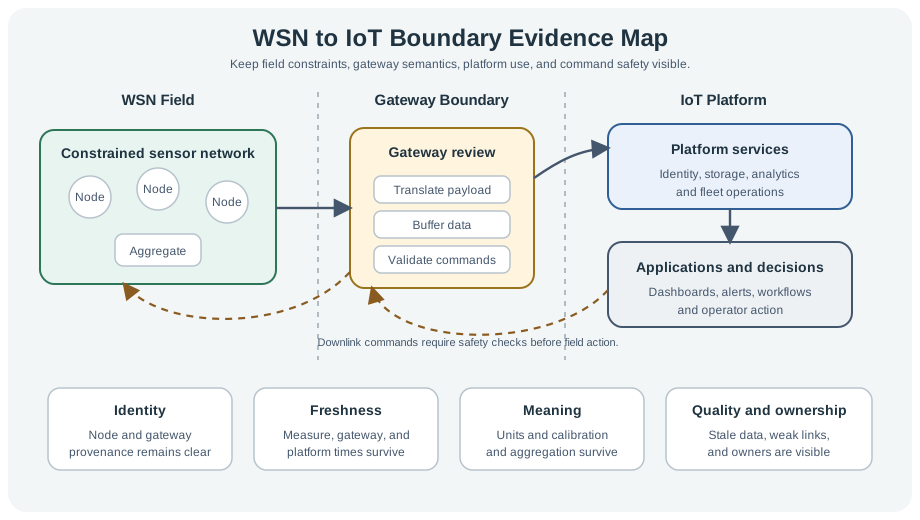
- Integration focus: The boundary where sensor-network evidence becomes application data and where application commands may return to the field.
- The review should preserve both views.
- A compact side-by-side comparison makes the same boundary concrete rather than only conceptual.
Major section
What The Gateway Must Preserve
Security: Separate field-network trust from cloud trust, manage keys and credentials, and prevent one captured node from becoming platform-wide access.
- The gateway should be reviewed as an evidence-preserving component, not just a protocol adapter.
- Meaning: Preserve units, calibration state, aggregation method, location, sensor role, and whether a value is raw, filtered, summarized, or estimated.
- Commands: Validate downlink commands against local safety rules, node reachability, rate limits, operator approval, and rollback behavior.
Major section
Integration Patterns
Different integration patterns fit different evidence and operating constraints.
- This fits intermittent backhaul, privacy boundaries, or time-sensitive local response.
- Hybrid expansion: Preserve a legacy WSN while adding new sensors, mobile collectors, gateways, or backhaul paths for zones where the existing network does not provide enough evidence.
- Cloud connectivity is a means, not the design goal.
Major section
Addressability And Header Fit
That adaptation buys interoperability and individual reachability, but it is not free.
- Making a WSN part of IoT does not mean every constrained node should behave like a cloud server.
- 6LoWPAN is one way to make small radio nodes IP-reachable without pretending the link is large.
- 6LoWPAN is a network-layer answer to reachability.
Major section
Data Meaning Across The Boundary
WSN packets are often optimized for local constraints.
- IoT platforms usually need richer context.
- The gateway or edge service must decide how much context to attach without pretending the sensor node measured more than it did.
- If the answer is unclear, the integration is not ready for application decisions.
Major section
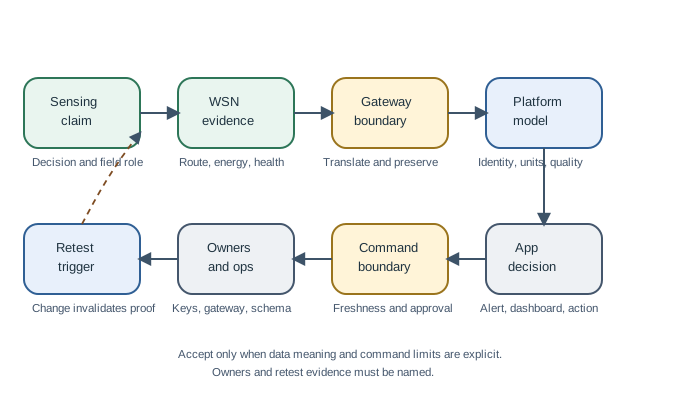
Greenhouse WSN to Dashboard
A greenhouse already has a local WSN that reports temperature and humidity to a gateway.
- Claim: The existing greenhouse WSN can act as the sensing layer for a cloud dashboard and alert workflow.
- Command boundary: remote recommendations are allowed; automatic actuator commands require a separate safety review.
- Retest trigger: gateway change, schema change, alert-rule change, sensor relocation, or new downlink automation.
Major section
Common Mistakes
Losing aggregation meaning: An average without member count, time window, missing-node status, and aggregation rule can mislead the application.
- Calling forwarding integration: Forwarded packets are not enough.
- The platform also needs identity, units, timestamps, quality status, and missing-data evidence.
- Ignoring gateway operations: Gateways need owners for credentials, firmware, backhaul, buffering, schema mapping, clock sync, alerting, and recovery.
Major section
Review Checklist
The sensing claim is still clear after data leaves the WSN.
- The gateway preserves node identity, units, timestamps, location, role, and quality status.
- The platform distinguishes quiet, stale, failed, and gateway-offline states.
- Credentials and keys are scoped so a field-node issue does not become a platform-wide issue.
Major section
Summary
WSNs and IoT are related but not identical.
- A WSN is often the constrained sensing layer that observes a physical environment.
- The gateway is the usual boundary, and it must preserve evidence rather than merely forward packets.
- Strong integration records show the sensing claim, field-network evidence, gateway translation, platform data model, command limits, owners, and retest triggers.
Deck summary
Key takeaways
Each unit measures soil or air and passes the reading through nearby units.
- The Internet of Things, or IoT, adds the wider service that stores, shows, and acts on their facts.
- A WSN is often the sensing subsystem inside a larger IoT system.
- WSN and IoT overlap, but they are not the same design problem.
- Security: Separate field-network trust from cloud trust, manage keys and credentials, and prevent one captured node from becoming platform-wide access.
Retrieval practice
Recall check 1 of 4

Packet Pete says: answer from memory, then check your reasoning.
Q1At the WSN-to-IoT boundary (usually the gateway), what must be preserved beyond simply forwarding packets?
Show answer
Answer: B The gateway boundary must preserve node identity, data meaning, freshness, quality, and command safety, not just forward packets.
Retrieval practice
Recall check 2 of 4
Packet Pete says: answer from memory, then check your reasoning.
Q2Why does 6LoWPAN matter when an IEEE 802.15.4 WSN node needs IPv6/UDP reachability?
Show answer
Answer: B 6LoWPAN adapts IPv6 and UDP to constrained 802.15.4 frames through header compression and fragmentation, but the integration still needs identity, freshness, and command-safety evidence.
Retrieval practice
Recall check 3 of 4
Packet Pete says: answer from memory, then check your reasoning.
Q3A gateway forwards WSN packets to a cloud topic, but the cloud record does not include measurement time, units, node role, or missing-node status. What is the main integration problem?
Show answer
Answer: B WSN-to-IoT integration is successful only when the platform receives enough context to make valid decisions.
Retrieval practice
Recall check 4 of 4
Packet Pete says: answer from memory, then check your reasoning.
Q4A farm has a reliable battery-powered WSN that already covers the fields. The owner wants mobile alerts and cloud analytics. Which first integration pattern is usually most defensible?
Show answer
Answer: B When an existing WSN already meets the field sensing claim, a gateway bridge is often a lower-risk path to IoT integration than replacing constrained nodes.
Print reference
Answers 1 of 2
Answer key.
- B · The gateway boundary must preserve node identity, data meaning, freshness, quality, and command safety, not just forward packets.
- B · 6LoWPAN adapts IPv6 and UDP to constrained 802.15.4 frames through header compression and fragmentation, but the integration still needs identity, freshness, and command-safety evidence.
- B · WSN-to-IoT integration is successful only when the platform receives enough context to make valid decisions.
Print reference
Answers 2 of 2
Answer key.
- B · When an existing WSN already meets the field sensing claim, a gateway bridge is often a lower-risk path to IoT integration than replacing constrained nodes.