Wireless Sensor Networks · Study deck
WSN Introduction and History
Inspect the Outdoor environmental sensor station (weatherproof enclosure) in a real physical setting diagram before reducing a deployment to network-node circles.
Packet Pete is your guide for this deck.
After studying this chapter
Learning objectives
You will be able to:
- State a bounded WSN sensing claim that names what must be observed and how often, instead of describing the network by radio label alone
- Describe how topology, routing, and gateway recovery affect whether stale or missing data stays visible to the application
- Explain: The weatherproof station exposes the enclosure, mast, cable, power, orientation, and siting decisions that determine whether a logical WSN design can survive in the field.
- Explain: The useful outcome is not "a packet arrived." It is "this tree needs water now.".

Major section
Start With the Field Story
The weatherproof station exposes the enclosure, mast, cable, power, orientation, and siting decisions that determine whether a logical WSN design can survive in the field.
- A small unit measures the soil.
- It may pass the result through other units before the message reaches a local bridge.
- The designer should start with the field decision.
Major section
Start With the Field Story (continued)
The useful outcome is not "a packet arrived." It is "this tree needs water now.".
- A wireless sensor network, or WSN, is a group of small measuring units that share facts over radio links.
- This simple story leaves out how units share time and choose routes.
- Under the Hood explains radio behavior, energy limits, and routing rules.
Major section
What a WSN Claim Means
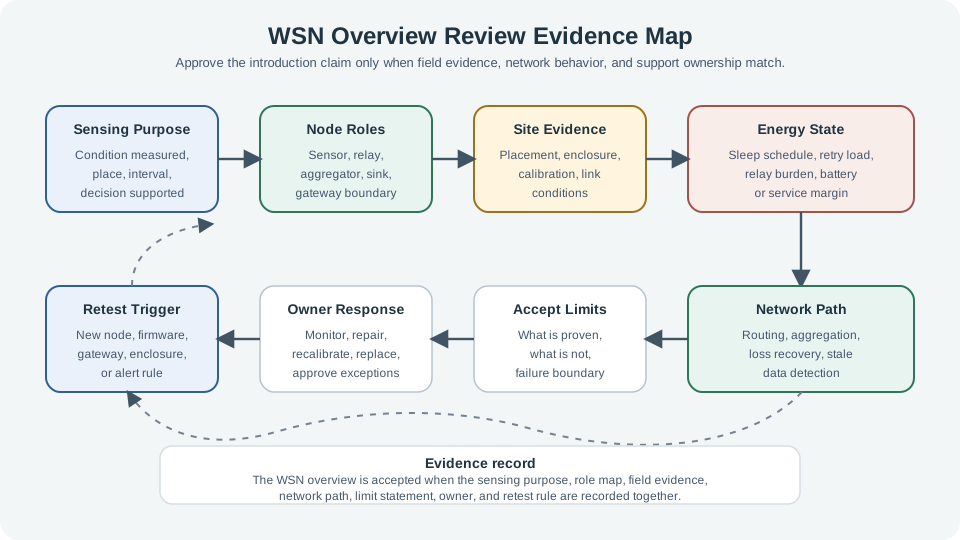
This reveals why wSN overview evidence map connecting sensing purpose, node roles, site evidence, energy state, network path, acceptance limits, owner response, and retest trigger.
- Early research proved that many constrained nodes can create useful system evidence.
- Field deployments proved that lab connectivity is only one part of the review.
- The visual at the WSN overview evidence map connecting sensing purpose, node roles, site evidence, energy state, network path, acceptance limits, owner response, and retest trigger diagram poses that question for the current what a wsn claim means decision.
Major section
What a WSN Claim Means (continued)
A WSN can look connected while the sensing point is misplaced, the relay carries too much traffic, the gateway loses meaning during recovery, or the support owner has no retest rule.
- The introduction should therefore approve only the part of the system that has matching field evidence.
- A successful packet in a lab does not prove field sensing quality.
- A mesh diagram is not proof of route resilience.
Major section
What a WSN Claim Means (continued)
WSN history matters because it explains the recurring pressures: constrained energy, lossy links, placement-sensitive measurements, topology changes, gateway boundaries, and maintenance ownership.
- Relay load, parent choice, loss, recovery, and battery impact need field evidence.
- A sensor reading is not useful unless it is placed, calibrated, timestamped, delivered, and interpreted for a decision.
- A WSN can be the wrong tool when wired sensing, manual sampling, a powered gateway, or fewer high-quality instruments provide better evidence.
Major section
WSN Review Record
A practical WSN review record should let another engineer repeat the decision.
- It states the sensing objective, node role model, topology, power budget, data path, gateway boundary, failure behavior, owner, and change that reopens the decision.
- Early design may record assumptions.
- Phenomenon, location, interval, accuracy need, latency, calibration rule, placement, and acceptance limit.
Major section
WSN Review Record (continued)
A release review should replace assumptions with representative evidence from field placement, enclosure, calibration, interference, traffic, route behavior, battery profile, gateway outage behavior, missing-data handling, and support procedures.
- The network carries data that is connected but not useful for the decision.
- Leaf nodes, relays, cluster heads, sinks, gateways, role changes, local storage, retry behavior, and ownership.
- Relay or gateway devices silently carry more traffic, energy, and maintenance burden than the review expects.
Major section
WSN Review Record (continued)
The design assumes connectivity from a diagram while field links, route repair, and data-loss behavior remain unproved.
- Battery life is estimated from one transmit event while hidden receive, retry, and maintenance work drains the node.
- Missing, stale, noisy, duplicated, or delayed data becomes a trusted operational signal.
- Owner, battery replacement, calibration, firmware, key rotation, gateway health, physical inspection, support runbook, and retest triggers.
- A bridge monitoring deployment needs vibration evidence at selected structural points.
Major section
WSN Review Record (continued)
The review should start with the control decision and acceptable latency, then record sensor placement, enclosure behavior near wet areas, calibration, gateway reachability, reporting interval, missing-node alerts, and battery replacement ownership.
- The safe approval statement is narrow: under the reviewed placement and reporting interval, this sensor field supports these zone-level decisions.
- The review should separate measurement quality from radio connectivity: mounting validation, feature preservation, sample or summary behavior, buffering, relay load, gateway outage behavior, weather exposure, and retest triggers after maintenance or firmware changes.
- The approval should not say that low-power wireless generally solves structural monitoring.
Major section
Layer Handoffs and Failures
A measurement can be wrong before it is transmitted.
- A good measurement can be buffered and delayed.
- A packet can reach a relay but not a gateway.
- A gateway can store data while the dashboard interprets it with stale thresholds.
- A working route can still be operationally unsafe if nobody owns batteries, calibration, or keys.
Major section
Layer Handoffs and Failures (continued)
Sensor, calibration, mounting, enclosure, placement, threshold, environment, or decision-latency change.
- The review should preserve the handoff from physical observation to node behavior, network delivery, gateway and backend interpretation, and operations.
- That separation keeps a narrow lab result from becoming a broad deployment claim.
- Measurement accuracy, backend semantics, alert correctness, or support ownership.
Major section
Layer Handoffs and Failures (continued)
The physical condition can be observed by the selected sensor at the reviewed location and mounting.
- The node can timestamp, process, buffer, sleep, wake, transmit, receive, and retry under the tested workload.
- Reporting interval, payload, firmware, sleep mode, battery, local storage, radio settings, or retry rule change.
- The topology and route can move data toward a sink or gateway under the reviewed link and traffic conditions.
Major section
Layer Handoffs and Failures (continued)
Node density, gateway location, obstruction, interference, route rule, relay role, aggregation, or failure scenario change.
- The service can store, display, alert, audit, and recover around the reviewed data path.
- That every future field condition, threshold, owner, key, firmware, or maintenance procedure preserves the same evidence.
- If the reading is noisy, inspect placement and calibration before changing routing.
Major section
Summary
WSN approval starts with a bounded sensing claim, not with a wireless label or a lab packet.
- Node roles, topology, routing, power, gateway behavior, data quality, and operations ownership need separate evidence.
- Sensing quality depends on placement, calibration, enclosure, interval, and the decision that uses the data.
- Energy review must include sensing, processing, transmit, receive, retries, listening windows, joins, downlinks, and maintenance traffic.
- Network review must cover topology, role burden, link quality, route repair, gateway recovery, and stale-data behavior.
Deck summary
Key takeaways
The weatherproof station exposes the enclosure, mast, cable, power, orientation, and siting decisions that determine whether a logical WSN design can survive in the field.
- The useful outcome is not "a packet arrived." It is "this tree needs water now.".
- This reveals why wSN overview evidence map connecting sensing purpose, node roles, site evidence, energy state, network path, acceptance limits, owner response, and retest trigger.
- A WSN can look connected while the sensing point is misplaced, the relay carries too much traffic, the gateway loses meaning during recovery, or the support owner has no retest rule.
Retrieval practice
Recall check 1 of 3

Packet Pete says: answer from memory, then check your reasoning.
Q1A team says a WSN is ready because every node can send one packet to the gateway in the lab. What should the review say?
Show answer
Answer: C A lab packet proves a narrow link observation, not the full sensing and operations claim.
Retrieval practice
Recall check 2 of 3
Packet Pete says: answer from memory, then check your reasoning.
Q2A pilot shows good readings from leaf nodes, but relay nodes lose battery much faster than expected. What evidence is missing before approval?
Show answer
Answer: A Relay nodes have a different duty burden than quiet leaf sensors, so they need separate evidence.
Retrieval practice
Recall check 3 of 3
Packet Pete says: answer from memory, then check your reasoning.
Q3Where should reviewers investigate the gap between recent node readings and the display?
Show answer
Answer: B The nodes measured locally, so the first evidence gap is delivery, recovery, and stale-data interpretation.
Print reference
Answers
Answer key.
- C · A lab packet proves a narrow link observation, not the full sensing and operations claim.
- A · Relay nodes have a different duty burden than quiet leaf sensors, so they need separate evidence.
- B · The nodes measured locally, so the first evidence gap is delivery, recovery, and stale-data interpretation.