Wireless Sensor Networks · Study deck
Infrastructure-Denied IoT: Field Architecture
The radio family is selected, but remote operation still has five linked concerns.
Packet Pete is your guide for this deck.
After studying this chapter
Learning objectives
You will be able to:
- Explain: The photograph therefore connects antenna theory to the deployment review: a catalog gain is credible only when mounting, surroundings, feedline condition, and safe access preserve it in the field.
- Explain: If a gateway can be placed high enough with acceptable line-of-sight or near-line-of-sight, private LoRaWAN or another LPWAN may be appropriate.
- Explain: The ionosphere bends part of the energy back toward Earth, creating regional coverage that can fill the usual "skip zone" of long-distance HF.
- Explain: The radio family is selected, but remote operation still has five linked concerns.
Major section
Start With the Situation
The radio family is selected, but remote operation still has five linked concerns.
- A weak signal may make a message hard to receive.
- An antenna sends and receives that radio signal.
- Stored-data custody asks where reports wait safely during an outage; recovery asks how they reach their destination afterward.
Major section
HF and NVIS as Background Knowledge
Infrastructure-denied environments sometimes require students to understand a less common option: high-frequency radio.
- HF means High Frequency, usually 3-30 MHz.
- Compared with common IoT bands, HF has long wavelengths: tens of metres rather than centimetres.
- Antennas are physically larger.
- Data rates are usually low.
Major section
HF and NVIS as Background Knowledge (continued)
Propagation varies by time of day and solar conditions.
- Licensing can be complex.
- Hardware and installation need radio expertise.
- The transmitter sends HF energy upward at a steep angle.
- The ionosphere bends part of the energy back toward Earth, creating regional coverage that can fill the usual "skip zone" of long-distance HF.
Major section
HF and NVIS as Background Knowledge (continued)
Typical NVIS use is not broadband.
- The useful mental model is: NVIS is a resilience and coverage tactic for unusual low-rate telemetry, not a replacement for mainstream IoT networking.
- HF propagation depends on the ionosphere, which changes across the day and with solar activity.
- The usable frequency lies between these limits, and that window changes over time.
Major section
Weak-Signal Digital Telemetry
When radio links are weak, engineers can trade speed for reliability.
- The result is that messages can sometimes be decoded even when the signal is near or below what a human listener would consider obvious.
- A good telemetry message carries only what is needed.
- The important question is not "how many bytes can I send?" It is "what decision can the receiver make from this message?".
Major section
Antennas in Remote Deployments
A link-budget gain value is credible only if the installed antenna preserves the assumed orientation, height, and feedline condition.
- The photograph therefore connects antenna theory to the deployment review: a catalog gain is credible only when mounting, surroundings, feedline condition, and safe access preserve it in the field.
- An antenna must be matched to the transmitter.
- Remote systems should report enough health information to detect radio degradation before total failure.

Major section
Power Architecture
Remote IoT power design is dominated by average current, not peak current alone.
- where Cbattery is battery capacity in mAh and Iavg is average current in mA.
- For many battery-powered nodes, the radio is more expensive than the sensor reading.
- Transmitting only on significant change.
- Using local storage when the link is unavailable.
Major section
Architecture Patterns
Infrastructure-denied IoT systems are usually built around a few recurring patterns.
- Nodes store readings locally and transmit when a link becomes available.
- The receiver may be fixed, mobile, aerial, or temporarily deployed.
- The node sends only important events immediately and stores detailed data locally for later retrieval.
Major section
Field Validation
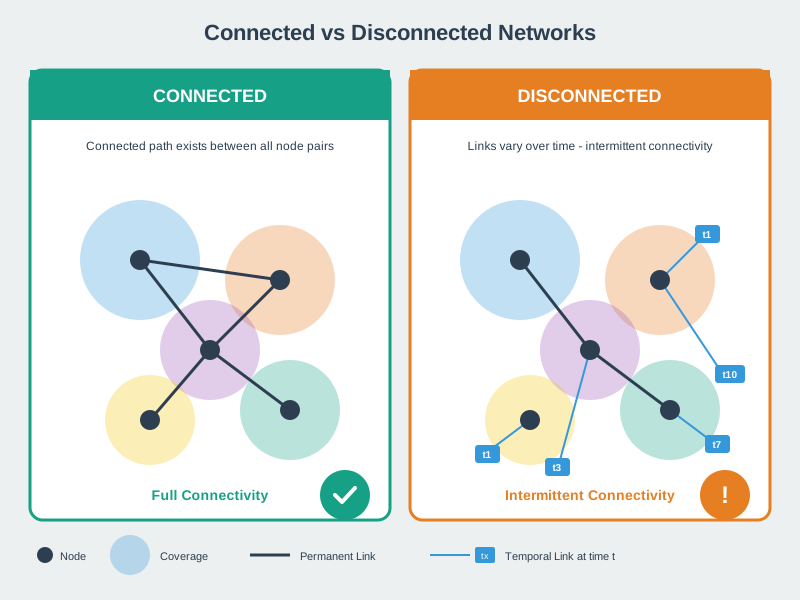
The disconnected case keeps readings locally, waits for a useful link, then transmits when delay is acceptable.
- That sequence does not establish that records survived or arrived in time.
- The section's custody table adds timestamps, retry counters, queue depth, route changes, and stale-data labels at each layer.
- These observations show what fails during an outage and what the operator should see.
Major section
Technology Selection Framework
If the sky is visible, satellite IoT can be attractive for sparse remote telemetry.
- If reliable cellular or LPWAN operator coverage exists and subscriptions are acceptable, managed connectivity may be simpler than private infrastructure.
- If not, ask whether a private gateway can be installed and powered.
- A technically elegant radio link is not enough.
Major section
Technology Selection Framework (continued)
If a gateway can be placed high enough with acceptable line-of-sight or near-line-of-sight, private LoRaWAN or another LPWAN may be appropriate.
- If dense canopy, buildings, or valleys block sky view, satellite may require antenna relocation, long acquisition times, higher power, or may be impractical.
- If only compact status or event messages are required, very low-rate options become possible.
- The correct IoT design is the one the organisation can sustain.
Major section
Summary
Infrastructure-denied IoT is about sustaining a complete communication system under physical, energy, regulatory, and operational constraints.
- The main lesson is not that one technology is best.
- The lesson is that remote IoT requires disciplined requirement definition, link-budget thinking, power modelling, antenna planning, field validation, and operational ownership.
- When the payload is small and latency can be relaxed, engineers gain design freedom.
Deck summary
Key takeaways
The radio family is selected, but remote operation still has five linked concerns.
- Infrastructure-denied environments sometimes require students to understand a less common option: high-frequency radio.
- Propagation varies by time of day and solar conditions.
- Typical NVIS use is not broadband.
- When radio links are weak, engineers can trade speed for reliability.
Retrieval practice
Recall check 1 of 5

Packet Pete says: answer from memory, then check your reasoning.
Q1A remote field sensor has a radio choice but no normal backhaul. What must the architecture add before release?
Show answer
Answer: B Remote operation depends on the whole field path.
Retrieval practice
Recall check 2 of 5
Packet Pete says: answer from memory, then check your reasoning.
Q2A remote sensor may use HF radio for small reports. What weak-signal limit must the team test?
Show answer
Answer: A HF propagation varies with those conditions and needs field evidence.
Retrieval practice
Recall check 3 of 5
Packet Pete says: answer from memory, then check your reasoning.
Q3A disaster-response sensor mesh has no cellular coverage and only intermittent gateway visits. Which evidence best tests alarm custody and expiry during no-contact intervals?
Show answer
Answer: A Infrastructure-denied validation must prove custody during no-contact intervals, not only show that a message can pass during a normal contact.
Retrieval practice
Recall check 4 of 5
Packet Pete says: answer from memory, then check your reasoning.
Q4A remote sensor needs to send a 20-byte status message every hour from a dense forest site with no cellular coverage and no safe route for frequent maintenance. Which design question should be answered first?
Show answer
Answer: B In infrastructure-denied IoT, the communication and power feasibility must be established before cloud architecture or analytics.
Retrieval practice
Recall check 5 of 5
Packet Pete says: answer from memory, then check your reasoning.
Q5Why can a very low data-rate radio design be appropriate for some remote IoT deployments?
Show answer
Answer: B If the application only needs tiny messages, throughput can be sacrificed to improve reliability and lifetime.
Print reference
Answers
Answer key.
- B · Remote operation depends on the whole field path.
- A · HF propagation varies with those conditions and needs field evidence.
- A · Infrastructure-denied validation must prove custody during no-contact intervals, not only show that a message can pass during a normal contact.
- B · In infrastructure-denied IoT, the communication and power feasibility must be established before cloud architecture or analytics.
- B · If the application only needs tiny messages, throughput can be sacrificed to improve reliability and lifetime.