Wireless Sensor Networks · Study deck
Participatory Sensing Platform
Picture a city asking people to mark broken pavements with their phones.
Packet Pete is your guide for this deck.
After studying this chapter
Learning objectives
You will be able to:
- Design a participatory sensing review around the decision, task, participant role, and evidence record.
- Separate mobile capture, upload, validation, aggregation, feedback, and operations responsibilities.
- Review sensor suitability, context capture, duplicate handling, calibration, and malicious or mistaken submissions.
- Identify coverage bias caused by who participates, where they travel, when they report, and which devices they use.
Major section
In 60 Seconds
Many reports can reveal a pattern.
- The map must show both the reports and the gaps.
- Participatory sensing means people help collect or label evidence.
- Tell the person what to see, what to send, and why it is needed.
- A large crowd does not remove bias.
Major section
In 60 Seconds (continued)
They separate raw reports from accepted evidence, mark missing areas as missing, keep personal data minimized, and give contributors clear feedback without implying that every submission is automatically correct.
- A good platform makes uncertainty and coverage limits easy to see.
- Under the Hood covers calibration, duplicate handling, harmful reports, and coverage bias.
- Those details may limit the claim.
Major section
Start With the Task
Participatory sensing fails when the task is vague.
- A useful task says what the participant should observe, what the phone or sensor should capture, what context is required, what precision is acceptable, and what decision the platform will support.
- Privacy boundary: Minimize location precision, identity, media, and retention to what the decision actually needs.
- Feedback rule: Tell contributors what happened to their report without exposing sensitive details or promising action the platform cannot guarantee.
Major section
Platform Review Route
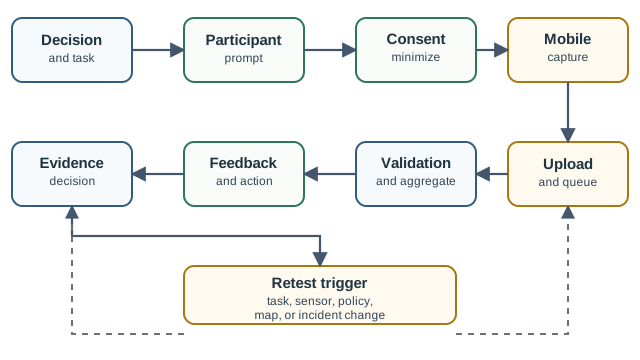
Consent and data limits cut what the phone may keep.
- Upload and a local queue save records when the link comes and goes.
- Checks and group work must keep failed or doubtful reports in view; they should not blend them into the result.
- A new task, user group, app, or pass rule sends the path back to test.
Major section
Platform Review Route (continued)
A reply tells people what took place, while the last box states what the group result can support.
- The route separates collection from acceptance.
- A report can be received, but still need duplicate review, context checks, sensor-quality review, or human confirmation before it supports a decision.
- A reading can look sound but still answer the wrong task.
Major section
Platform Review Route (continued)
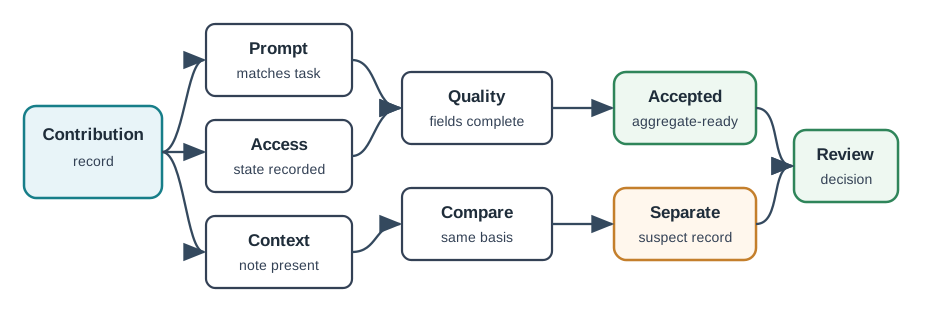
Access state and site facts show whether the phone was allowed to collect and whether the value can be read in context.
- Quality fields and one shared basis then decide if the report can join the group result.
- Passed records go to study, while suspect ones keep a reason and wait for review.
- This protects the result from repeats, old reports, missing facts, and uneven use without throwing away a record that may still help.
Major section
Platform Layers
A participatory sensing platform usually has four review layers.
- The names can vary, but the responsibilities should be visible.
- Collection layer: Secure upload, retry, batching, deduplication keys, format checks, rate limits, and basic spam controls.
- Aggregation and decision layer: Maps, summaries, alerts, work queues, confidence labels, missing-area markers, and export records.
Major section
Data Quality Evidence
It also checks permission, placement, prompt, and sensor mode before comparing reports.
- Validation can accept a report for aggregation or keep it separate from the main claim.
- Feedback then tells the contributor what happened and gives an owner a follow-up action.
- Quality review should not pretend that all problems are malicious.
- Aggregate only like-with-like records.
Major section
Data Quality Evidence (continued)
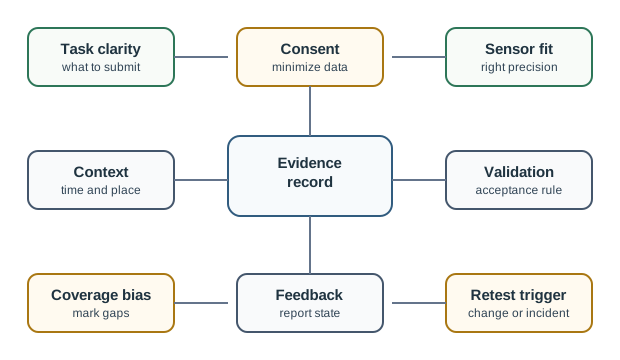
The lower fields record task clarity, consent, sensor fit, duplicate and reference checks, coverage bias, and a retest trigger.
- Blank areas remain unknown; a dashboard must show missing and low-confidence evidence rather than presenting every received report as proof.
- That ledger lets operators use early reports without overclaiming them.
- Validation tools also need caveats.
Major section
Data Quality Evidence (continued)
Nearby points are not automatically comparable if they use different prompts, device states, capture conditions, or privacy treatments.
- Duplicate merging can hide repeated problems if the merge radius is too wide.
- Reputation can freeze out new contributors.
- Outlier removal can suppress rare real events.
- Manual review can lag behind field changes.
Major section
Worked Review: Street Damage Reporting
Reports include a photo, an approximate location, a category, and optional notes.
- The authority uses the reports for inspection routing and maintenance planning.
- Bias: Areas with active contributors will appear more visible than quiet areas.
- The dashboard should show low-report zones instead of treating silence as no damage.
Major section
Common Review Mistakes
Counting reports as truth: A submission is not automatically accepted evidence.
- Missing contributors can create missing evidence.
- Overcollecting location: Exact traces are rarely needed for every participatory task.
- Hiding uncertainty on maps: Maps should show confidence, stale reports, missing zones, and report state.
- Skipping feedback: Contributors need a clear outcome path.
Deck summary
Key takeaways
Many reports can reveal a pattern.
- They separate raw reports from accepted evidence, mark missing areas as missing, keep personal data minimized, and give contributors clear feedback without implying that every submission is automatically correct.
- Participatory sensing fails when the task is vague.
- Consent and data limits cut what the phone may keep.
- A reply tells people what took place, while the last box states what the group result can support.
Retrieval practice
Recall check 1 of 4

Packet Pete says: answer from memory, then check your reasoning.
Q1A participatory street-damage platform receives one photo and location from a single resident. How should the platform classify and use this single resident report?
Show answer
Answer: B A single citizen report is provisional evidence that needs validation before it drives action.
Retrieval practice
Recall check 2 of 4
Packet Pete says: answer from memory, then check your reasoning.
Q2A participatory street-damage platform receives a photo and location from one resident. What status should the platform give this report before taking action?
Show answer
Answer: D Participatory reports should move through explicit states such as provisional, accepted, duplicate, rejected, expired, or inspected.
Retrieval practice
Recall check 3 of 4
Packet Pete says: answer from memory, then check your reasoning.
Q3A community noise map has many reports near cafes and transit stops but few reports from residential side streets. What should the platform do before using the map for planning?
Show answer
Answer: D Coverage bias is a data-quality issue.
Retrieval practice
Recall check 4 of 4
Packet Pete says: answer from memory, then check your reasoning.
Q4A participatory noise map receives readings from different phone models, prompt versions, and carrying positions. What is the strongest aggregation rule?
Show answer
Answer: C Participatory sensing should aggregate compatible records with explicit context, confidence, privacy, and decision limits.
Print reference
Answers
Answer key.
- B · A single citizen report is provisional evidence that needs validation before it drives action.
- D · Participatory reports should move through explicit states such as provisional, accepted, duplicate, rejected, expired, or inspected.
- D · Coverage bias is a data-quality issue.
- C · Participatory sensing should aggregate compatible records with explicit context, confidence, privacy, and decision limits.