Wireless Sensor Networks · Study deck
Delay-Tolerant Networks for IoT
A park ranger walks past remote river monitors once each week.
Packet Pete is your guide for this deck.
After studying this chapter
Learning objectives
You will be able to:
- Explain store-carry-forward as a WSN evidence claim rather than a slogan.
- Decide when a DTN pattern fits better than continuous multi-hop routing or always-on backhaul.
- Compare direct delivery, limited-copy forwarding, flooding, and history-informed forwarding without overclaiming their results.
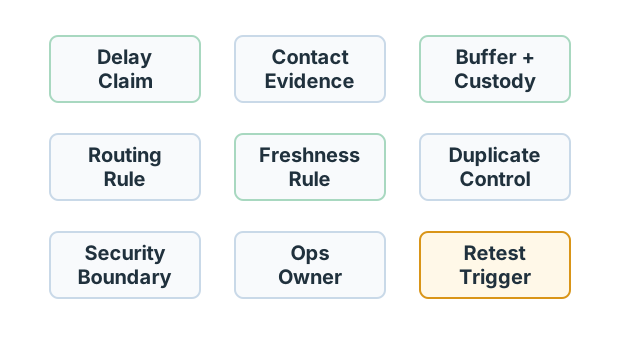
- Review contact, buffer, custody, freshness, duplicate, energy, and security evidence for a DTN deployment.
Major section
In 60 Seconds
Each monitor can store a reading, the ranger's device can carry it, and the office can receive it later.
- The useful question is whether that delay still supports the environmental decision.
- Urgent danger that cannot wait needs another local or immediate path.
- The strongest design admits where waiting is safe and where it is not.
Major section
In 60 Seconds (continued)
The deeper sections compare direct, limited-copy, flooding, and history-based forwarding, plus custody, storage, safety, and security limits.
- A weekly water trend may survive.
- A fire warning may not.
- A delay-tolerant network lets a WSN or IoT system move data even when no end-to-end path exists at the moment the data is created.
Major section
Start With the Delay Claim · DTN Review Route
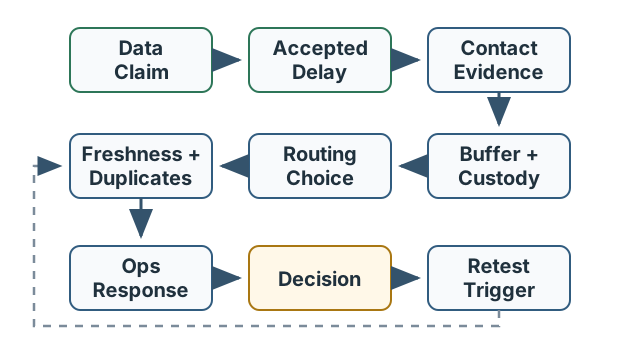
The first review question is not "which DTN protocol?" It is "what delay can the sensing decision tolerate?" DTN is useful only when the decision can wait for intermittent contact.
- A soil trend, wildlife track, maintenance log, or remote clinic batch can often wait.
- The route is a loop.
- A fire alarm, hazardous gas alert, active safety interlock, or emergency shutdown usually cannot.
- If the system cannot state those boundaries, it is not ready for a DTN claim.
Major section
Store-Carry-Forward Evidence
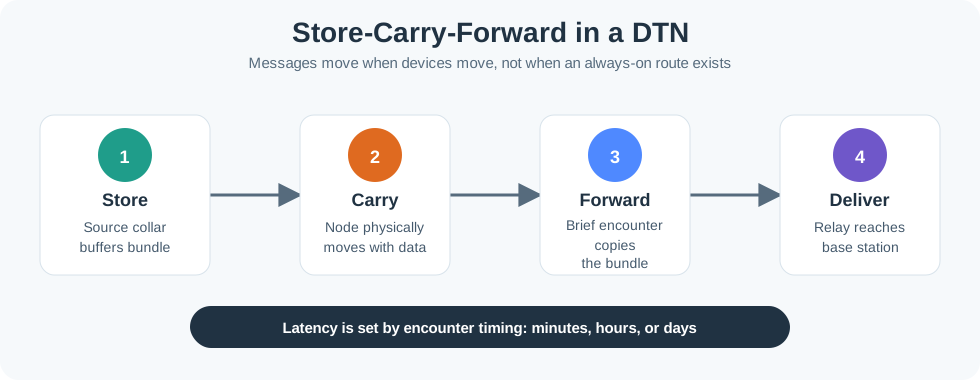
The next Store-Carry-Forward Evidence step depends on DTN store-carry-forward sequence.
- The source collar stores a bundle until a mobile node arrives.
- That node carries the data as it moves, then copies it during a brief encounter.
- A relay later delivers it to the base station.
- The budget starts at sampling time, not upload time.
Major section
Store-Carry-Forward Evidence (continued)
A successful transfer can still fail the sensing claim if the record is too old for the decision.
- Encounter timing can stretch latency from minutes to days, so delivery alone does not prove the reading is fresh enough for the decision.
- Each claim needs a named age limit.
- Each point can fail independently.
Major section
Store-Carry-Forward Evidence (continued)
The section's review must also check buffer capacity, custody receipt, and age from the original measurement, since each stage can fail independently.
- A record can spend time waiting in the source buffer, waiting for a carrier contact, transferring during a short encounter, waiting in the carrier buffer, waiting for gateway contact, and waiting for backend processing.
- Forward: The message transfers when contact occurs.
- The review should make those failure modes visible.
Major section
Intermittent Contact Routing
Direct delivery: The source keeps the message until it meets the destination or gateway.
- Limited-copy forwarding: A bounded number of copies are handed to selected carriers.
- This improves delivery chances while keeping buffer, airtime, and duplicate risk reviewable.
- Flooding: Messages are copied broadly across contacts.
- This depends on stable mobility and useful encounter records.
Major section
Intermittent Contact Routing (continued)
Hybrid forwarding: Routine data uses limited copies while exceptional data gets a different rule.
- The accepted rule should follow the data claim.
- Trend data can usually tolerate tighter copy limits.
- Rare safety-relevant messages may justify more aggressive forwarding only if the system also reviews energy, congestion, and privacy consequences.
Major section
DTN Evidence Record
The trace asks for contact duration, discovery and handshake time, and usable payload bytes to show that a handoff can finish.
- Custody evidence keeps the source copy until receipt is proved, while measurement, transfer, and gateway times distinguish a delayed reading from a current one.
- The record should be understandable by networking, operations, and data users.
- Figure the Human delay-tolerant network trace stores a river-monitor reading until a park ranger's weekly visit, carries a retryable copy, and forwards it at a later office contact diagram shows the contacts and records behind a delayed reading.
- In the Human delay-tolerant network trace stores a river-monitor reading until a park ranger's weekly visit, carries a retryable copy, and forwards it at a later office contact diagram, the river monitor stores a reading before the ranger's visit, the ranger carries it, and the office receives it at a later contact.
Major section
Worked Review: Wildlife Collar Uploads · Worked Review: Clinic Data Mule Route
Live intervention would require another communication path.
- A wildlife study uses collars that store location summaries and upload when an animal passes near a water-station gateway.
- The team wants to use the data for movement-pattern research, not live animal rescue.
- Urgent clinical alerts need a separate channel.
Major section
Common DTN Review Mistakes · Review Checklist
Calling delayed data live: A DTN path can be useful and still not be current enough for alerts, dispatch, or safety control.
- Counting contacts without transfer evidence: Passing near a gateway is not enough.
- Ignoring buffer pressure: Longer gaps, larger payloads, duplicate copies, or failed handoffs can silently fill storage and drop old data.
- Deleting without custody proof: If a node deletes after an unverified transfer, the system can lose data while reporting no obvious fault.
Major section
Summary
Delay-tolerant networking is a useful WSN and IoT pattern when useful data can wait for intermittent contacts.
- The review should not stop at naming store-carry-forward.
- It should prove that storage, mobility, forwarding, custody, freshness, copy limits, security, and operations ownership fit the decision being made.
- Narrow or reject DTN claims when the data must support live alarms, immediate control, or decisions that cannot tolerate stale or missing readings.
Deck summary
Key takeaways
Each monitor can store a reading, the ranger's device can carry it, and the office can receive it later.
- The deeper sections compare direct, limited-copy, flooding, and history-based forwarding, plus custody, storage, safety, and security limits.
- The first review question is not "which DTN protocol?" It is "what delay can the sensing decision tolerate?" DTN is useful only when the decision can wait for intermittent contact.
- The next Store-Carry-Forward Evidence step depends on DTN store-carry-forward sequence.
- A successful transfer can still fail the sensing claim if the record is too old for the decision.
Retrieval practice
Recall check 1 of 6

Packet Pete says: answer from memory, then check your reasoning.
Q1A mobile sink receives a batch from a trail sensor, but the transfer is interrupted before the gateway confirms receipt. Under a sound custody rule, what should the sensor do?
Show answer
Answer: A A DTN custody rule keeps a retryable copy at the source until receipt is confirmed or the data expires.
Retrieval practice
Recall check 2 of 6

Packet Pete says: answer from memory, then check your reasoning.
Q2A trail sensor meets its collector rarely, has little storage, and can contact passing relays. Which option offers relay opportunities while bounding extra copies, provided measurements support it?
Show answer
Answer: C A copy limit bounds storage and airtime while measured contacts show whether relays improve delivery over direct transfer.
Retrieval practice
Recall check 3 of 6

Packet Pete says: answer from memory, then check your reasoning.
Q3A carrier has reliable recent gateway contacts, while another has none. Which forwarding rule can use that evidence?
Show answer
Answer: A History-informed forwarding needs fresh encounter evidence.
Retrieval practice
Recall check 4 of 6

Packet Pete says: answer from memory, then check your reasoning.
Q4How should this delayed collection path be judged for its stated use?
Show answer
Answer: D DTN review starts with the delay claim.
Retrieval practice
Recall check 5 of 6

Packet Pete says: answer from memory, then check your reasoning.
Q5A mobile sink receives a batch from a trail sensor, but the transfer is interrupted before the gateway confirms receipt. What should the trail sensor do under a sound custody rule?
Show answer
Answer: A A DTN custody boundary says when data can be deleted safely.
Retrieval practice
Recall check 6 of 6

Packet Pete says: answer from memory, then check your reasoning.
Q6A DTN trail monitor increases copies and TTL, but buffers start dropping records before gateway contact. How should the copy and retention settings be reviewed after buffer drops?
Show answer
Answer: D DTN reliability depends on copy count, TTL, queue policy, custody, and freshness labels working together.
Print reference
Answers 1 of 2
Answer key.
- A · A DTN custody rule keeps a retryable copy at the source until receipt is confirmed or the data expires.
- C · A copy limit bounds storage and airtime while measured contacts show whether relays improve delivery over direct transfer.
- A · History-informed forwarding needs fresh encounter evidence.
- D · DTN review starts with the delay claim.
- A · A DTN custody boundary says when data can be deleted safely.
Print reference
Answers 2 of 2
Answer key.
- D · DTN reliability depends on copy count, TTL, queue policy, custody, and freshness labels working together.