Wireless Sensor Networks · Study deck
Human-Centric Sensing
Human-centric sensing extends a WSN by involving people, phones, wearables, vehicles, or carried devices in the sensing path.
Packet Pete is your guide for this deck.
After studying this chapter
Learning objectives
You will be able to:
- Classify human roles in WSN sensing as target, operator, carrier, contributor, or affected stakeholder.
- Compare participatory, opportunistic, wearable, and carried-device sensing without overclaiming coverage or quality.
- Identify consent, privacy, device, incentive, bias, and safety evidence needed before accepting a human-centric sensing claim.
- Review crowdsourced or mobility-assisted readings for calibration, context, duplicates, spoofing, and missing populations.
Major section
Start With the Human Role
They may choose when to report.
- Include people who do not join.
- Recheck when the purpose, reward, device mix, or affected group changes.
- The reports can cover places with no fixed sensors.
- A useful map must show both the added view and the missing view.
Major section
Start With the Human Role (continued)
Under the Hood examines bias, trust, calibration, and the limits of conclusions drawn from uneven human participation.
- A person may be measured.
- They may carry a device through an area.
- They may add context that a machine cannot see.
- They may also be affected by the result.
Major section
Start With the Human Role (continued)
Mobile carrier: The person, vehicle, or carried device moves through places where fixed WSN nodes cannot stay connected and later forwards stored data.
- Offer a way to stop.
- A useful service should not punish silence or lack of access.
- A phone model may change the reading.
- People may visit some areas more often.
Major section
Start With the Human Role (continued)
Rewards may change behavior.
- Health, work, and private spaces need stronger safeguards.
- Context provider: The person supplies labels, annotations, confirmations, or local knowledge that a fixed sensor cannot infer safely.
- Affected stakeholder: The person may be impacted by alerts, maps, services, enforcement, or resource allocation based on the sensing result.
Major section
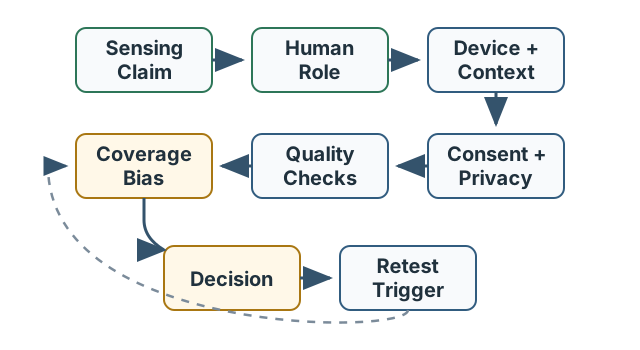
Human-Centric Sensing Review Route
People may contribute readings and may also be affected by the published result.
- Device evidence covers placement, microphone permission, background state, calibration, and local context; permission by itself does not establish quality.
- Those gaps can narrow the claim to aggregated area trends instead of precise street routes.
- Missing reports cannot prove a place is quiet.
Major section
Participation Modes
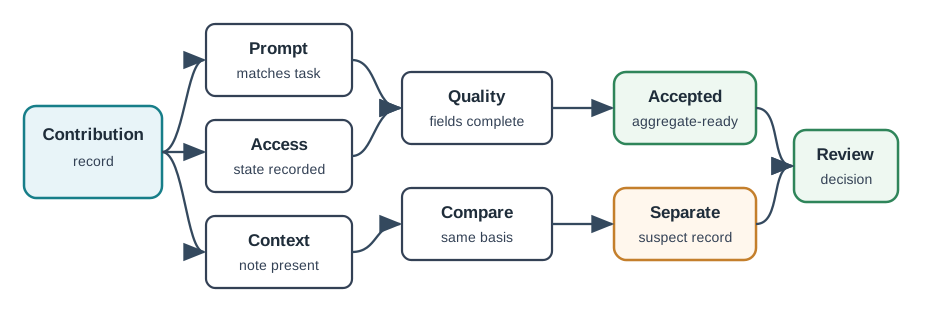
Human-centric sensing should be described by how data enters the system and how much participant action is required.
- Opportunistic sensing: Approved background collection uses device sensors or metadata with minimal user action.
- Carried-device sensing: Phones, tags, vehicles, or tools carry readings through a place.
- Hybrid campaign: Background readings are paired with intentional labels or confirmations.
Major section
Participation Modes (continued)
Human-assisted DTN: People or vehicles carry stored WSN data between disconnected segments.
- The chosen mode should follow the monitoring question.
- Quality fields and the comparison basis decide whether records can be combined.
- The review decision must preserve that separation so a large response count cannot hide duplicates, stale samples, or biased coverage.
Major section
Consent, Privacy, and Data Minimization
The review should avoid treating "anonymous" as a complete protection.
- The stronger question is whether the system collects only what it needs, protects it while it is useful, aggregates or removes detail when possible, and makes the participant boundary visible.
- Minimization boundary: Collect the least precise location, time, identifier, sensor stream, and retention period that still supports the accepted claim.
- Privacy review is not a one-time checkbox.
Major section
Device and Data Quality Evidence
Phones, wearables, and carried devices are not identical field instruments.
- They differ in sensor accuracy, mounting, operating system behavior, battery state, permissions, sampling rate, and user handling.
- Quality evidence should match the decision being made.
- A rough city trend map, a maintenance dispatch, a safety alert, and a participant feedback message do not need the same evidence standard.
Major section
Coverage Bias and Representativeness
The review record should state what the data does not cover.
- Human mobility can fill gaps that fixed WSNs miss, but it can also create new blind spots.
- People do not move randomly, carry devices the same way, or represent every place equally.
- Missing data is not proof that a place is healthy, quiet, safe, or unchanged.
Major section
Coverage Bias and Representativeness (continued)
Spatial bias: Busy streets, popular paths, campuses, and affluent areas may be overrepresented while quiet, private, rural, or underserved areas are missing.
- Device bias: Different models, operating systems, sensor placements, cases, and permission settings can change measurement behavior.
- Incentive bias: Rewards, rankings, or dispatch outcomes can encourage duplicate reports, gaming, selective reporting, or overfocus on visible locations.
- Operational bias: Crew routes, maintenance boundaries, and dashboard defaults can make some observations easier to act on than others.
Major section
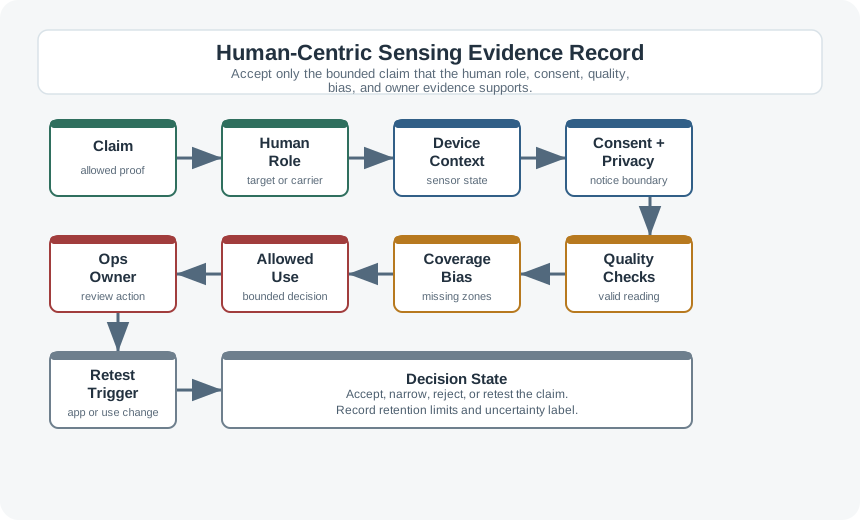
Human-Centric Sensing Evidence Record
Coverage bias and allowed use then limit what the result may support.
- The final owner and retest trigger keep the decision operational when recruitment, firmware, placement, or the intended use changes.
- The record should be usable by technical, operations, and governance reviewers.
- : Human-centric sensing evidence states.
Major section
Worked Review: Community Noise Mapping
The first proposal stores precise routes and timestamps from every phone, then publishes street-level heat maps.
- Human role: Participants are opportunistic contributors and affected stakeholders.
- Data boundary: The system should not store precise individual routes when area-level trends are enough for the stated planning claim.
- Quality evidence: Phone placement, microphone permission, background sampling state, calibration checks, and local context labels need review.
Major section
Worked Review: Carried Sensor Patrol
A park monitoring system uses visitor-carried tags to upload stored readings from fixed trail sensors when people pass a kiosk.
- The design claims it can replace daily staff collection.
- Human role: Visitors are mobile carriers, not trained sensor operators.
- The system must tolerate irregular paths and missed contacts.
- Alarm-like claims need a different path.
Major section
Common Human-Centric Sensing Mistakes · Review Checklist
Role and claim: Human role, sensing purpose, allowed decision, and excluded uses are explicit.
- Calling location data anonymous: Removing names is not enough when routes, times, rare visits, or small groups can still reveal people or sensitive places.
- Ignoring nonparticipants: A crowdsourced map can be loudest where contributors are easiest to recruit, not where the problem is greatest.
- Consent and control: Collection timing, participant notice, pause/exit behavior, and new-use triggers are documented.
Deck summary
Key takeaways
They may choose when to report.
- Under the Hood examines bias, trust, calibration, and the limits of conclusions drawn from uneven human participation.
- Mobile carrier: The person, vehicle, or carried device moves through places where fixed WSN nodes cannot stay connected and later forwards stored data.
- Rewards may change behavior.
- People may contribute readings and may also be affected by the published result.
Retrieval practice
Recall check 1 of 4

Packet Pete says: answer from memory, then check your reasoning.
Q1A trail WSN stores readings on fixed nodes and uploads them only when volunteer hikers pass a kiosk with a carried device. Which human role should the review emphasize?
Show answer
Answer: C People who transport stored data between disconnected segments act as mobile carriers in the sensing path.
Retrieval practice
Recall check 2 of 4
Packet Pete says: answer from memory, then check your reasoning.
Q2A trail WSN stores readings on fixed sensor nodes and uploads them when volunteer hikers pass a kiosk with a carried device. What human role should the review record emphasize?
Show answer
Answer: B Human-centric sensing review starts with the human role.
Retrieval practice
Recall check 3 of 4
Packet Pete says: answer from memory, then check your reasoning.
Q3A phone-based noise map only needs neighborhood-level planning trends, but the proposal stores precise individual routes for every participant. What should the reviewer require?
Show answer
Answer: C Human-centric sensing privacy review should match collection detail to the accepted claim.
Retrieval practice
Recall check 4 of 4
Packet Pete says: answer from memory, then check your reasoning.
Q4A phone-based sensing campaign has consent, but most accepted readings come from one commute corridor and are uploaded hours late. What should the review record say?
Show answer
Answer: D Human-centric sensing review separates collection permission from data quality, coverage meaning, custody freshness, privacy, and allowed use.
Print reference
Answers
Answer key.
- C · People who transport stored data between disconnected segments act as mobile carriers in the sensing path.
- B · Human-centric sensing review starts with the human role.
- C · Human-centric sensing privacy review should match collection detail to the accepted claim.
- D · Human-centric sensing review separates collection permission from data quality, coverage meaning, custody freshness, privacy, and allowed use.