Wireless Sensor Networks · Study deck
Emergent Swarm Behavior in WSNs
Picture many small sensors spreading through a damaged building.
Packet Pete is your guide for this deck.
After studying this chapter
Learning objectives
You will be able to:
- Explain how local WSN rules can create network-level behavior without central command.
- Identify convergence, oscillation, partition, fairness, and energy risks in swarm-style WSN behavior.
- Build a swarm-behavior evidence record with failure response, owner, and retest triggers.
- Explain how local WSN rules can create network-level behavior without central command
Major section
In 60 Seconds
No single sensor can see the whole area.
- Swarm behavior is the larger pattern created by many such local choices.
- A useful rule needs a stop condition and a safe response when the pattern does not appear.
- A pattern that appears once is not yet a reliable swarm behavior.
- The simple example does not prove the best global result.
Major section
In 60 Seconds (continued)
Local rules can create surprise and instability.
- Under the Hood examines convergence, limits, and failure cases.
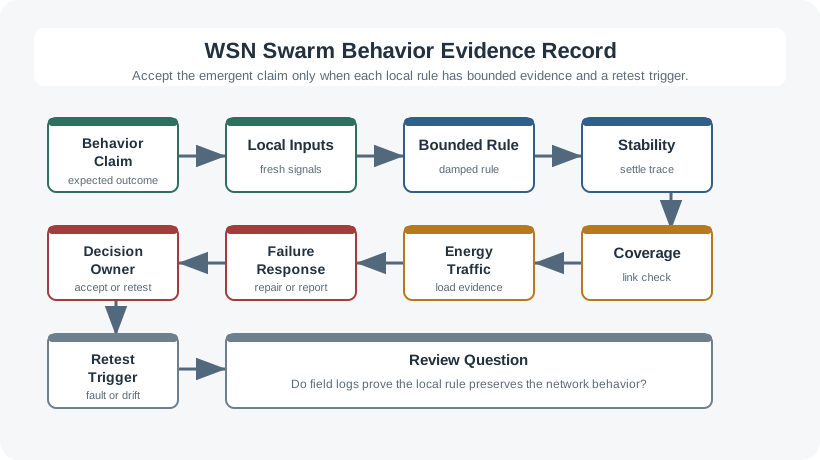
- A reviewer should treat the swarm claim as an evidence claim, not as a magic property.
- The claim must say what local information each node can observe, what rule it applies, what global behavior should emerge, how convergence is detected, and what failure or instability reopens the decision.
Major section
Swarm Behavior Review Route
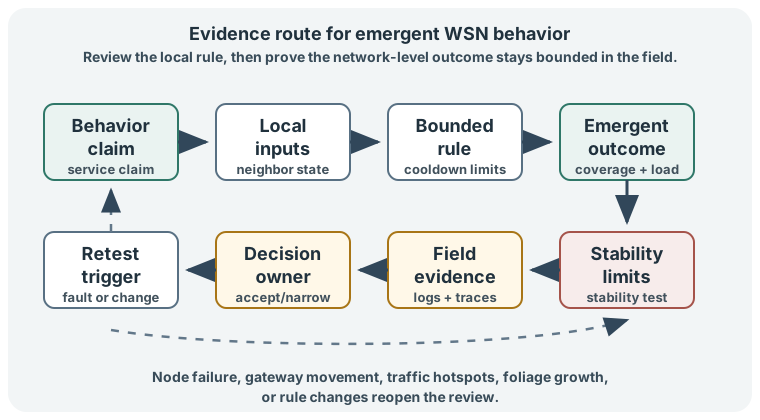
The next Swarm Behavior Review Route step depends on WSN swarm behavior evidence route.
- Figure Figure: WSN swarm behavior evidence route begins with a behavior claim and the local inputs a node can see.
- A bounded rule, including cooldown limits, changes those inputs into an outcome in coverage or load.
- Stability checks ask whether the outcome settles or stays within accepted limits.
- Field logs and route traces then support an accept or narrow decision with an owner.
Major section
Local Rules That Matter in WSNs
They also create review risk because local evidence can be stale, partial, or misleading.
- Swarm behavior is not limited to moving robots.
- In a WSN, local rules may change sampling, radio power, duty cycle, relay choice, cluster membership, or repair state.
- Ant-colony routing uses this idea with virtual pheromone rather than a biological trail.
Major section
Local Rules That Matter in WSNs (continued)
Alignment-style rule: Coordinate timing, reporting cadence, channel choice, or forwarding preference with nearby nodes so local behavior does not conflict.
- Cohesion-style rule: Preserve neighborhood connectivity, cluster membership, or path continuity so a local adaptation does not fragment the network.
- A node increases the local preference for links that recently delivered traffic with acceptable delay, energy cost, queue state, or link quality.
- The review should translate the biology into measurable node state.
Major section
Local Rules That Matter in WSNs (continued)
These rules are useful because they do not require every node to know the whole network.
- Forwarding remains probabilistic, so the network can use a strong path without completely hiding alternatives.
- Pheromone values decay, so stale paths fade when a relay fails, a link degrades, or a better path appears.
- A pheromone value might mean recent delivery success, link margin, queue delay, remaining energy, or a weighted score.
Major section
What Each Node Must Know · Emergence Needs Boundaries
The reviewer should inspect whether each node can actually observe the conditions used by the rule.
- Neighbor evidence: Node identity, link quality, recent packet success, receive windows, duplicate readings, contention, and whether the neighbor is active, sleeping, failed, or only temporarily unreachable.
- Local state: Battery or supply state, queue pressure, sampling state, storage limit, event intensity, firmware version, clock state, and recent restart or brownout history.
- Emergent behavior should be reviewed as bounded adaptation.
Major section
IoT Boundary and Gateway Evidence
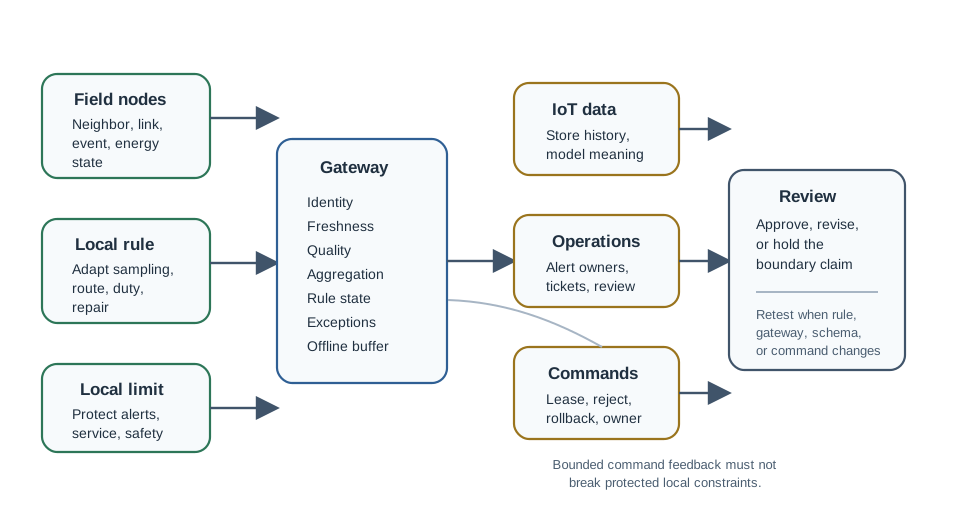
The boundary keeps swarm coordination reviewable after it becomes part of an IoT platform workflow.
- Swarm-style WSN behavior often sits inside a broader IoT system.
- The review should separate local autonomy from gateway custody, cloud oversight, and command authority.
- Command ownership covers who may change a rule, when it expires, and how rollback works.
Major section
IoT Boundary and Gateway Evidence (continued)
Gateway evidence: Gateways should preserve rule version, node state, degraded labels, missing-neighbor signals, and the reason a local action was taken.
- Cloud boundary: Cloud services can audit trends, tune approved limits, and assign owners, but they should not silently override local safety or coverage constraints.
- Figure Figure: Greenhouse WSN example lowers local temperature sampling only follows a greenhouse node that may lower duplicate trend sampling when nearby readings agree.
- The gateway keeps the rule version, node state, degraded labels, missing-neighbor signals, and reason for the local change.
Major section
Convergence and Stability Checks
The reviewer needs evidence that the rule settles into an acceptable operating state or remains bounded while conditions change.
- Convergence does not need to mean every value is fixed forever.
- Evaporation is the part of ant-colony routing that makes old evidence fade.
- With decay, a path must keep being reinforced by successful traffic to stay attractive.
Major section
Dense Greenhouse Monitoring · Worked Review: Relay Hotspot Relief
Local input: Neighbor count, recent readings, timestamp freshness, calibration status, and whether the neighbor remains connected during the active duty state.
- Protected constraint: Temperature alarms and minimum reporting freshness must remain active even when duplicate trend readings are reduced.
- Acceptance evidence: Field logs show fewer duplicate trend samples while alarm latency, coverage, and gateway delivery remain within the accepted service claim.
- The rule needs hysteresis, cooldown, and a visible degraded state.
Major section
Common Swarm Review Mistakes · Review Checklist
Claiming global optimality: A local rule can improve a local condition without proving the best network-wide outcome.
- Ignoring oscillation: Reactive rules can make neighbors chase each other.
- Hiding degraded service: Self-organization should not silently mask a failed node, broken path, or lost coverage state.
- Movement is not free coverage.
Major section
Summary
They do not promise universal optimality, guaranteed energy savings, or automatic self-healing.
- Emergent swarm behavior in WSNs is useful when local rules produce a reviewable network behavior: balanced density, protected connectivity, adaptive sampling, hotspot relief, gap response, or recovery signaling.
- The key review question is not whether the behavior is inspired by a swarm model.
- They record what the rule is allowed to change, what it must not break, what evidence proves success, and what condition requires retesting.
Major section
Key Takeaway · Concept Relationships
Emergent Swarm Behavior in WSNs should evaluate swarm behavior through local rules, emergent effects, stability, failure response, observability, and deployment evidence.
- Swarm behavior affects Communication Paradigms because local forwarding, aggregation, and downlink choices can change traffic shape.
- Swarm behavior connects to Coverage Fundamentals because local adaptation must preserve the accepted sensing and delivery claim.
- Swarm behavior can support Mobile Coverage Optimization, but mobility needs route, recharge, safety, localization, and maintenance evidence.
Deck summary
Key takeaways
No single sensor can see the whole area.
- Local rules can create surprise and instability.
- The next Swarm Behavior Review Route step depends on WSN swarm behavior evidence route.
- They also create review risk because local evidence can be stale, partial, or misleading.
- Alignment-style rule: Coordinate timing, reporting cadence, channel choice, or forwarding preference with nearby nodes so local behavior does not conflict.
Retrieval practice
Recall check 1 of 5

Packet Pete says: answer from memory, then check your reasoning.
Q1A relay-load rule makes every overloaded relay immediately push neighbors away, and in testing routes keep oscillating so queues never settle. Which fix best addresses this?
Show answer
Answer: D Unbounded local reactions cause oscillation; hysteresis and cooldown keep emergent behavior stable and observable.
Retrieval practice
Recall check 2 of 5
Packet Pete says: answer from memory, then check your reasoning.
Q2A swarm rule works with all nodes awake. What test could expose a hidden failure?
Show answer
Answer: A Changed operating states can make local rules oscillate or partition.
Retrieval practice
Recall check 3 of 5
Packet Pete says: answer from memory, then check your reasoning.
Q3In an ant-colony routing rule for a WSN, why should pheromone values decay instead of lasting indefinitely?
Show answer
Answer: A Pheromone decay keeps ant-colony routing from locking onto stale paths.
Retrieval practice
Recall check 4 of 5
Packet Pete says: answer from memory, then check your reasoning.
Q4A WSN team says its nodes will self-organize because each node changes sampling rate based on nearby readings. How should reviewers assess the claimed self-organization behavior?
Show answer
Answer: A A WSN swarm claim needs reviewable evidence: local observations, bounded rule actions, protected service constraints, stability behavior, and a retest trigger.
Retrieval practice
Recall check 5 of 5
Packet Pete says: answer from memory, then check your reasoning.
Q5A relay-load rule makes every overloaded relay immediately discourage neighbors from using it. During testing, routes keep switching between relays and queues never settle. Which fix best addresses the swarm behavior problem?
Show answer
Answer: D Emergent behavior must stay bounded.
Print reference
Answers
Answer key.
- D · Unbounded local reactions cause oscillation; hysteresis and cooldown keep emergent behavior stable and observable.
- A · Changed operating states can make local rules oscillate or partition.
- A · Pheromone decay keeps ant-colony routing from locking onto stale paths.
- A · A WSN swarm claim needs reviewable evidence: local observations, bounded rule actions, protected service constraints, stability behavior, and a retest trigger.
- D · Emergent behavior must stay bounded.