Wireless Sensor Networks · Study deck

WSN System Architecture

Imagine sensors watching a greenhouse overnight.

Packet Pete is your guide for this deck.

architectureapplicationstopology
iotclass.org

After studying this chapter

Learning objectives

You will be able to:

  • Translate a monitoring claim into an accepted WSN architecture instead of starting from a topology label
  • Distinguish the evidence burden carried by sensor nodes, relays, cluster heads, gateways, reference nodes, mobile nodes, and backends
  • Choose between star, tree, mesh, cluster, and hybrid topologies based on simplicity, resilience, energy, latency, and operations cost
  • Identify gateway and backend boundaries where buffering, backhaul outages, duplicates, or missing data can break the architecture claim
iotclass.org

Major section

Start With the Field Story

One node measures the air, nearby nodes pass the reading along, and an operator receives a warning.

  • A gateway is the device that connects the sensor network to another system.
  • Latency means the delay from the field event to the response.
  • At each handoff, ask what can be lost or changed.
iotclass.org

Major section

Architecture Starts With Claims
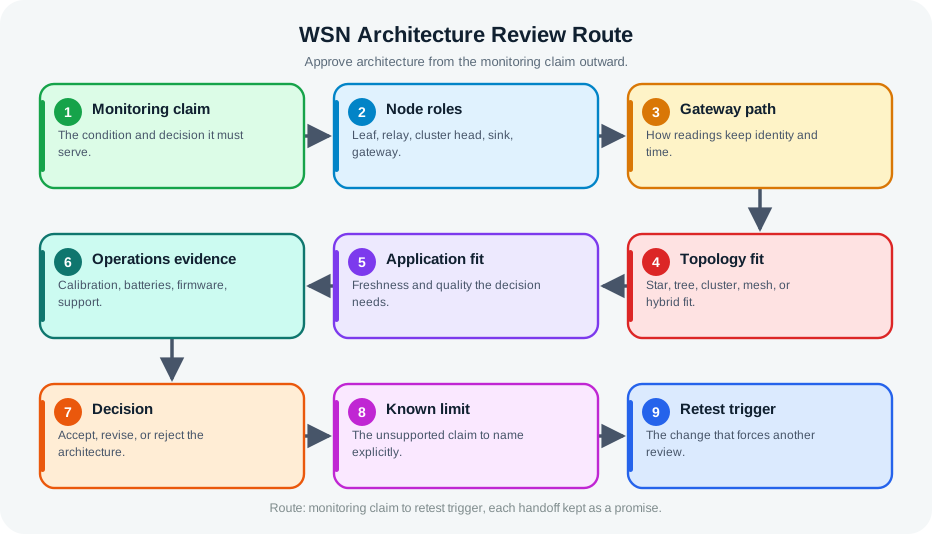
Wireless sensor network architecture is the connection between a field monitoring claim and a supportable system.

  • This conclusion belongs in architecture starts with claims.
  • The architecture should make those differences visible before a topology diagram becomes an approval.
Use the architecture route to keep the review ordered: start with the monitoring claim, assign node roles, prove the gateway path, test topology and application fit, preserve operations evidence, then state the decision, known limit, and retest trigger.
iotclass.org

Major section

Architecture Review Record

A practical architecture record should let another engineer repeat the decision.

  • It should be short enough to use and specific enough to prevent scope drift.
  • Phenomenon, location, interval, latency, data-quality need, decision user, known limit, and non-goal.
  • The system collects readings without proving what operational decision they support.
iotclass.org

Major section

Handoffs and Failure Boundaries

Architecture failures often look like one symptom even when the broken boundary is elsewhere.

  • A node may measure correctly while the relay path drains a gateway-adjacent node.
  • A gateway may buffer data while the backend displays stale values without a warning.
  • A topology may carry normal traffic while failing during a burst or after a parent node changes.
iotclass.org

Major section

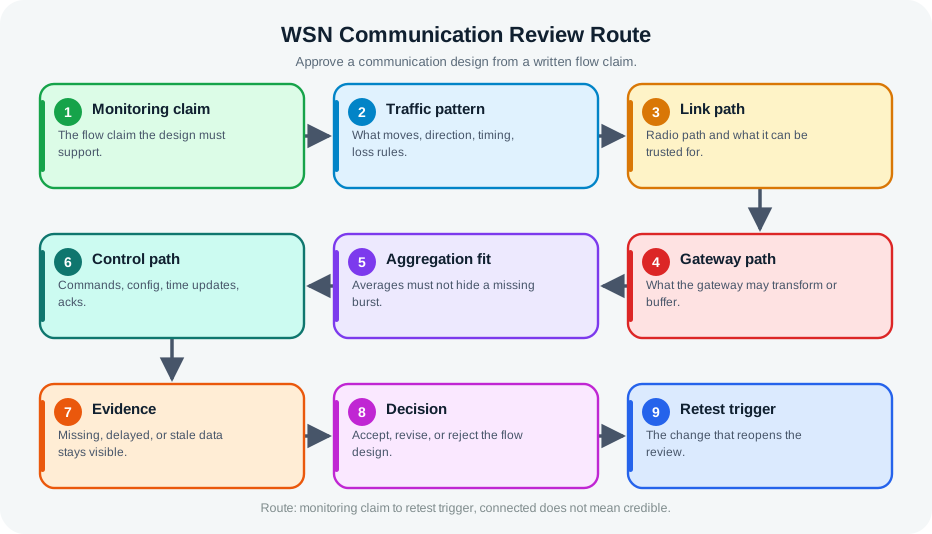
WSN Communication Patterns

Each sensor has a small reading, but the farmer needs one clear view.

  • The first question is who sends what, to whom, and how often.
  • The record should show lost data instead of quietly filling the gap.
One WSN reading travels from field sensor through a neighbor relay and gateway to the backend operator, with delay, loss, retry, buffering, and duplicate evidence attached to each handoff.
iotclass.org

Deck summary

Key takeaways

One node measures the air, nearby nodes pass the reading along, and an operator receives a warning.

  • Wireless sensor network architecture is the connection between a field monitoring claim and a supportable system.
  • A practical architecture record should let another engineer repeat the decision.
  • Architecture failures often look like one symptom even when the broken boundary is elsewhere.
  • Each sensor has a small reading, but the farmer needs one clear view.
iotclass.org

Retrieval practice

Recall check 1 of 6

Packet Pete says: answer from memory, then check your reasoning.

Q1A team starts a WSN architecture review by choosing mesh because it sounds reliable. What should the review require first?

AApprove mesh after adding more nodes, because density alone proves route recovery and coverage.
BSelect mesh first, then let gateways and ownership rules follow the routing diagram.
CSkip retest triggers once the initial layout has acceptable radio links.
DDefine the monitoring claim and evidence boundary before choosing the topology label.
Show answer

Answer: D Topology should follow the claim, node roles, gateway path, backend decision, owner, limits, and retest triggers.

iotclass.org

Retrieval practice

Recall check 2 of 6

Packet Pete says: answer from memory, then check your reasoning.

Q2A greenhouse WSN architecture was approved for slow temperature and humidity trends. The team now wants to reuse it for immediate fire alarm response. What should happen?

AApprove reuse after adding an alarm tile to the trend dashboard and keeping the same gateway path.
BKeep the climate approval if the same installed sensors still report temperature and humidity values.
CRemove the gateway and approve local alarms because direct node operation also meets the timing target.
DRun a new alarm review covering latency, detection, failure behavior, notifications, false alarms, and response ownership.
Show answer

Answer: D A new application claim needs new architecture evidence and may require different node roles, paths, and response ownership.

iotclass.org

Retrieval practice

Recall check 3 of 6

Packet Pete says: answer from memory, then check your reasoning.

Q3Where should the system investigate the old values shown after backhaul recovery?

AReview sensor calibration for a bias in the recovered readings.
BReview only the topology diagram, treating dashboard freshness as outside architecture.
CReview gateway and operations freshness: buffering, timestamps, stale labels, mapping, and alerts.
DRestore the last stored reading to the current-value display during reconnection, keeping the dashboard state unchanged until new samples arrive.
Show answer

Answer: C The architecture failure is in preserving meaning across outage and recovery, not necessarily in the sensors.

iotclass.org

Retrieval practice

Recall check 4 of 6

Packet Pete says: answer from memory, then check your reasoning.

Q4A WSN diagram shows many nodes sending arrows to a gateway. What makes the communication design reviewable?

AApprove after one packet reaches the dashboard and a larger gateway icon appears in the diagram.
BTreat all wireless traffic as self-explanatory once every node uses the same radio family.
CWrite a flow claim separating data, control, coordination, gateway behavior, limits, owner, and retest trigger.
DIncrease drawn gateway capacity without recording timing, loss, retry, or recovery evidence.
Show answer

Answer: C A WSN communication review starts with the monitoring claim and then states the traffic paths and evidence boundaries that support it.

iotclass.org

Retrieval practice

Recall check 5 of 6

Packet Pete says: answer from memory, then check your reasoning.

Q5A bridge-monitoring WSN uses relay nodes near the gateway. Which practitioner evidence should be added before accepting the communication design?

AConfirm that each sensor uses the same radio and firmware revision.
BAccept the first far-node packet as proof of sustained relay capacity.
CRecord relay load, retries, and buffering.
DAdd relays near the gateway because extra relay paths remove the current service bottleneck.
Show answer

Answer: C Practitioner review should preserve the path evidence, role burden, known limit, owner, and retest trigger for the accepted communication claim.

iotclass.org

Retrieval practice

Recall check 6 of 6

Packet Pete says: answer from memory, then check your reasoning.

Q6How should the team assess averaging against the inspection goal?

ARequire proof that aggregation preserves burst evidence or sends exception records separately.
BAccept averaging because it reduces radio load and makes the long-term vibration trend easier to inspect.
CIgnore the issue because the radio link succeeded before aggregation changed the data.
DRemove the gateway so raw readings stay local without operator visibility or timing evidence.
Show answer

Answer: A Under-the-hood review checks whether communication behavior changes the evidence needed by the claim.

iotclass.org

Print reference

Answers 1 of 2

Answer key.

  1. D · Topology should follow the claim, node roles, gateway path, backend decision, owner, limits, and retest triggers.
  2. D · A new application claim needs new architecture evidence and may require different node roles, paths, and response ownership.
  3. C · The architecture failure is in preserving meaning across outage and recovery, not necessarily in the sensors.
  4. C · A WSN communication review starts with the monitoring claim and then states the traffic paths and evidence boundaries that support it.
iotclass.org

Print reference

Answers 2 of 2

Answer key.

  1. C · Practitioner review should preserve the path evidence, role burden, known limit, owner, and retest trigger for the accepted communication claim.
  2. A · Under-the-hood review checks whether communication behavior changes the evidence needed by the claim.
iotclass.org