Wireless Sensor Networks · Study deck
WSN Energy Management
Picture a hill sensor that reports fire risk and relays messages for two nearby units.
Packet Pete is your guide for this deck.
After studying this chapter
Learning objectives
You will be able to:
- Build a WSN energy record from measured node states rather than a single battery-life estimate
- Explain why average node lifetime can hide the first relay, cluster head, or event-heavy node that actually breaks the monitoring claim
- Evaluate harvesting, duty cycling, local processing, and topology-control tradeoffs before approving them as energy fixes
- Explain: Spend Energy on the Decision, Not on Hidden Waiting: Picture a hill sensor that reports fire risk and relays messages for two nearby units.
Major section
Start With the Field Story
Spend Energy on the Decision, Not on Hidden Waiting: Picture a hill sensor that reports fire risk and relays messages for two nearby units.
- Its own report is cheap.
- Long listen periods, retries, and relay work may empty it first.
- An average day cannot prove field life.

Major section
Phoebe's Field Notes: Why The Relay's Extra Current Costs More Than It Looks Like
The mathematical gist: A 1600 mAh pack at the chapter's 50 µA leaf reference gives 32,000 h by linear division.
- A relay carrying six shares of traffic draws 300 µA, whose linear life is 5,333 h.
- Applying the illustrative Peukert model t=tref(Iref/I)k gives 4,876 h at k=1.05 or 3,116 h at k=1.30.
- Peukert's law was developed for lead-acid batteries; use a fitted exponent only when discharge tests support that model for the chosen pack and current range.
Major section
In 60 Seconds
WSN energy management is the evidence record that explains how a field network can keep sensing, forwarding, recovering, and being serviced for the promised monitoring period.
- The beginner mistake is to approve energy from a quiet-lab current number.
- A field node may spend energy on sensor warm-up, radio retries, receive windows, storage, clock repair, route changes, firmware updates, outage buffering, or recovery from weak links.
- The review has to preserve those states before it claims lifetime.
Major section
Beginner Examples
A soil-monitoring node that sleeps well can still fail if a distant gateway causes repeated retries.
- A bridge node with a good battery can still become the limiting node if it relays traffic for a cluster.
- A solar-assisted node still needs evidence for shaded periods, storage recovery, cold starts, and maintenance owner response.
- A longer sleep interval may save energy while making a control, alarm, or missing-data claim too weak.
Major section
Adapt Payload Detail as a Controlled Policy
The mechanism is valuable because it makes adaptation explicit, but it adds model, tuning, and verification cost.
- A very small report can omit trend or diagnostic evidence, while a large report occupies the channel longer, may need fragmentation, and costs more when interference forces a retry.
- One adaptive approach separates interpretation from sequential control.
- For a wearable node, stable measurements and a weak battery may justify a compact periodic summary.
Major section
Evidence Record
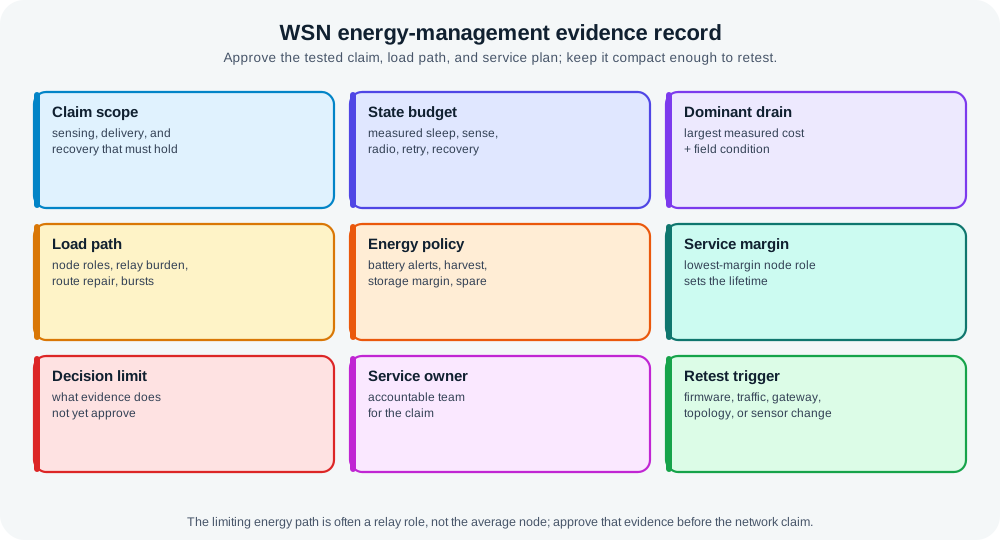
A practical energy record starts with the monitoring objective and then works backward through node states, traffic paths, service rules, and changes that reopen review.
- It should make the limiting condition visible instead of hiding it inside an average lifetime estimate.
- Bench estimates omit wake overhead, receive windows, retries, or failed recovery loops.
- Firmware, sensor, enclosure, radio setting, sample period, storage, update method, or wake source changes.
- The network has no support path before the monitoring claim silently degrades.
Major section
Evidence Record (continued)
Traffic rate, link quality, gateway position, event burst, sensor mode, duty rule, or environmental condition changes.
- Average node lifetime hides the first role that fails and breaks the network claim.
- Topology, gateway, relay role, route policy, antenna, firmware, node density, or reporting path changes.
- Battery alert, harvesting evidence, storage recovery, maintenance access, spare strategy, owner, fallback, and known limit.
Major section
Worked Reviews
Agricultural soil network: A soil network reports slow trends from battery nodes.
- Longer sleep intervals and local aggregation may be acceptable if missing readings stay visible and the dashboard decision tolerates delay.
- The record should include measured sensor warm-up, packet delivery, retry behavior, gateway outage buffering, service access after weather, and the lowest-margin node role.
- Bridge monitoring: A bridge network may have a few relay nodes that carry traffic from hard-to-reach sensors.
Major section
Evidence Record Template
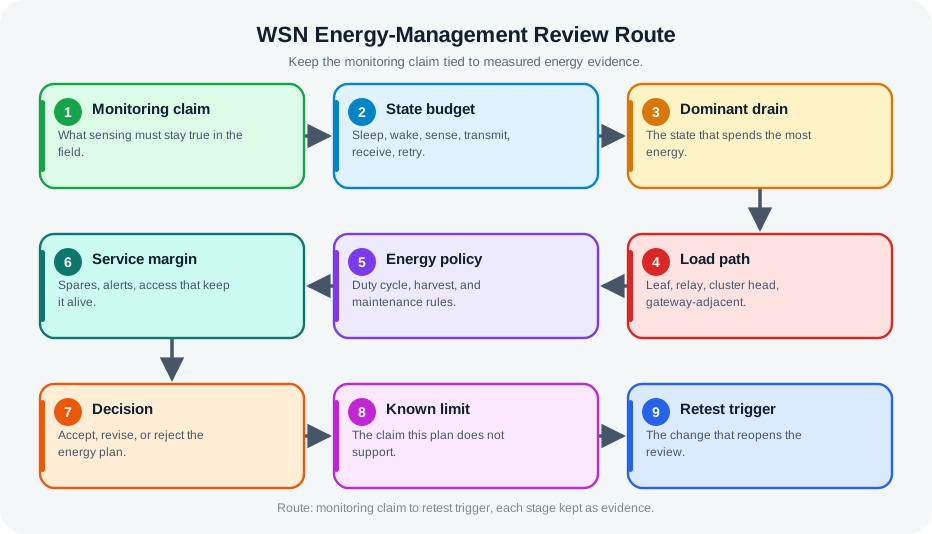
Figure Figure: Worked WSN energy record compares a 50-microamp leaf links a measured state budget to the node role that limits service life.
- Sleep, wake, sensing, send, listen, relay, retry, and recovery each need current and time evidence.
- With the chapter's 1600 mAh usable pack, the relay's simple division gives 5,333 hours before the chemistry correction.
- Energy evidence record template Monitoring claim: what sensing, delivery, and recovery behavior must remain true.
Major section
Where Energy Evidence Fails
Under the hood, energy failures often appear when a rare or hidden state becomes common.
- A weak link can turn transmit into repeated receive and retry work.
- A gateway outage can turn normal reporting into buffering and replay.
- A brownout loop can spend more energy recovering than sensing.
- A firmware update can change every state in the budget.
Major section
Where Energy Evidence Fails (continued)
Traffic BoundaryEvent bursts, downlink commands, diagnostics, commissioning, and firmware updates can change radio and receive-window costs.
- Topology BoundaryGateway movement, route repair, relay concentration, mobile sinks, and antenna changes can shift energy burden to a different node.
- Harvesting needs the same discipline.
- They should not be used as a blanket "maintenance-free" label.
Major section
Where Energy Evidence Fails (continued)
Service BoundaryAlerts, harvesting, replacement access, support owner, and fallback behavior decide whether low-energy evidence becomes an operational failure.
- Solar, vibration, thermal, or flow sources can extend service life when the measured source, storage element, load profile, quiet period, cold-start behavior, and owner response match the claim.
- Average-current arithmetic is useful only after the state sequence is honest.
- The under-the-hood rule is to keep the limiting evidence visible.
Major section
Where Energy Evidence Fails (continued)
Recovery states are easy to miss because they happen after something has already gone wrong.
- A tiny active interval can still dominate if it repeats after every failed packet or every wake cycle.
- Brownout restart, queue rebuild, route rediscovery, buffered upload, and drained-storage recovery can turn a good sleep budget into a bad field budget.
- A leaf node, relay, cluster head, and gateway-adjacent node may run the same firmware but spend energy in different proportions.
Major section
Summary
WSN energy management should protect the monitoring claim, not just quote a battery-life estimate.
- A reviewable record includes measured state budget, dominant drain, routing load, harvesting fit, service margin, owner, known limit, and retest trigger.
- Radio retries, relay roles, gateway behavior, event bursts, downlink commands, recovery loops, and firmware updates can dominate field energy.
- Average node lifetime can hide the first relay, cluster head, gateway-adjacent node, or event-heavy node that breaks the claim.
Deck summary
Key takeaways
Spend Energy on the Decision, Not on Hidden Waiting: Picture a hill sensor that reports fire risk and relays messages for two nearby units.
- The mathematical gist: A 1600 mAh pack at the chapter's 50 µA leaf reference gives 32,000 h by linear division.
- WSN energy management is the evidence record that explains how a field network can keep sensing, forwarding, recovering, and being serviced for the promised monitoring period.
- A soil-monitoring node that sleeps well can still fail if a distant gateway causes repeated retries.
- The mechanism is valuable because it makes adaptation explicit, but it adds model, tuning, and verification cost.
Retrieval practice
Recall check 1 of 3

Packet Pete says: answer from memory, then check your reasoning.
Q1A pilot shows leaf nodes have comfortable battery margin, but two gateway-adjacent relays spend most of their energy forwarding retries. What should the energy review examine first?
Show answer
Answer: A Fast drain at gateway-adjacent relays points the energy review at forwarding load, retries, and route quality first.
Retrieval practice
Recall check 2 of 3
Packet Pete says: answer from memory, then check your reasoning.
Q2A WSN pilot shows edge nodes have comfortable battery margin, but two gateway-adjacent relays spend most energy forwarding retries. What should the energy review do first?
Show answer
Answer: B Practitioner energy review should identify the limiting node role and prove service margin for the claim that depends on it.
Retrieval practice
Recall check 3 of 3
Packet Pete says: answer from memory, then check your reasoning.
Q3A bridge WSN proposal says vibration harvesting will make every node maintenance-free, but only two mounting points have source evidence and no storage recovery test exists. How should the team limit its maintenance-free claim across bridge mounting points?
Show answer
Answer: C Under-the-hood review checks whether hidden states, source variability, and service evidence preserve the energy claim.
Print reference
Answers
Answer key.
- A · Fast drain at gateway-adjacent relays points the energy review at forwarding load, retries, and route quality first.
- B · Practitioner energy review should identify the limiting node role and prove service margin for the claim that depends on it.
- C · Under-the-hood review checks whether hidden states, source variability, and service evidence preserve the energy claim.