Wireless Sensor Networks · Study deck
WSN Energy: Duty-Cycle Foundations
A sensor node saves energy only when its radio truly sleeps.
Packet Pete is your guide for this deck.

After studying this chapter
Learning objectives
You will be able to:
- Explain duty cycling as an operating-state decision, not only an energy-saving trick.
- Connect wake rules to coverage, latency, and reporting-path evidence.
- Compare synchronous, asynchronous, event-driven, and hybrid scheduling choices.
- Review measured current and service evidence without relying on universal lifetime claims.
Major section
Start With the Field Story
A leak begins just after it sleeps, and its parent device also sleeps when the warning is sent.
- A low energy number is useless if the important event waits too long or has no awake path.
- A duty cycle is the share of time a device stays active.
- Latency means the delay from an event to a useful result.
- Drift one clock, miss one wake, change a parent, and send a burst.
Major section
Start With the Field Story (continued)
The schedule should make the failure visible rather than silently save power.
- One schedule cannot fit every season, traffic load, or network shape.
- The deeper sections compare aligned and listening-based methods and show how to trade energy for timely coverage with a reviewable limit.
- Duty cycling is the promise that a node can sleep without missing what matters.
Major section
Duty Cycling as an Active Coverage Claim
In a WSN review, a sleeping sensor is not automatically part of the active monitoring claim.
- It may still be useful, but it only counts if the wake rule, event timing, and delivery path support the claim being made.
- Installed state: The node is physically present and may have power, calibration, and mounting evidence.
- Active state: The node is awake, calibrated, reachable, and able to sense or relay within the accepted time window.
Major section
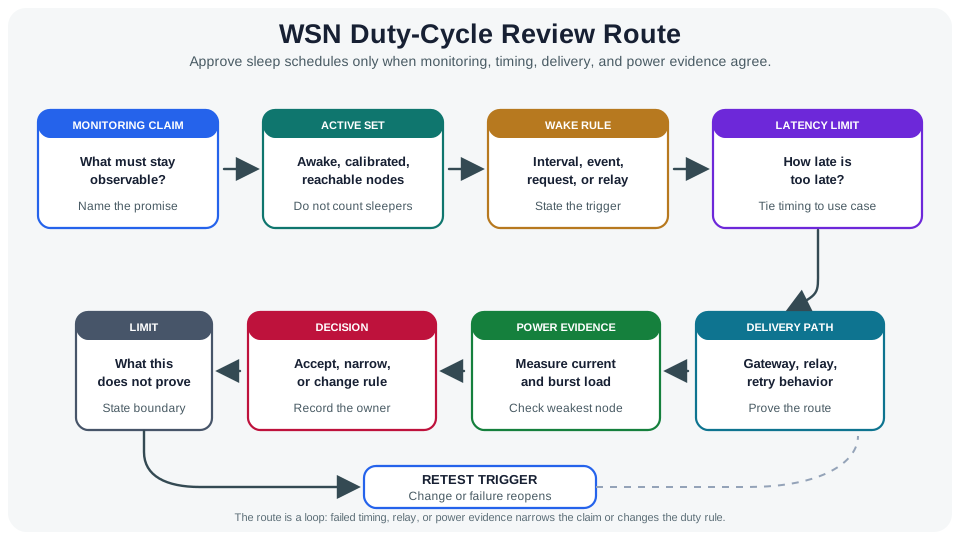
Duty-Cycle Review Route
The Duty-Cycle Review Route claim needs a visual check.
- Its example listens for 200 ms in each 2 s frame and leaves the radio off for 1.8 s, so listen duty is 10%.
- The linked usable-charge example gives an idealized runtime of about 18.4 days.
Major section
What the Schedule Must State
Retest trigger: The site, firmware, sensor, traffic, weather, gateway, or maintenance change that reopens the duty-cycle decision.
- A duty-cycle schedule needs enough detail for another reviewer to reproduce the decision.
- A statement such as "nodes sleep most of the time" is not reviewable.
- The same percentage duty cycle can mean very different behavior.
Major section
Synchronous and Asynchronous Scheduling
Duty-cycling protocols are often introduced by name, but a review should first ask what coordination problem the schedule solves.
- Synchronous schedule: Neighboring nodes share planned wake windows.
- Hybrid schedule: Some periods are scheduled, while urgent events use a separate wake rule.
- Protocol names such as S-MAC, T-MAC, B-MAC, X-MAC, and receiver-initiated MACs are useful vocabulary, but they are not a substitute for review evidence.
Major section
MAC Protocol Evidence
A WSN review should name the required latency, throughput, scalability, fairness, bandwidth utilization, and energy efficiency before choosing a contention or scheduled access pattern.
- Energy waste commonly appears as idle listening by receivers, excessive transmit power or retransmission by senders, and radio start-up latency that is paid every time the node wakes.

Major section
MAC Protocol Evidence (continued)
Its receiver may need to be active during both superframes.
- The visible relationship between (a) sleep and (b) init radio identifies what must remain true in the real system.
- Contention-based MACs, including Wi-Fi-style carrier-sense access, let stations use random access after sensing the channel.
- S-MAC makes the idle-listening trade explicit.
Major section
MAC Protocol Evidence (continued)
They also solve the transmit opportunity only; a receiver that must hear possible traffic still needs awake-time evidence.
- Contention-free MACs, including TDMA-style schedules, reserve a transmission opportunity before the payload is sent.
- GSM, Bluetooth scheduling, and 802.15.4 beacon/GTS behavior are examples to review by their timing evidence, not by the label alone.
- In non-beacon mode, the coordinator sends no periodic beacons and devices use unslotted CSMA/CA.
Major section
MAC Protocol Evidence (continued)
In particular, POWER must be reconciled with: Active before the result can guide implementation.
- IEEE 802.15.4, used beneath Zigbee and 6LoWPAN, distinguishes beacon-enabled from non-beacon operation; Z-Wave uses a different MAC and PHY.
- In beacon-enabled mode, a coordinator's periodic beacons provide synchronization, and a tracking node can wake shortly before an expected beacon rather than listen continuously.
- With those jobs separated, the chapter's mac protocol evidence claim remains testable.
Major section
MAC Protocol Evidence (continued)
A non-beacon design does not automatically use B-MAC or X-MAC preambles: those are separate low-power-listening mechanisms that require their own sender and receiver timing evidence.
- A beacon-tracking design still needs clock-drift and guard-time checks, while any design that actually uses strobed preambles needs preamble-cost and rendezvous checks.
- In a beacon-enabled Zigbee network with parent and child coordinators, a router can track its parent's beacon and serve its own superframe to its children.
- The synchronization step itself is not a single broadcast; it is a small contention round the review should be able to name.
Deck summary
Key takeaways
A leak begins just after it sleeps, and its parent device also sleeps when the warning is sent.
- The schedule should make the failure visible rather than silently save power.
- In a WSN review, a sleeping sensor is not automatically part of the active monitoring claim.
- The Duty-Cycle Review Route claim needs a visual check.
- Retest trigger: The site, firmware, sensor, traffic, weather, gateway, or maintenance change that reopens the duty-cycle decision.
Retrieval practice
Recall check 1 of 4

Packet Pete says: answer from memory, then check your reasoning.
Q1A sleep schedule looks efficient on paper, but field alarms arrive late. What evidence should decide its power claim?
Show answer
Answer: A Energy savings are useful only with the required service.
Retrieval practice
Recall check 2 of 4
Packet Pete says: answer from memory, then check your reasoning.
Q2A storage room is called 'redundant' because two sensors sit at each spot, but one sleeps for long intervals with no event wake rule. Is the redundancy real?
Show answer
Answer: A A sleeping backup only provides redundancy if its wake rule and latency meet the claim.
Retrieval practice
Recall check 3 of 4
Packet Pete says: answer from memory, then check your reasoning.
Q3A sender cannot keep a shared clock with sleepy receivers. Which schedule should the team assess first?
Show answer
Answer: A It does not depend on a shared clock, but still needs service tests.
Retrieval practice
Recall check 4 of 4
Packet Pete says: answer from memory, then check your reasoning.
Q4Why does X-MAC use addressed strobed preambles instead of one long B-MAC preamble?
Show answer
Answer: A X-MAC reduces B-MAC's long-preamble and overhearing costs by sending short addressed strobes; the intended receiver can acknowledge early, and non-target neighbors can return to sleep.
Print reference
Answers
Answer key.
- A · Energy savings are useful only with the required service.
- A · A sleeping backup only provides redundancy if its wake rule and latency meet the claim.
- A · It does not depend on a shared clock, but still needs service tests.
- A · X-MAC reduces B-MAC's long-preamble and overhearing costs by sending short addressed strobes; the intended receiver can acknowledge early, and non-target neighbors can return to sleep.