Wireless Sensor Networks · Study deck
WSN Deployment Sizing
Picture a farm that needs a soil reading from every growing zone before sunrise.
Packet Pete is your guide for this deck.
After studying this chapter
Learning objectives
You will be able to:
- Explain: A neat map suggests twenty sensors, but trees block some links, two areas need backup coverage, and the maintenance team cannot reach one field in winter.
- Explain: A dense spreadsheet can still be wrong if it ignores weak locations, active sleep schedules, gateway reachability, installation access, weather, calibration, spare stock, or support ownership.
- Explain: At the WSN deployment sizing evidence record diagram, the record starts with the claim's scope and operating state, then names the count driver: area, target, or route.
- Explain: The merged deployment-energy chapter adds a practical check: sizing is not only a coverage count.
Major section
Start With the Field Story
A neat map suggests twenty sensors, but trees block some links, two areas need backup coverage, and the maintenance team cannot reach one field in winter.
- The first count is not yet a plan.
- A gateway is a device that joins the field network to another network.
- This pilot cannot prove every season or failure combination.
Major section
In 60 Seconds
A sizing result is not just a number of nodes.
- Good sizing starts with evidence.
- Area, point, barrier, path, and hybrid deployments have different count drivers.
- A dense spreadsheet can still be wrong if it ignores weak locations, active sleep schedules, gateway reachability, installation access, weather, calibration, spare stock, or support ownership.
Major section
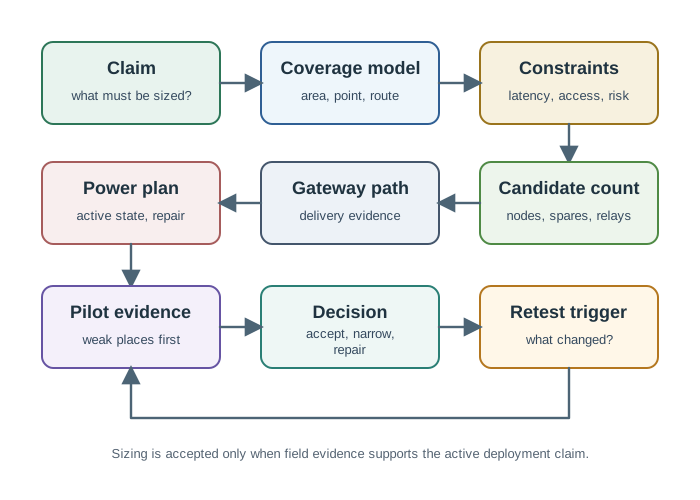
Deployment Sizing Review Route
A gateway path must carry the evidence, and the power plan must cover the active state and repair.
- Pilot results should test weak locations before the team accepts, narrows, or repairs the proposed size.
- A retest trigger records what change would make the decision stale.
- The route is a loop.
Major section
Inputs That Change the Size
Different WSN deployments are sized by different constraints.
- A count that is adequate for one claim may be wasteful or unsafe for another.
- Coverage model: Area coverage is driven by region size and weak locations.
- Point coverage is driven by target inventory.
- Barrier and path coverage are driven by crossings, route bends, gates, and bypasses.
Major section
Inputs That Change the Size (continued)
Redundancy: Backup sensing, spare nodes, independent relay paths, and repair access can require more devices than a single-coverage drawing suggests.
- Connectivity: Gateway reach, relay density, interference, walls, foliage, antenna placement, and backhaul availability can become the binding constraint.
- Installation limits: Mounting height, enclosure rating, cable access, safety rules, tenant access, calibration time, and commissioning windows often decide whether a sizing plan is practical.
- The safest sizing habit is to identify the binding constraint.
Major section
From Coverage to Candidate Count
Candidate count is an estimate that needs validation.
- The method depends on the coverage type.
- A chemical room, fence line, tank list, and service corridor should not be collapsed into one vague "site coverage" count.
- A spreadsheet can estimate a starting count, but field evidence decides whether the selected spacing, mounting position, and active state support the claim.
Major section
Gateway and Backhaul Sizing
Gateway sizing is not only a capacity question.
- Backhaul: The path from gateway to platform or local system needs its own evidence: coverage, uptime, data cap, security, and support owner.
- A deployment can have enough sensors and still fail if readings cannot leave the site.
- Sizing should therefore record both sensing capacity and data-delivery capacity.
Major section
Deployment-Energy Sizing Controls
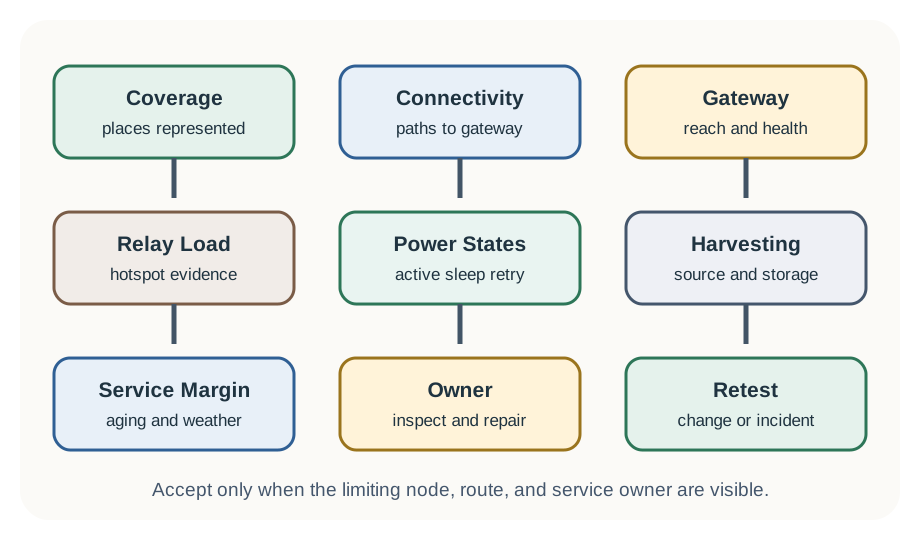
The merged deployment-energy chapter adds a practical check: sizing is not only a coverage count.
- The final size must include the power, relay, gateway, and service controls that keep the accepted claim alive.
- The same cell then gives a shorter modeled service horizon for that relay.
- The limiting node often determines the service claim.
Major section
Limiting Node and Service Margin
Each one needs an owner and retest trigger, otherwise it becomes an unowned promise.
- Many-to-one WSN traffic makes average sizing dangerous.
- A node near the sink may relay traffic for many other nodes, while an edge node sends only its own readings.
- Extra margin should name the failure mode it covers.
Major section
Pilot Evidence Record
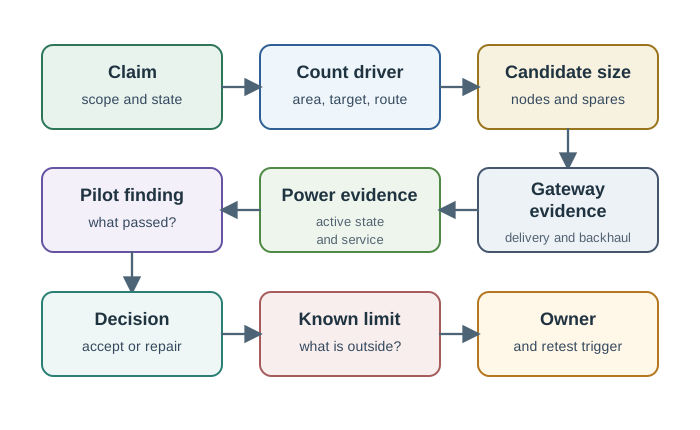
Candidate size includes nodes and spares.
- The pilot finding states what passed; the decision can accept the size or call for repair.
- A known limit keeps uncovered or untested conditions explicit, and the owner and retest trigger say who revisits them.
- Figure the WSN deployment sizing evidence record diagram shows how a pilot can support a size decision.
- At the WSN deployment sizing evidence record diagram, the record starts with the claim's scope and operating state, then names the count driver: area, target, or route.
Major section
Worked Review: Greenhouse Expansion
The requirement is area coverage during the night schedule, with enough evidence to detect weak zones near doors and fans.
- Claim: The new growing bay will have area monitoring during the normal night schedule, with weak zones near doors and fans explicitly tested.
- Retest trigger: Reopen sizing after shelf movement, fan changes, gateway relocation, sensor model change, repeated missed readings, or changed night schedule.
- The point is not to memorize a node count.
Major section
Worked Review: Pipeline Valve Monitoring
A utility needs to monitor named valves along a pipeline corridor.
- The requirement is point coverage at the valves, not full area monitoring of the corridor between valves.
- Claim: The named valve list has point coverage with a reporting path to the gateway during the accepted schedule.
- Gateway driver: Long route geometry, terrain, relay options, backhaul availability, and weak links during bad weather or maintenance states.
Major section
Common Sizing Mistakes
One number for the whole site: Hybrid sites need separate counts and evidence for rooms, targets, boundaries, and routes.
- Counting installed instead of active nodes: Sleeping, failed, uncalibrated, unreachable, or disabled nodes should not silently satisfy the accepted size.
- Forgetting gateways: The sensor count is not enough if weak nodes cannot deliver data or if one gateway failure invalidates the claim.
- No retest trigger: Deployment size drifts after layout changes, sensor replacement, gateway movement, firmware changes, and environmental change.
Major section
Concept Relationships
WSN Coverage Fundamentals explains how sizing depends on coverage claims and evidence.
- WSN Coverage: Problem Types separates area, point, barrier, path, hybrid, and redundancy decisions.
- WSN Energy Duty Cycling explains how sleep schedules affect active sizing and latency.
- Communication Paradigms connects gateway and reporting-path evidence to the deployment size.
Deck summary
Key takeaways
A neat map suggests twenty sensors, but trees block some links, two areas need backup coverage, and the maintenance team cannot reach one field in winter.
- A sizing result is not just a number of nodes.
- A gateway path must carry the evidence, and the power plan must cover the active state and repair.
- Different WSN deployments are sized by different constraints.
- Redundancy: Backup sensing, spare nodes, independent relay paths, and repair access can require more devices than a single-coverage drawing suggests.
Retrieval practice
Recall check 1 of 5

Packet Pete says: answer from memory, then check your reasoning.
Q1A sizing review finds 80 sensors satisfy the point-target list, but gateway-path tests show weak delivery unless two extra relay locations are added. What should the reviewer conclude?
Show answer
Answer: A A defensible size needs both target coverage and a proven delivery path; weak gateway paths require relays or a narrower claim.
Retrieval practice
Recall check 2 of 5
Packet Pete says: answer from memory, then check your reasoning.
Q2A deployment predicts two years of life from average node energy, but the gateway-adjacent relays fail in months. What should the sizing review require?
Show answer
Answer: B Deployment sizing must satisfy the limiting node or group.
Retrieval practice
Recall check 3 of 5
Packet Pete says: answer from memory, then check your reasoning.
Q3A plan copies a vendor range and a fixed gateway ratio to claim an exact node count. What is missing?
Show answer
Answer: A Sizing estimates need field evidence instead of universal ratios.
Retrieval practice
Recall check 4 of 5
Packet Pete says: answer from memory, then check your reasoning.
Q4A WSN sizing review finds that 80 sensors may satisfy the point target list, but gateway-path tests show weak delivery unless two extra relay locations are added. What should the reviewer conclude?
Show answer
Answer: B Deployment sizing must satisfy the monitoring claim and the delivery path.
Retrieval practice
Recall check 5 of 5
Packet Pete says: answer from memory, then check your reasoning.
Q5A proposal chooses the lowest-cost sensor because its unit price is much lower, but it needs more mounting points, more battery visits, and extra gateway repairs. How should the proposal compare the two sensor choices?
Show answer
Answer: C Deployment sizing should compare total supportable deployment evidence, not only sensor unit price.
Print reference
Answers
Answer key.
- A · A defensible size needs both target coverage and a proven delivery path; weak gateway paths require relays or a narrower claim.
- B · Deployment sizing must satisfy the limiting node or group.
- A · Sizing estimates need field evidence instead of universal ratios.
- B · Deployment sizing must satisfy the monitoring claim and the delivery path.
- C · Deployment sizing should compare total supportable deployment evidence, not only sensor unit price.