Wireless Sensor Networks · Study deck
WSN Coverage Worked Examples
Worked examples are useful when they keep the decision visible.
Packet Pete is your guide for this deck.

After studying this chapter
Learning objectives
You will be able to:
- Explain: This three-part reading supports the stated result: WSN deployment sizing record linking claim, count driver, candidate size, gateway evidence, power evidence, pilot finding, decision, known limit, owner, and retest trigger.
- Explain: Good repair evidence: New readings from weak locations, an updated active-set check, a connectivity pass, and a short note saying which previous gap was closed.
- Explain: Finding: The schedule may be acceptable for slow-moving observations, but it is not evidence for immediate alarm detection unless the latency requirement also passes.
- Explain: Claim: The corridor remains acceptably monitored while the sleep schedule saves energy.
Major section
Example Review Route
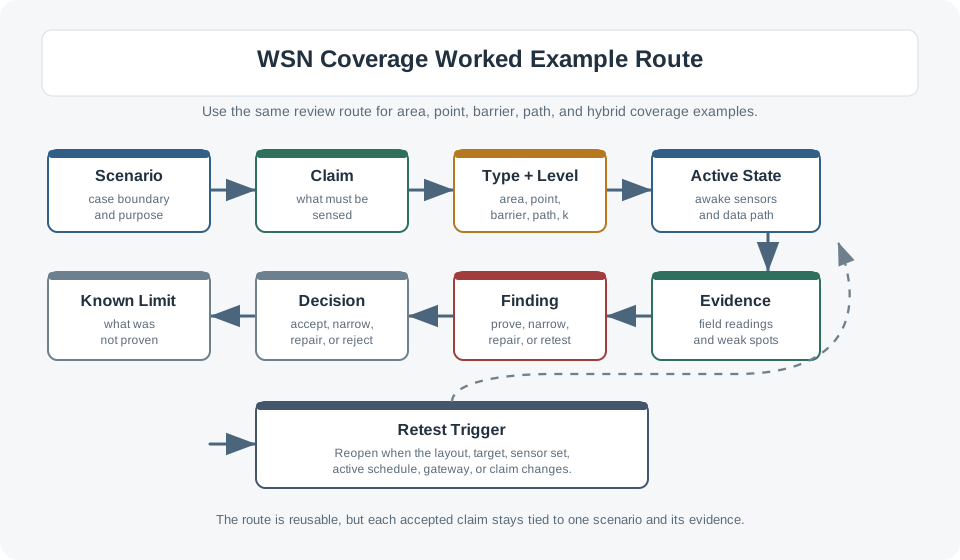
A hidden assumption between Scenario and case boundary could overturn example review route.
- The resulting structure is not decorative: Wireless sensor network coverage worked example review route connecting the scenario, coverage claim, coverage type and level, active state, field evidence, finding, decision, known limit, and retest trigger.
- The route keeps examples from drifting into calculation theater.
Major section
Example 1: Redundant Area Monitoring
A water treatment room has an area coverage claim: important process conditions should be detected anywhere inside the monitored room during normal operation.
- The risk is high enough that the design asks for backup sensing at weak points.
- Claim: The monitored process room has redundant area coverage during the normal operating schedule.
- Finding: The central area has strong overlap, but corner and edge locations have weaker evidence.
- The learning point is not a fixed sensor count.
Major section
Example 1: Redundant Area Monitoring (continued)
Some sensors shown in the planning drawing are not active during the reviewed schedule.
- Retest trigger: Reopen the review after sensor movement, schedule change, equipment layout change, failed reading, or gateway relocation.
- The learning point is that redundant coverage must be true at the weak locations and in the active operating state.
- Good repair evidence: New readings from weak locations, an updated active-set check, a connectivity pass, and a short note saying which previous gap was closed.
Major section
Example 2: Duty-Cycle Evidence
A remote wildlife monitoring deployment needs long battery life.
- Claim: The corridor remains acceptably monitored while the sleep schedule saves energy.
- Finding: The schedule may be acceptable for slow-moving observations, but it is not evidence for immediate alarm detection unless the latency requirement also passes.
- Duty cycling is a coverage decision, not only an energy decision.
Major section
Example 3: Sensing Range Tradeoff
A cheaper sensor can still be the expensive choice if it needs more locations, more batteries, more calibration, or more repair visits.
- Evidence limit: A longer sensing range can cover more space, but it can also sense through openings, across adjacent zones, or from poor mounting angles.
- Field validation decides whether the extra range is useful.
- Retest trigger: Reopen after partition changes, tenant layout changes, sensor replacement, changed mounting height, repeated false occupancy, or repeated missed occupancy.
Major section
Barrier Coverage for Crossings
The requirement is crossing detection, not full interior tracking.
- Likely claim: Barrier coverage along the stated boundary, with explicit tests at gates, corners, likely bypasses, and weak line-of-sight points.
- The test supports the barrier claim, not full interior monitoring.
- Repair evidence: Additional crossing tests after vegetation growth, fence changes, sensor relocation, or repeated false alarms.
Major section
Example Evidence Record
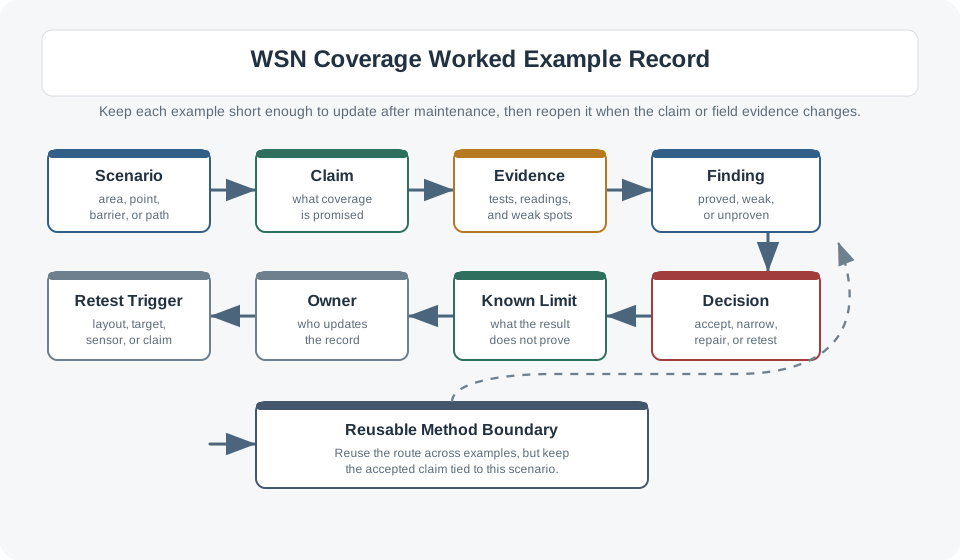
The visual next names area, point, to show where the review fixes the spatial boundary; barrier, or path finally adds a distinct review condition.
- They keep example evidence record tied to observable evidence.
- The record should be short enough to update after maintenance.
Major section
Common Worked-Example Mistakes
Approving the calculation: A calculation can be correct while the deployed claim is still unproven.
- Ignoring weak locations: Edges, corners, obstructions, gates, route bends, and sleeping sensors often decide whether the claim is honest.
- Mixing energy and coverage: Battery savings are useful only if the accepted active state still supports the coverage claim.
- Using unit cost as the decision: Hardware price does not include placement count, installation time, battery visits, false alarms, missed detections, or support ownership.
Major section
Every Number Needs a Sizing Boundary
The deeper layer is the arithmetic boundary behind those decisions.
- The same calculation can be honest for a fenced corridor, misleading for a whole room, and useless after a gateway move.
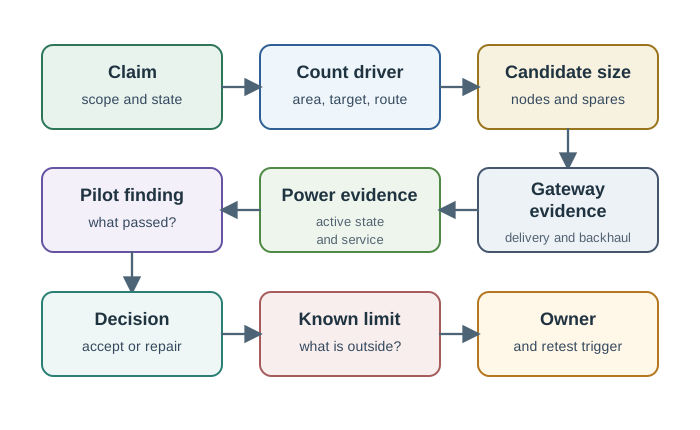
- Two observations govern this part of every number needs a sizing boundary: scope and state and: Count driver.
Major section
Every Number Needs a Sizing Boundary (continued)
The point of the depth layer is not to make the worked example mathematical for its own sake.
- This three-part reading supports the stated result: WSN deployment sizing record linking claim, count driver, candidate size, gateway evidence, power evidence, pilot finding, decision, known limit, owner, and retest trigger.
- The review also separates arithmetic precision from field certainty.
- Decision: Say accept, narrow, repair, or retest, then record what change reopens the sizing decision.
Major section
Work the Random-Deployment Count
Rearranging the full-disk case gives lambda = -ln(1-p) / (pi*Rs^2).
- Multiplying by 10,000 gives 95.4 expected nodes, so the planning count rounds up to 96 before boundary margin and deployment constraints.
- For 95% expected one-coverage at a point at least 10 m inside every square boundary, -ln(0.05) = 2.996, so lambda = 2.996 / 314.16 = 0.00954 nodes per square metre.
- Raising the target from 95% to 99% does not mean four percent more nodes.
Major section
k-Coverage Placement Meaning
Two refinements change what the worked number means.
- Under the same Poisson model, the number of sensors covering a point has mean mu = lambda*pi*Rs^2.
- To make under-coverage unlikely, the mean usually needs to sit above the required k value.
- Second, placement model changes the count.
Major section
k-Coverage Placement Meaning (continued)
The safe review habit is to keep the count driver visible.
- The example must say whether redundancy is a resilience requirement, a localization requirement, or just a comfort phrase.
- Barrier coverage counts scale with boundary segments and crossing tests.
- A worked example that mixes those drivers should be split before the arithmetic is accepted.
Deck summary
Key takeaways
A hidden assumption between Scenario and case boundary could overturn example review route.
- A water treatment room has an area coverage claim: important process conditions should be detected anywhere inside the monitored room during normal operation.
- Some sensors shown in the planning drawing are not active during the reviewed schedule.
- A remote wildlife monitoring deployment needs long battery life.
- A cheaper sensor can still be the expensive choice if it needs more locations, more batteries, more calibration, or more repair visits.
Retrieval practice
Recall check 1 of 5

Packet Pete says: answer from memory, then check your reasoning.
Q1A worked example shows strong overlap at a room's center, but field readings were never taken near corners and equipment shadows. What should the reviewer conclude?
Show answer
Answer: A Untested corners and shadows require narrowing the claim or validating weak locations before acceptance.
Retrieval practice
Recall check 2 of 5
Packet Pete says: answer from memory, then check your reasoning.
Q2A longer-range sensor costs less per covered area on paper. What should a pilot test?
Show answer
Answer: C Installed evidence can overturn the paper cost advantage.
Retrieval practice
Recall check 3 of 5
Packet Pete says: answer from memory, then check your reasoning.
Q3A worked example shows strong sensor overlap in the center of a process room, but field readings were not taken near corners or equipment shadows. What should the reviewer conclude?
Show answer
Answer: C Worked examples should not accept a broad coverage claim from evidence collected only in the easiest part of the deployment.
Retrieval practice
Recall check 4 of 5
Packet Pete says: answer from memory, then check your reasoning.
Q4A low-duty-cycle wildlife schedule gives long battery life but can delay detection for several minutes. Which use is the best fit without a new review?
Show answer
Answer: A Duty-cycle examples must keep the energy decision tied to the monitoring claim and latency tolerance.
Retrieval practice
Recall check 5 of 5
Packet Pete says: answer from memory, then check your reasoning.
Q5A 10,000 square metre Poisson planning model with 10 m sensing radius estimates about 96 nodes for 95% one-coverage at points at least 10 m from every boundary and about 147 for 99%. What is the best review conclusion?
Show answer
Answer: A Coverage targets near 100% have diminishing returns under the random deployment model.
Print reference
Answers
Answer key.
- A · Untested corners and shadows require narrowing the claim or validating weak locations before acceptance.
- C · Installed evidence can overturn the paper cost advantage.
- C · Worked examples should not accept a broad coverage claim from evidence collected only in the easiest part of the deployment.
- A · Duty-cycle examples must keep the energy decision tied to the monitoring claim and latency tolerance.
- A · Coverage targets near 100% have diminishing returns under the random deployment model.