Wireless Sensor Networks · Study deck
WSN Coverage: Problem Types
Do not treat coverage as one shape.
Packet Pete is your guide for this deck.

After studying this chapter
Learning objectives
You will be able to:
- Distinguish area, point, barrier, path, and hybrid WSN coverage problems.
- Translate a monitoring objective into the right coverage formulation.
- Explain how redundancy and active operating state change the meaning of a coverage claim.
- Identify evidence needed to accept each coverage type in a deployed WSN.
Major section
Start With the Field Story · In 60 Seconds
WSN coverage problem types describe what must be sensed.
- Area coverage asks whether a continuous region is monitored.
- Point coverage asks whether named targets are monitored.
- Barrier coverage asks whether a boundary crossing will be detected.
- Path coverage asks whether a route or corridor is monitored.
Major section
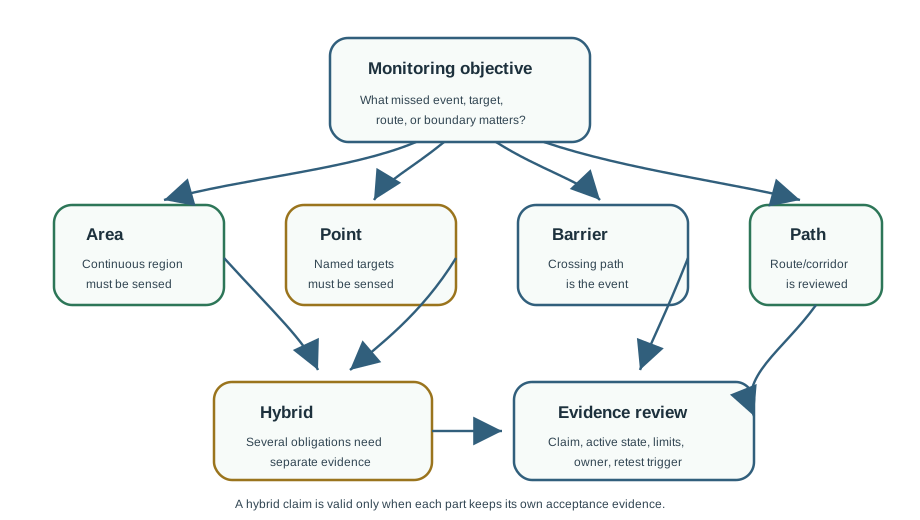
Coverage Type Starts With the Objective · Selection Route
A continuous region needs area coverage.
- Named targets need point coverage.
- A crossing needs barrier coverage.
- A route or corridor needs path coverage.
- A hybrid case carries several obligations, each with its own acceptance evidence.
Major section
Point Coverage · Barrier Coverage
Point coverage is used when the requirement names discrete targets.
- Common mistake: Calling a point-coverage plan "site coverage" when the spaces between points are not actually monitored.
- Point coverage can be efficient and accurate when the important locations are known.
- Barrier coverage is used when crossing a boundary is the event of interest.
Major section
Path Coverage · Hybrid Coverage
Path coverage is used when sensing quality matters along a route rather than across an entire area.
- Common mistake: Expanding a route requirement into full area coverage, then spending effort monitoring areas that do not affect the route decision.
- Path coverage is useful when a learner needs to reason about movement, inspection, or monitoring continuity along a route.
- It should state whether missed events between route points are acceptable.
Major section
Evidence Record · Redundancy and Active State
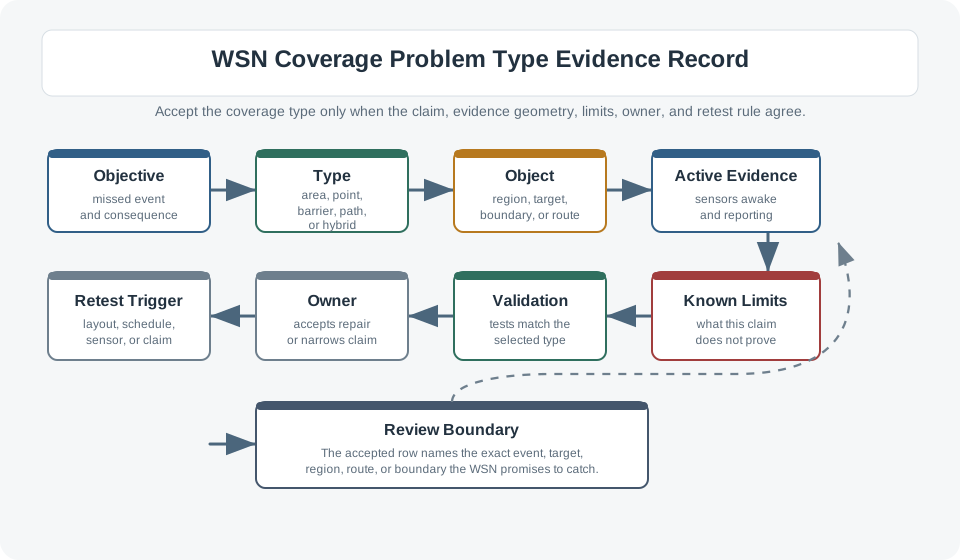
Their relationship makes WSN coverage problem type evidence record reviewable.
- Active evidence counts sensors that are awake and reporting, while validation tests must match that selected type.
- Known limits say what the result does not prove.
- The accepted row should name exactly what the network promises to catch.
- This record also helps later chapters.
Major section
Worked Review: Storage Yard · Worked Review: Building Access
A site manager says, "We need coverage for the storage yard." That phrase is too broad to approve.
- This requires evidence across the whole region.
- This requires a complete target list and sensor-to-target mapping.
- This protects the boundary but does not prove internal source detection.
Major section
Common Problem-Type Mistakes · Review Checklist
Using the broadest type by default: Full area coverage is not automatically the right goal.
- Confusing barrier and interior monitoring: A perimeter detector can show a crossing event without proving that internal conditions are monitored after the crossing.
- Ignoring path timing: A route can look covered on a map but fail if sensors are asleep during the movement window.
- Combining claims without evidence: A hybrid design needs separate acceptance evidence for each coverage obligation.
Major section
Problem-Type Contract
The deeper review is to treat each type as a contract about the missed event that would make the deployment fail.
- Area coverage fails when an accepted part of the region is outside the sensing condition.
- Point coverage fails when a named target lacks accepted sensing evidence.
- Barrier coverage fails when a crossing path can evade the belt.
Major section
Problem-Type Contract (continued)
Path coverage fails when the route segment or movement window is not supported.
- Hybrid coverage fails when one of its separate subclaims is hidden inside a broad label.
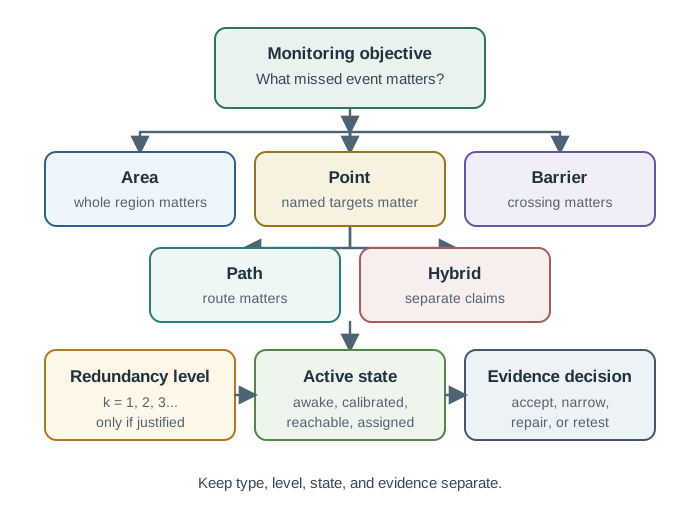
- The separate whole region matters label fixes the spatial boundary, preventing the first two stages from being accepted on their own.
- This distinction carries forward into problem-type contract.
Major section
Problem-Type Contract (continued)
The contract should also name the review boundary.
- The complete reading is that wireless sensor network coverage type decision map linking monitoring objective to area, point, barrier, path, hybrid, redundancy level, active state, and evidence decision.
- A dense point design still does not prove interior area coverage.
- That silence is not a defect if it is visible.
Major section
Problem-Type Contract (continued)
A clean barrier chain still does not prove what happens after entry.
- A route plan still does not cover storage racks away from the path.
- The problem type is the smallest honest sentence that names what the network promises to catch and what it explicitly leaves outside the claim.
- A claim can be valid for the north fence, the loading aisle, or the twelve valves while being silent about the rest of the site.
Major section
Split Hybrid Coverage Claims
For a hybrid claim, each subclaim needs its own monitored object, active state, validation evidence, known limit, owner, and retest trigger.
- The practical mistake is letting the strongest-looking subclaim lend credibility to the others.
- A clear fence test does not validate tank monitoring.
- A full target list does not validate route timing.
Major section
Split Hybrid Coverage Claims (continued)
The result may look less impressive than one large map, but it is much easier to repair because each failing obligation is visible.
- A route pass during the day does not validate a night rotation.
- After the split, use separate acceptance verbs.
- Separate verbs keep the review operational.
Major section
Problem Types Change Geometry · Summary
Problem type changes the geometry of proof.
- Area coverage samples or bounds a two-dimensional region.
- Hybrid coverage combines several geometries that must remain separate.
- The difference is not only cost; it is also evidence shape.
- For area coverage, the evidence should expose holes, edge cases, obstructions, and active-state gaps in the region.
Deck summary
Key takeaways
WSN coverage problem types describe what must be sensed.
- A continuous region needs area coverage.
- Point coverage is used when the requirement names discrete targets.
- Path coverage is used when sensing quality matters along a route rather than across an entire area.
- Their relationship makes WSN coverage problem type evidence record reviewable.
Retrieval practice
Recall check 1 of 5

Packet Pete says: answer from memory, then check your reasoning.
Q1A WSN must monitor twelve named valves on a pipeline; the spaces between them need no continuous sensing. Which coverage problem type fits?
Show answer
Answer: A Monitoring discrete named targets like specific valves is a point-coverage problem.
Retrieval practice
Recall check 2 of 5
Packet Pete says: answer from memory, then check your reasoning.
Q2A map shows redundant sensors at a point, but a required sensor sleeps during alarms. What must a redundancy claim count?
Show answer
Answer: B Sleeping sensors cannot provide concurrent alarm coverage.
Retrieval practice
Recall check 3 of 5
Packet Pete says: answer from memory, then check your reasoning.
Q3A WSN is required to monitor twelve named valves on a pipeline. The spaces between the valves do not need continuous sensing. Which coverage problem type fits best?
Show answer
Answer: B Coverage type should follow the monitoring objective.
Retrieval practice
Recall check 4 of 5
Packet Pete says: answer from memory, then check your reasoning.
Q4A perimeter sensor line detects crossings at the fence, but the chapter draft says the whole yard is monitored. What is the best correction?
Show answer
Answer: B Problem-type quality depends on matching the claim to evidence and stating limits clearly.
Retrieval practice
Recall check 5 of 5
Packet Pete says: answer from memory, then check your reasoning.
Q5A team validates door sensors, a fence crossing test, and a robot aisle pass, then labels the whole building as area covered. What is the strongest review response?
Show answer
Answer: A Each coverage problem type has its own evidence geometry.
Print reference
Answers
Answer key.
- A · Monitoring discrete named targets like specific valves is a point-coverage problem.
- B · Sleeping sensors cannot provide concurrent alarm coverage.
- B · Coverage type should follow the monitoring objective.
- B · Problem-type quality depends on matching the claim to evidence and stating limits clearly.
- A · Each coverage problem type has its own evidence geometry.