Wireless Sensor Networks · Study deck
WSN Coverage: Implementations
Implementation turns coverage theory into installation work.
Packet Pete is your guide for this deck.
After studying this chapter
Learning objectives
You will be able to:
- Explain: The cold-storage map underneath shows why a planned sensing circle is not enough by itself: weak areas, sleeping sensors, and reporting-path checks must be reviewed in the operating state.
- Explain: A node should advertise intent, wait through a randomized or ordered back-off, listen for neighbour status changes, and re-evaluate redundancy against the current active set before sleeping.
- Explain: The review then shows whether the schedule preserved sensing, route reachability, and repair ownership across the transition instead of only proving that each node made a plausible local decision.
- Explain: Those answers make acceptance maintainable.
Major section
From Claim to Implementation
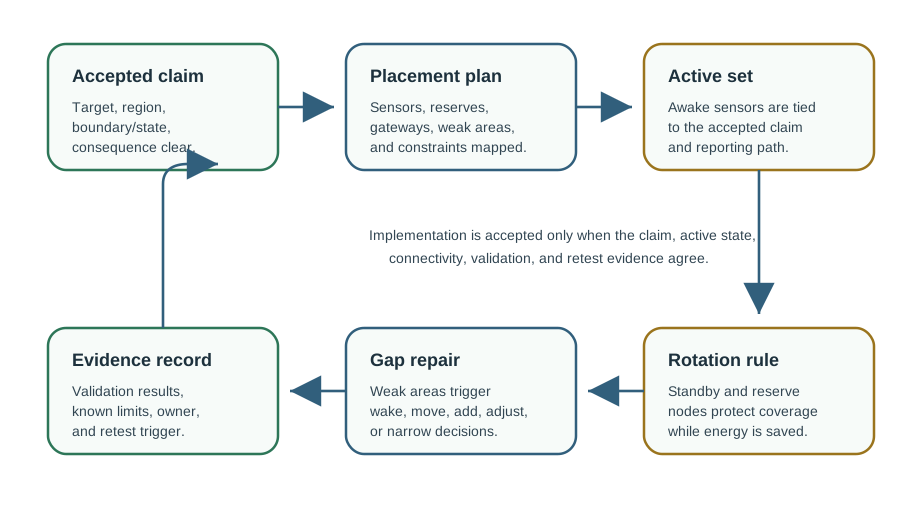
The cold-storage map underneath shows why a planned sensing circle is not enough by itself: weak areas, sleeping sensors, and reporting-path checks must be reviewed in the operating state.
- If the field evidence exposes a weak or uncovered area, the implementation must repair or narrow the claim, retest, and update the evidence record before acceptance.
- The visual in the WSN coverage implementation route diagram makes the dependency explicit: the accepted claim defines what must remain true, the placement plan proposes where sensing responsibility sits, the active state identifies what is actually awake, and field validation checks weak points and reporting paths.
Major section
Implementation Inputs
A coverage implementation record should be short enough to maintain and specific enough to audit.
- A sensor that detects an event but cannot report it is not operationally useful.
- Energy rule: Tie sleep, wake, sampling, and rotation choices to the coverage claim so energy savings do not quietly remove required sensing.
- Retest trigger: List the conditions that reopen review: sensor replacement, firmware change, layout change, battery alarm, repeated packet loss, or a failed validation pass.
Major section
Choosing an Implementation Pattern
The important choice is not the label; it is the evidence the pattern must produce.
- The evidence should include the layout, install confirmation, and field validation at boundaries and weak areas.
- Algorithms such as OGDC belong here, but the approved result is the active set and its evidence, not the algorithm name.
- The record should show which set is active, which set is standby, and how failure or rotation preserves the claim.
Major section
Field Validation Loop
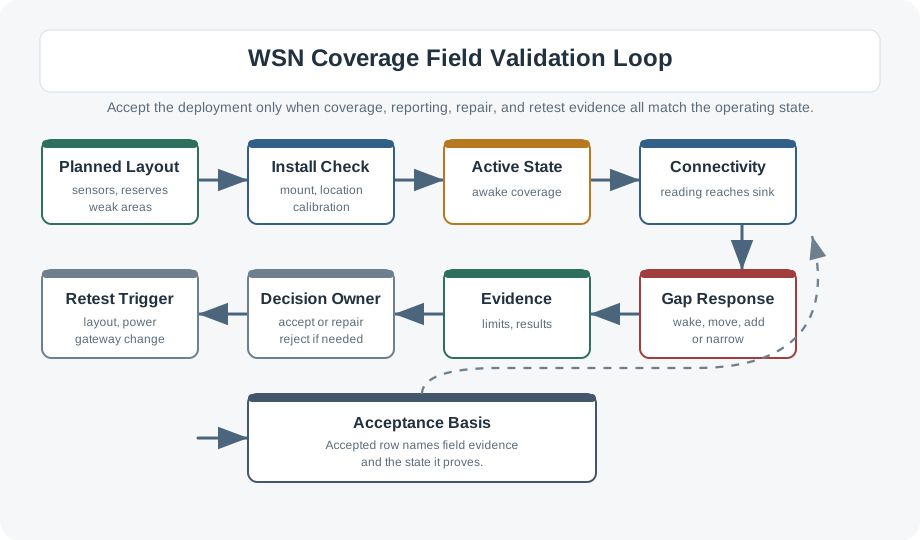
The loop matters because coverage can fail for several different reasons.
- A sensing gap, a sleeping sensor, a blocked route, and a missing maintenance record all require different fixes.
Major section
Worked Review: Cold Storage Zone
Coverage claim: Temperature excursions near doors and product aisles must be detected while the room is operating normally.
- Key implementation risk: Doors, pallets, and metal shelving may make a simple range drawing too optimistic.
- This review does not require a complicated algorithm.
- It requires a coverage claim that survives the actual operating environment.
Major section
Worked Review: Perimeter Detection
A perimeter monitoring system is concerned with movement across a boundary rather than full area coverage.
- A dense area-coverage layout may waste nodes, while a sparse boundary layout may miss gaps at gates, corners, or service paths.
- Coverage claim: Movement across the protected boundary must be detected at approved crossing points and likely bypass paths.
- Active-state check: A rotating or duty-cycled design must still keep the barrier active during the protected window.
Major section
Common Implementation Mistakes
Forgetting sleeping sensors: A coverage plan that works only when every sensor is awake is not the same as a duty-cycled coverage plan.
- Using one sensing range everywhere: Walls, weather, vegetation, mounting height, and target type can change effective sensing.
- Field validation should test the weak areas.
- No repair owner: Gap repair is slow when nobody owns the decision to wake a reserve node, move a sensor, add hardware, or narrow the accepted claim.
Major section
Acceptance as State Invariant
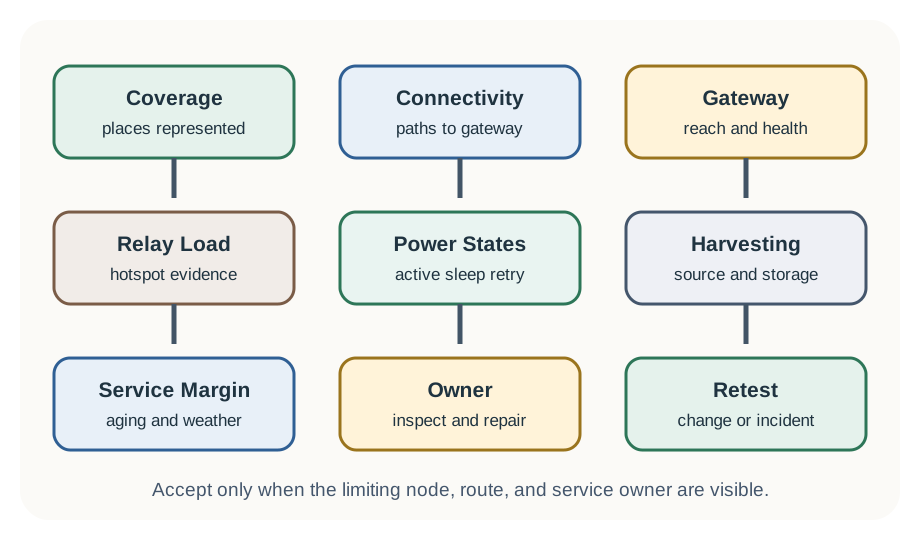
The deeper implementation rule is stricter: acceptance must be true for a named network state, and the record must say which state is being approved.
- A plan that covers with all nodes awake is not the same artifact as a plan that covers while a duty-cycle schedule sleeps half the aisle nodes.
- Those answers make acceptance maintainable.
- They expose the two conditions that the surrounding argument must keep together.
Major section
Acceptance as State Invariant (continued)
That contrast is the visual's teaching load: WSN implementation record linking coverage, relay load, service margin, connectivity paths, power states, owner, gateway health, harvesting, and retest trigger.
- The chapter can now use acceptance as state invariant without dropping the conditions shown here.
- This matters most when optimization is successful.
- Energy-saving schedules, active-set selection, and rotation can make the network last longer, but they also create multiple valid-looking states.
Major section
Acceptance as State Invariant (continued)
The reviewer should approve the weakest state that is actually used in operation, not the most flattering state shown in the planning diagram.
- A quick way to test the invariant is to ask what would make the accepted row false.
- If a relay fails, the record should show which coverage claims lose their reporting path.
- If a battery policy changes, the record should show which active set needs retesting.
Major section
Build the Active-Set Ledger
A practical implementation review should keep a small active-set ledger.
- The ledger is not a complete routing table and it is not a raw sensor inventory.
- That keeps the ledger short enough to maintain after field changes.
- The useful habit is to write the ledger after validation, not before.
Major section
Sleep Can Break Coverage Proofs
If both decisions are applied simultaneously, both nodes can sleep and open a hole that neither node saw in its own pre-sleep check.
- The failure is not bad geometry; it is stale coordination.
- The proof was true for the old active set and false for the new one.
- A central controller can sequence the same idea explicitly, but the invariant is identical: every sleep action must leave a newly verified active set behind.
Major section
Sleep Can Break Coverage Proofs (continued)
The retest trigger is therefore part of the technical proof, not paperwork.
- A node should advertise intent, wait through a randomized or ordered back-off, listen for neighbour status changes, and re-evaluate redundancy against the current active set before sleeping.
- The implementation record should capture the approved rule, not merely the existence of a duty cycle.
- For an auditable design, store the before-state, the change event, and the after-state evidence together.
Major section
Sleep Can Break Coverage Proofs (continued)
Replacing a sensor, changing firmware, moving a gateway, or lowering a battery threshold can alter the active set or reporting path while leaving the old coverage drawing untouched.
- Without it, the implementation can keep carrying an acceptance decision that no longer describes the network state in the field.
- The review then shows whether the schedule preserved sensing, route reachability, and repair ownership across the transition instead of only proving that each node made a plausible local decision.
- During handoff: Status changes are sequenced so two mutually redundant nodes do not disappear together.
Major section
Concept Relationships
WSN Coverage: Fundamentals defines the coverage claim before implementation begins.
- WSN Coverage: Problem Types separates area, point, barrier, and path coverage.
- WSN Coverage Algorithms explains how algorithms support coverage selection and maintenance.
- WSN Deployment Sizing connects implementation records to node counts, gateway evidence, and field margins.
Deck summary
Key takeaways
The cold-storage map underneath shows why a planned sensing circle is not enough by itself: weak areas, sleeping sensors, and reporting-path checks must be reviewed in the operating state.
- A coverage implementation record should be short enough to maintain and specific enough to audit.
- The important choice is not the label; it is the evidence the pattern must produce.
- The loop matters because coverage can fail for several different reasons.
- Coverage claim: Temperature excursions near doors and product aisles must be detected while the room is operating normally.
Retrieval practice
Recall check 1 of 4

Packet Pete says: answer from memory, then check your reasoning.
Q1A warehouse layout covers every aisle, but the duty-cycle schedule sleeps several aisle sensors during loading hours. What should the reviewer require first?
Show answer
Answer: D An implementation must show coverage holds during the weakest scheduled active set, not only when all nodes are awake.
Retrieval practice
Recall check 2 of 4
Packet Pete says: answer from memory, then check your reasoning.
Q2A WSN layout shows every aisle of a warehouse inside at least one planned sensing area, but the duty-cycle schedule puts several aisle sensors to sleep during loading hours. What should the reviewer ask for before accepting the implementation?
Show answer
Answer: A A WSN coverage implementation must be accepted against the active state used in operation, not just the full set of installed sensors.
Retrieval practice
Recall check 3 of 4
Packet Pete says: answer from memory, then check your reasoning.
Q3Field validation finds a weak coverage area near a service door. Which response best preserves implementation quality?
Show answer
Answer: C Gap repair should connect the observed failure to a concrete action and a retest result.
Retrieval practice
Recall check 4 of 4
Packet Pete says: answer from memory, then check your reasoning.
Q4Two mutually redundant WSN nodes each proves it can sleep, but both sleep in the same round and open a hole. What should the implementation fix?
Show answer
Answer: B Mutually redundant nodes can invalidate a correct local proof if sleep decisions happen simultaneously.
Print reference
Answers
Answer key.
- D · An implementation must show coverage holds during the weakest scheduled active set, not only when all nodes are awake.
- A · A WSN coverage implementation must be accepted against the active state used in operation, not just the full set of installed sensors.
- C · Gap repair should connect the observed failure to a concrete action and a retest result.
- B · Mutually redundant nodes can invalidate a correct local proof if sleep decisions happen simultaneously.