Wireless Sensor Networks · Study deck
WSN Coverage: Fundamentals
Picture an orchard where sensors should warn when frost reaches young trees.
Packet Pete is your guide for this deck.
After studying this chapter
Learning objectives
You will be able to:
- Translate a monitoring goal into an area, point, barrier, or path coverage claim.
- Choose a sensing model that matches the environment and evidence available.
- Explain how redundancy, duty cycling, and connectivity affect coverage acceptance.
- Identify common ways a coverage plan drifts between design and deployment.
Major section
Start With the Field Story
A map of circles may look complete, yet wind, leaves, height, dead units, and sleeping schedules can leave the coldest row unseen.
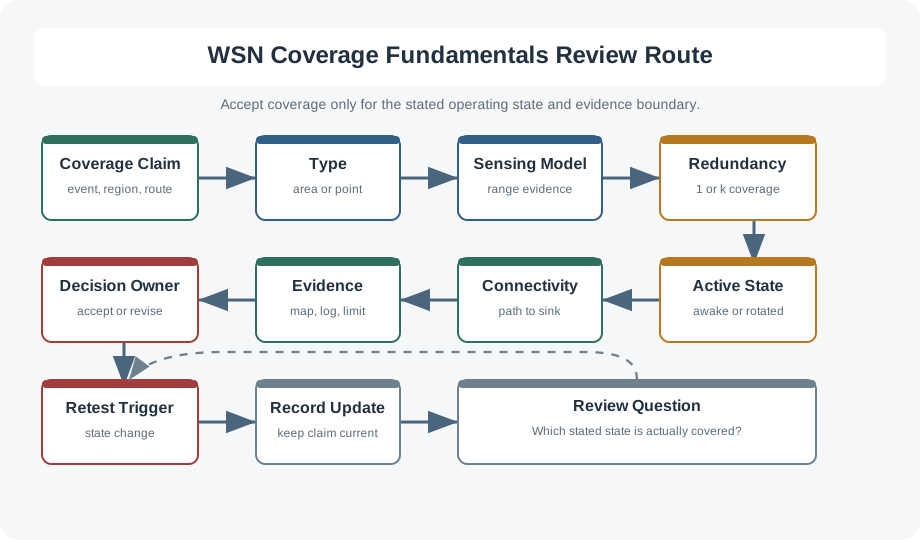
- The grower must decide what covered means for this event.
- A remote map can help compare seasons, but it must not hide a missing local reading or become the only path to protection.
- This opening does not choose one shape or prove every season.
Major section
Coverage Types
Coverage type controls the rest of the review.
- A design that is excellent for one type can be wrong for another.
- Area coverage: Reviews whether a continuous region has acceptable sensing evidence.
- Point coverage: Reviews whether named targets, assets, entrances, valves, machines, or measurement points are covered.
- The coverage type should appear in the first line of a review record.
Major section
Sensing Model and Evidence
The sensing model explains what "covered" means.
- The evidence explains why the team believes that model applies.
- Measured evidence: Field readings, calibration checks, site tests, or inspection passes can override a convenient planning assumption.
- Simulation evidence: Simulations can compare options, but the record should name the assumptions and what still requires field confirmation.
Major section
Redundancy and k-Coverage
Redundancy should match consequence and failure mode.
- 1-coverage: One acceptable sensing source may be enough for low-consequence trends or periodic sampling.
- k-coverage: Multiple acceptable sensing sources support fault tolerance, confidence, and rotation, but only if they are meaningfully independent.
- Priority zones: Different zones can require different redundancy.
- Uniform high redundancy can waste energy and budget.
Major section
Energy and Operating State
Coverage that only exists when every node is awake is often not the deployed coverage.
- Degraded design: Reviews what remains true after a failed node, blocked sensor, low battery, moved gateway, or missed maintenance window.
- Energy planning is part of coverage, not a separate afterthought.
- Sleep schedules, sampling intervals, local processing, and routing load can all change which coverage claim is true.
Major section
Common Mistakes
Starting with sensor count: Counts are outputs of a claim and model.
- They should not define the coverage requirement.
- Trusting nominal range: Manufacturer or planning range is not field evidence.
- The record should state environmental limits.
- Ignoring duty cycling: The all-awake map can pass while the scheduled operating state fails.
Major section
Active-State Coverage Record
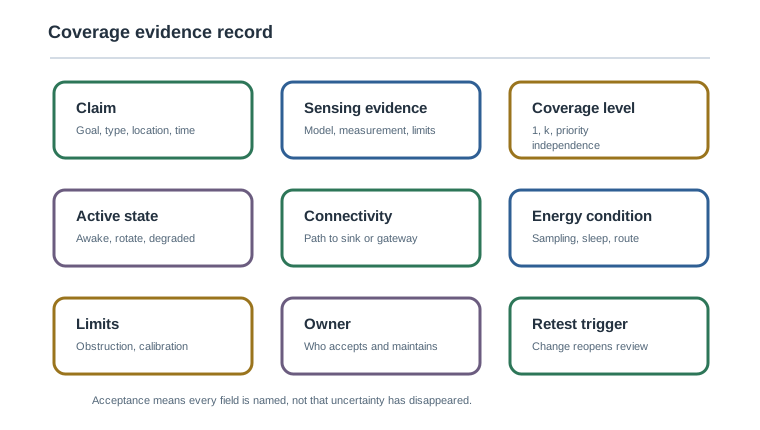
The body chapter names the coverage type, sensing model, redundancy target, active state, connectivity path, limits, owner, and retest trigger.
- The deeper rule is that those fields form one acceptance state, not a general promise about the whole network.
- The next Active-State Coverage Record step depends on WSN active-state coverage map.
- A coverage record should answer which claim was accepted, which sensors were allowed to count, which evidence time was used, and which change would reopen the review.
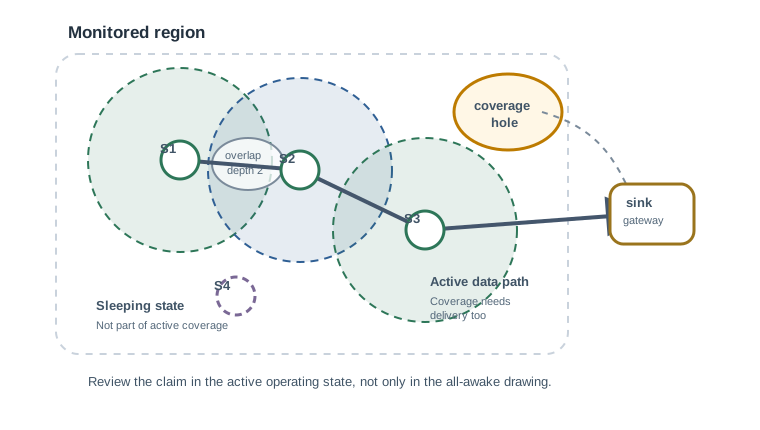
- The monitored region has overlap at depth two, but it also has a hole.
Major section
Active-State Coverage Record (continued)
A sleeping sensor is explicitly excluded from active coverage, even if its disk appears on the plan.
- The active data path to the sink matters too: sensing a point is not enough if its evidence cannot be delivered.
- A useful state record is closer to a small contract than a picture.
- If any one field changes, the old acceptance may still be historically true, but it is no longer proof of the current deployment.
Major section
Active-State Coverage Record (continued)
A plan with a higher nominal coverage percentage can be weaker if it counts sleeping nodes, assumes an obsolete shelf layout, or omits the gateway path.
- A plan with a lower percentage can be stronger for the real mission if it names the priority zone, preserves the active set, and records exactly which uncovered region is outside the accepted claim.
- The state record is what lets those judgments be compared honestly.
- Role state: Sleeping, disabled, uncalibrated, moved, or out-of-role nodes are named separately so they cannot silently inflate coverage.
- The same contract also prevents false comparisons between designs.
Major section
Rehearse the Claim Against State Changes
A fundamentals review becomes practical when the team tests the accepted claim against the first failures that will happen in the field.
- The goal is not to imagine every possible accident.
- The strongest field review language is usually explicit and limited.
- For coverage fundamentals, a good practitioner record is not longer than the deployment.
Major section
Sensing vs Delivery Predicates
A robust implementation therefore stores two predicates.
- The geometric shortcut most often taught in coverage fundamentals is useful only when its assumptions are visible.
- In a convex region with complete coverage by active nodes, Rc >= 2Rs is enough to make neighboring sensing disks communicate, so complete coverage implies network connectivity.
- The sensing predicate asks whether location or target x is accepted by the chosen model at time t: C(x,t).
Major section
Sensing vs Delivery Predicates (continued)
The shortcut fails when the region is not convex, the coverage is partial, the active set changes, the radio range is obstructed, or the sink path depends on sleeping relays.
- The delivery predicate asks whether the active node that supports that claim can deliver evidence to a sink, gateway, or accepted local decision point: D(s,t).
- A coverage claim is operationally true only where the accepted sensing predicate and delivery predicate are both true for the same state.
- This avoids a common error: reporting a beautiful coverage ratio while the supporting readings are stranded behind a sleeping relay.
Major section
Sensing vs Delivery Predicates (continued)
In practice, those predicates are evaluated over a finite review grid, named targets, boundary samples, or path segments.
- Each sample should carry the sensor or sensors that satisfy C, the route or local rule that satisfies D, and the interval for which both remain true.
- That interval matters: a node can satisfy sensing during a sample window and lose delivery during a later store-forward gap.
- Treating the two predicates as timestamped graph checks keeps the coverage record honest when duty cycling, gateway movement, and maintenance windows change the graph.
Deck summary
Key takeaways
A map of circles may look complete, yet wind, leaves, height, dead units, and sleeping schedules can leave the coldest row unseen.
- Coverage type controls the rest of the review.
- The sensing model explains what "covered" means.
- Redundancy should match consequence and failure mode.
- Coverage that only exists when every node is awake is often not the deployed coverage.
Retrieval practice
Recall check 1 of 5

Packet Pete says: answer from memory, then check your reasoning.
Q1A site must detect whether a person crosses a fenced boundary; the interior does not need continuous sensing. Which coverage framing fits?
Show answer
Answer: D Detecting whether a crossing can slip through a boundary line is barrier coverage.
Retrieval practice
Recall check 2 of 5
Packet Pete says: answer from memory, then check your reasoning.
Q2A site needs to detect whether a person crosses a fenced boundary. Which coverage framing should the review start with?
Show answer
Answer: D Coverage type should match the monitoring question.
Retrieval practice
Recall check 3 of 5
Packet Pete says: answer from memory, then check your reasoning.
Q3A proposed WSN passes coverage review only when every node is awake. The deployed design will rotate active sets to save energy. What is the strongest next review step?
Show answer
Answer: B Energy-saving operation changes the active coverage state.
Retrieval practice
Recall check 4 of 5
Packet Pete says: answer from memory, then check your reasoning.
Q4A first-pass map assumes sensing is certain inside a fixed radius, but trial readings fade near moving shelves. Which model and evidence should the team use for the installed claim?
Show answer
Answer: D Variable detection needs field evidence.
Retrieval practice
Recall check 5 of 5
Packet Pete says: answer from memory, then check your reasoning.
Q5A coverage review stores C(x,t) for sensing and D(s,t) for delivery. Which acceptance rule is strongest?
Show answer
Answer: D A reviewable coverage claim needs accepted sensing evidence and accepted evidence delivery for the same operating state.
Print reference
Answers
Answer key.
- D · Detecting whether a crossing can slip through a boundary line is barrier coverage.
- D · Coverage type should match the monitoring question.
- B · Energy-saving operation changes the active coverage state.
- D · Variable detection needs field evidence.
- D · A reviewable coverage claim needs accepted sensing evidence and accepted evidence delivery for the same operating state.