Wireless Sensor Networks · Study deck

WSN Coverage Algorithms

Picture smoke sensors spread across a store room.

Packet Pete is your guide for this deck.

coveragealgorithmsactive-set-selection
iotclass.org

After studying this chapter

Learning objectives

You will be able to:

  • Distinguish coverage verification, active-set selection, rotation scheduling, and gap repair algorithms.
  • Select an algorithm family that matches the coverage claim and available evidence.
  • Identify the assumptions that can invalidate an algorithm result in a real WSN.
  • Build a review record for an algorithm decision.
iotclass.org

Major section

Start With the Field Story · In 60 Seconds

A map of neat circles may suggest that every point is watched.

  • Shelves, weak batteries, poor placement, and a failed relay can still leave a gap that the drawing does not show.
  • Coverage algorithms are tools for choosing and checking active nodes.
  • The algorithm is only one part of the decision.
iotclass.org

Major section

Algorithm Families

Coverage algorithms are easiest to review when each family is tied to a specific job.

  • A single chapter or design document may mention several algorithms, but each algorithm should still have a clear role.
  • They must be reviewed in the scheduled state, not only the all-awake state.
  • Placement and scheduling problems are often expressed with familiar optimization vocabulary.

Why it matters

Those formulations are useful only after the coverage type is clear, because the same graph or facility objective can optimize the wrong thing if the real claim is a barrier, path, point, or active-set coverage requirement.

iotclass.org

Major section

Selection Route · Verification Algorithms
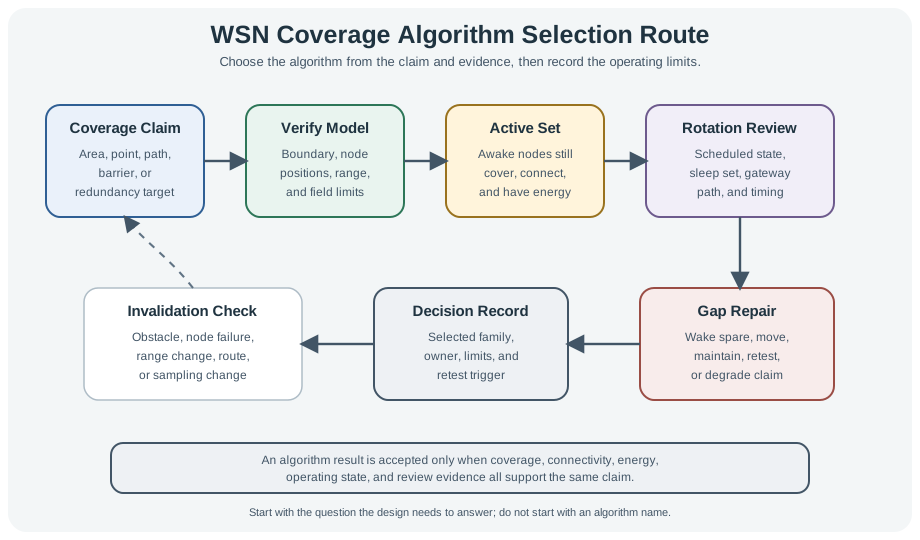
This progression makes the point concrete: WSN coverage algorithm selection route that starts with the coverage claim, verifies the model, checks the active set, reviews rotation, repairs gaps, and records decision limits.

  • They do not choose the best deployment by themselves; they tell the reviewer whether the current claim has enough support.
  • Enter the WSN coverage algorithm selection route from claim through model verification, active-set review, rotation review, gap repair, and decision record diagram at Coverage Claim, which defines what the design promises.
WSN coverage algorithm selection route from claim through model verification, active-set review, rotation review, gap repair, and decision record
iotclass.org

Major section

Active-Set Algorithms

Active-set algorithms select a subset of nodes to keep awake.

  • A set that covers the area but cannot deliver data is not an accepted active set.
  • The output should be recorded as a decision, not a guarantee.
  • The record should say which nodes are active, which nodes are sleeping, which claim the active set supports, and what change invalidates the selection.
iotclass.org

Major section

Crossing-Point and OGDC Checks

The merged OGDC chapter adds useful detail for dense area-coverage designs.

  • Crossing-point verification can focus a geometric review on likely hole boundaries, but only when the sensing model is close enough to disk-like area coverage for the shortcut to be valid.
  • OGDC-style active-set selection is also a review decision, not a guarantee.
  • The closest available node tends to be selected; the algorithm does not move nodes into the ideal positions.
A hexagonal packing of sensing disks with one disk-disk crossing that falls just outside every disk's interior -- the gap a crossing-point check exists to catch.
iotclass.org

Major section

Rotation Scheduling · Gap Repair

Rotation scheduling moves the active role between sensor sets.

  • The reviewer should inspect the worst scheduled state, not just the best state.
  • If one rotation step leaves a target uncovered or isolates a node from the gateway, the rotation needs repair.
  • Claim: what coverage must remain true during rotation.
  • The response is not always activation.

Key terms

Sometimes the right response
Sometimes the right response is to mark a zone as degraded, dispatch maintenance, change the route, or reject the coverage claim until a retest passes.

Why it matters

Reading both prevents a local success from becoming a system claim.

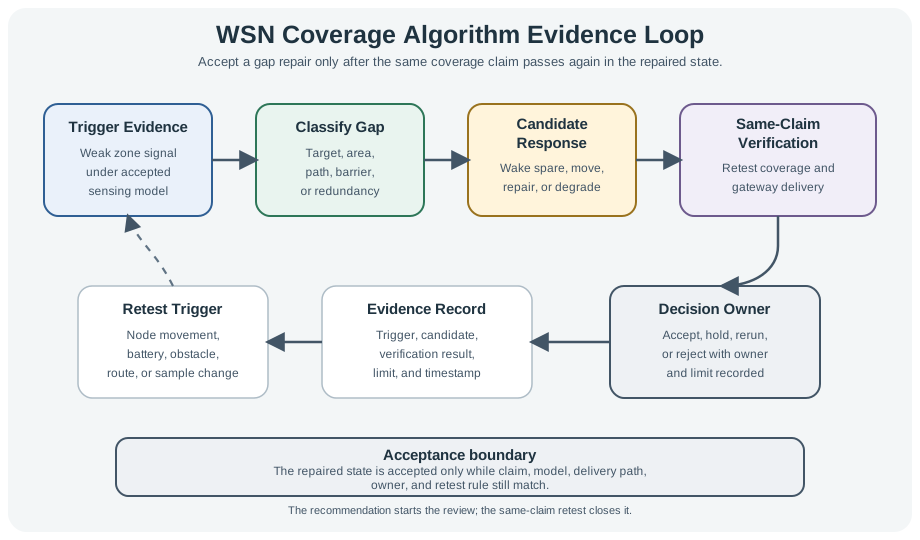
Coverage algorithm evidence loop showing trigger evidence, candidate response, same-claim verification, decision owner, and retest trigger
iotclass.org

Major section

Worked Review: Verification First · Worked Review: Active Set

The planning map looks complete, but the reviewer notices that one row of sensors is mounted behind dense foliage and the acceptance model has not been updated for the obstruction.

  • The review decision is to hold the claim.
  • The algorithm may still be useful, but the sensing model is not yet aligned with field conditions.
  • Accepted evidence: The boundary is clear, sensor positions are listed, and the target variable matches the use case.

Why it matters

A facility chooses an active-set algorithm to reduce always-awake operation.

iotclass.org

Major section

Common Mistakes

Treating simulation as acceptance: A simulation can guide review, but it does not replace field evidence under final operating conditions.

  • Ignoring routing: Coverage output is incomplete if the selected sensors cannot deliver readings.
  • Testing only all-awake states: The accepted design must pass in the duty-cycled or rotated state that will run in practice.
  • Overclaiming repair: Gap repair should not be called automatic until the trigger, candidate, verification, and owner are all recorded.
iotclass.org

Major section

Algorithm Output Is an Approval State
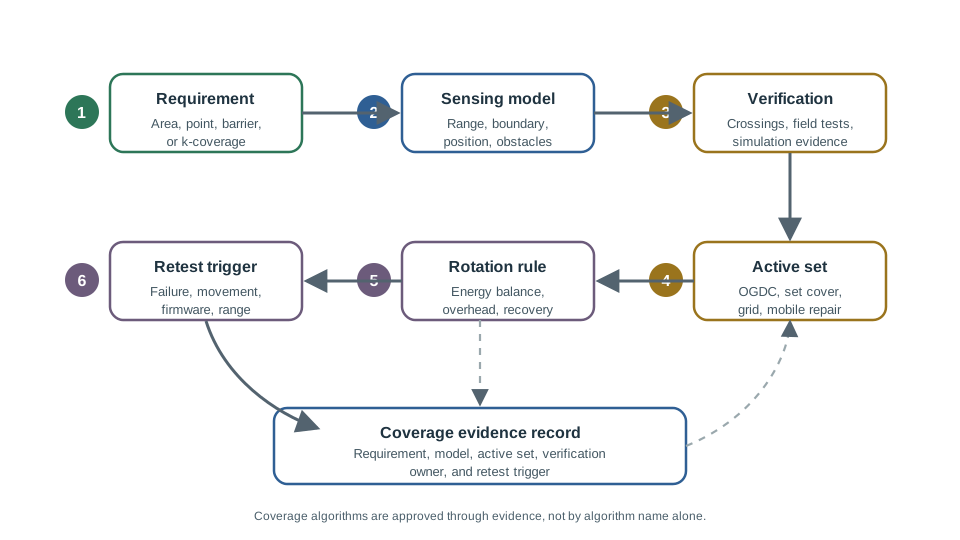
A sensing model then states range, boundaries, positions, and obstacles; verification needs crossings, field tests, or simulation evidence.

  • A failure, move, firmware change, or range change triggers review again.
  • This explains why a selected node set is only an approval state for one model and operating window.
  • The decision can be useful and still remain conditional.

Why it matters

This framing prevents a common failure in WSN coverage work.

WSN coverage algorithm review map
iotclass.org

Major section

Algorithm Output Is an Approval State (continued)

The evidence record also names the owner who must close remaining field checks.

  • A team may run an active-set algorithm, see that the selected nodes cover the drawing, and then describe the result as accepted coverage for the site.
  • A verification algorithm may return "covered" while the field team still owes a mounting retest.
  • A gap-repair algorithm may find a spare node while operations still owns the maintenance decision.
iotclass.org

Major section

Algorithm Output Is an Approval State (continued)

This framing prevents a common failure in WSN coverage work.

  • A rotation schedule may look balanced while the network team still owes a route check for the worst scheduled state.
  • The algorithm output is therefore the start of an evidence record, not a substitute for one.
  • Accepted state: The output is tied to one coverage claim, one sensing model, one active state, and one verification method.
iotclass.org

Major section

Build an Active-Set Ledger

For a practitioner, the most useful artifact is a short ledger for each accepted active set.

  • The ledger does not need to be complex.
  • It needs to keep the algorithm's output connected to the evidence that made it acceptable.
  • The ledger is especially important when an active-set algorithm and a rotation schedule are both used.

Key terms

Recording those limits
Recording those limits is not bureaucracy; it is how the team avoids turning an optimization result into a broader coverage promise.
iotclass.org

Major section

Build an Active-Set Ledger (continued)

Recording those limits is not bureaucracy; it is how the team avoids turning an optimization result into a broader coverage promise.

  • The active-set algorithm might identify several candidate awake sets.
  • The rotation schedule then chooses when each set runs.
  • A reviewer should not approve the average schedule while ignoring the weakest state.
iotclass.org

Major section

Build an Active-Set Ledger (continued)

Each row should name the selected nodes, the sleeping nodes that matter, the coverage claim, the delivery path, the energy or duty-cycle condition, the owner of the decision, and the trigger that forces a retest.

  • The accepted state is the worst scheduled state that still passes sensing, delivery, and energy checks.
  • If the first set covers the target list but the second set loses the gateway route, the schedule is not accepted even if the lifetime estimate improves.
  • A selected set can be accepted for point coverage of machine targets and rejected for area coverage between those machines.
Three nodes X, Y, and Z placed sqrt(3) times the sensing radius apart in a triangular pattern -- the equilateral spacing that minimizes overlap while covering the crossings between them.
iotclass.org

Major section

Finite Geometry Model Boundaries · Summary

In that case, the geometric candidates are still useful test points, but they are not the whole acceptance record.

  • For finite geometry model boundaries, a result at disk 1 is incomplete without disk 2.
  • The shortcut becomes unsafe when the model is looser than the geometry.
  • Voronoi and Delaunay structures have the same review boundary.

Key terms

disk 1
disk 1 is incomplete without disk 2.
WSN coverage algorithms
WSN coverage algorithms are decision aids.
Two overlapping sensing disks over a region boundary, with circled dots marking the disk-disk and disk-boundary crossing points a finite coverage check verifies.
iotclass.org

Deck summary

Key takeaways

A map of neat circles may suggest that every point is watched.

  • Coverage algorithms are easiest to review when each family is tied to a specific job.
  • This progression makes the point concrete: WSN coverage algorithm selection route that starts with the coverage claim, verifies the model, checks the active set, reviews rotation, repairs gaps, and records decision limits.
  • Active-set algorithms select a subset of nodes to keep awake.
  • The merged OGDC chapter adds useful detail for dense area-coverage designs.
iotclass.org

Retrieval practice

Recall check 1 of 4

Packet Pete says: answer from memory, then check your reasoning.

Q1A WSN team needs to decide which sensors stay awake while preserving the accepted coverage condition. Which algorithm family answers this?

AVerification algorithms test whether a claimed area is covered.
BGap-repair algorithms react after a weak sensing zone appears.
CActive-set algorithms choose awake nodes for current coverage.
DRotation algorithms change the active sets over longer periods.
Show answer

Answer: C Active-set algorithms select which sensors stay awake while still satisfying the coverage condition.

iotclass.org

Retrieval practice

Recall check 2 of 4

Packet Pete says: answer from memory, then check your reasoning.

Q2A WSN team asks which sensors should be awake while preserving the accepted coverage condition. Which algorithm family best matches that question?

AActive-set algorithms, because they select the awake subset for the current coverage state
BVerification algorithms, because they only test whether the current coverage claim is true
CGap-repair algorithms, because sleeping sensors leave positions that need replacements to maintain the accepted coverage
DRotation scheduling, because distributing awake time across sensors can balance their energy use over the deployment
Show answer

Answer: A Active-set algorithms choose the awake sensor subset.

iotclass.org

Retrieval practice

Recall check 3 of 4

Packet Pete says: answer from memory, then check your reasoning.

Q3A gap-repair algorithm recommends waking a spare sensor after a weak zone appears. What evidence is needed before the repair is accepted?

AA versioned repair decision record naming the selected spare sensor
BA revised coverage diagram with the spare sensor's estimated footprint and a modeled signal-strength contour for that location.
CTrigger evidence, candidate evidence, and retest evidence for the repaired operating state
DA revised lifetime estimate after the spare sensor is activated
Show answer

Answer: C Gap repair is accepted only when the trigger, candidate action, repaired-state verification, and owner are visible in the evidence record.

iotclass.org

Retrieval practice

Recall check 4 of 4

Packet Pete says: answer from memory, then check your reasoning.

Q4An active-set algorithm returns nodes A, C, and F as awake. What evidence is needed before accepting that set as operational coverage?

AThe set covers the most diagram area, so no route check is needed.
BCoverage, delivery path, energy state, owner, and retest trigger for that set.
CAll nodes were awake in simulation, so the active subset inherits that result.
DThe algorithm name is known, so assumptions do not need to be recorded.
Show answer

Answer: B An active-set output becomes operational coverage only when the selected set has coverage, delivery, energy, ownership, and retest evidence for the deployed state.

iotclass.org

Print reference

Answers

Answer key.

  1. C · Active-set algorithms select which sensors stay awake while still satisfying the coverage condition.
  2. A · Active-set algorithms choose the awake sensor subset.
  3. C · Gap repair is accepted only when the trigger, candidate action, repaired-state verification, and owner are visible in the evidence record.
  4. B · An active-set output becomes operational coverage only when the selected set has coverage, delivery, energy, ownership, and retest evidence for the deployed state.
iotclass.org