Wireless Sensor Networks · Study deck
WSN Coverage: Mobile Sensors
Picture a farm where one sensor cannot see behind a tall crop row.
Packet Pete is your guide for this deck.
After studying this chapter
Learning objectives
You will be able to:
- distinguish static-only, mobile-only, and hybrid static-mobile coverage designs
- decide when a mobile platform is a gap-repair tool, a patrol tool, or a primary sensor
- review the operational evidence behind a mobile coverage claim
- identify failure modes that make mobile coverage unreliable
Major section
Start With the Field Story
A small rover can visit the gap, take a reading, and return to charge.
- Mobile coverage means using a moving sensor to observe places that fixed sensors do not cover well.
- Safety must not depend on a rover that is absent when the event occurs.
- Under the Hood examines path planning, coverage, and energy limits.
Major section
In 60 Seconds
Mobile sensors can improve a wireless sensor network when the monitored area is large, changing, hard to access, or only needs periodic confirmation.
- Mobile coverage is not a free replacement for a static layer.
- A mobile platform has travel time, recharge time, localization error, path risk, communication gaps, and maintenance needs.
- It should not be used to support a continuous safety requirement unless the active static layer still satisfies the required coverage degree while the mobile unit is moving, charging, or unavailable.
Major section
Review Route
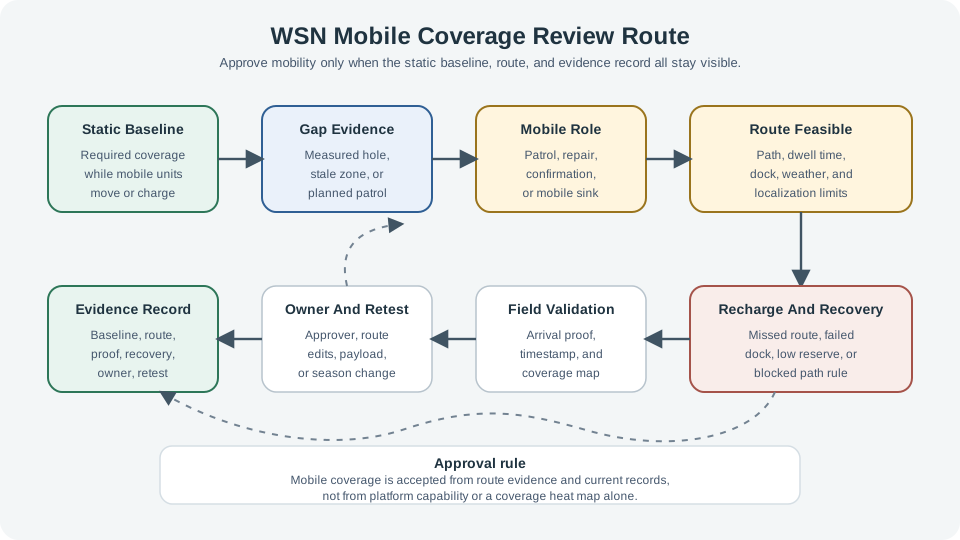
Fixed nodes keep alert coverage while the mobile unit visits hard-to-wire aisles for a weekly humidity map.
- The route records zones, checkpoints, communication handoff, and docking.
- A completed visit still needs a timestamp, location confidence, calibration, and route completion evidence before its readings support coverage.
- A route edit, obstruction, docking failure, firmware change, or missed checkpoint reopens the review.
- The planned path alone cannot prove the claim; the completed run and the fixed baseline must both be checked.
Major section
Evidence Record
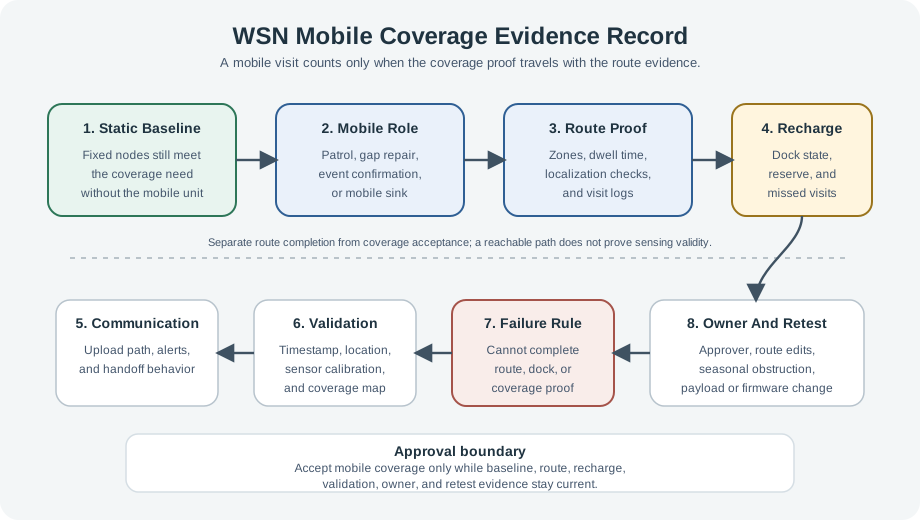
Its static baseline asks whether fixed nodes still meet the coverage need without the mobile unit.
- Recharge and communication fields show whether docking, reserve, upload, and handoff can support the patrol.
- A failure rule handles an incomplete route, while an owner and retest trigger keep later route or firmware changes visible.
- Reachability alone does not prove sensing validity.
Major section
Mobile Self-Healing and Virtual Forces
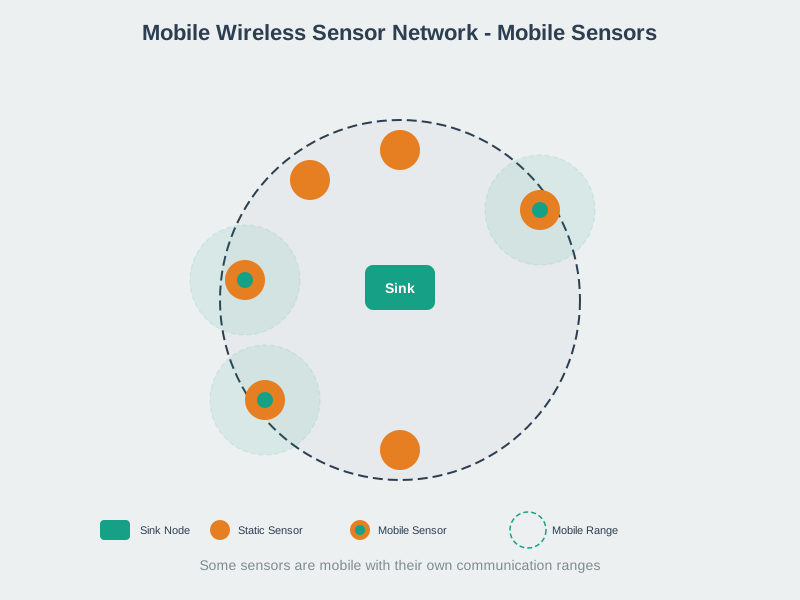
The sketch is a model of roles and reach, so it cannot alone approve a move.
- Their relationship makes the relationship behind Mobile Self-Healing and Virtual Forces reviewable.
- The sink shows why the new position must still deliver readings.
- The common algorithmic pattern is a Virtual Force Algorithm (VFA).
Major section
Mobile Self-Healing and Virtual Forces (continued)
Those labels help frame the self-healing question: moving a sensor toward a hole may improve one area but remove coverage or a relay path at its starting point.
- The review question is not "which node is closest to the hole?" A nearby node may be load-bearing: if it moves, the original zone loses coverage or loses the only relay path to the sink.
- A farther redundant node can be safer when its origin remains covered, its route is clear, and the coverage gained per meter is better.
- VFA should be treated as a planning aid, not as automatic approval.
Major section
Worked Reviews
Scenario: field conditions change slowly, and periodic sampling is useful for irrigation or crop-health decisions.
- Repair pattern: trigger reserve-node wakeup or maintenance when mobile coverage is repeatedly needed in the same zone.
- Scenario: fixed infrastructure is damaged, unavailable, or too slow to deploy.
- Separate route safety from sensing validity; a reachable path does not prove coverage quality.
Major section
Implementation Checklist
Baseline: The fixed or currently active network coverage is documented for periods when mobile units are unavailable.
- Role: The mobile platform is classified as patrol, gap repair, event confirmation, mobile sink, or temporary coverage.
- Route: The approved route includes zones, dwell time, path limits, localization confidence, docking, and fallback behavior.
- Energy: Travel, sensing, communication, docking, retries, and reserve behavior are included in the operational model.
Major section
Movement Energy Budget
If the actuator cost is 1.8 J per meter, a 6 m relocation costs 10.8 J by itself, so the move consumes 12.1 J before retries, route correction, or docking loss are counted.
- Those numbers are not universal actuator values; they show why unnecessary repositioning can erase the lifetime gain from better coverage.
- The movement budget also changes the failure model.
- Static coverage proof asks whether a point is inside enough sensing disks.
Major section
Common Mistakes
Replacing continuous coverage with patrols: Periodic visits are not equivalent to continuous detection in safety, security, or alarm workflows.
- Ignoring recharge and docking: Coverage claims must include the time spent traveling, charging, waiting, and recovering from failed docking.
- Confusing movement with evidence: A route plan is not proof unless the platform actually reached the zone and recorded valid sensing data.
- Using stale coverage maps: Weather, terrain, obstacles, layout changes, and failed nodes can invalidate the map that selected the route.
Major section
Summary
Mobile sensors add flexibility to WSN coverage when they are used for the right job: patrol, gap repair, temporary monitoring, event confirmation, or mobile data collection.
- The quality standard is evidence.
- A mobile-coverage design should record the static baseline, mobile role, route, recharge behavior, communication assumptions, validation method, failure response, owner, and retest trigger.
- It should not claim reliability or savings from mobility alone.
Major section
Concept Relationships
Mobile depends on baseline: The fixed or active layer determines what remains covered when the mobile unit is unavailable.
- Patrol depends on time: Periodic coverage is useful only when data age and missed visits are acceptable.
- Route depends on operations: Terrain, docking, localization, weather, communication, and maintenance can all invalidate a route.
- Mobile sink depends on latency: Collecting data later is useful only when delayed upload is acceptable for the monitored event.
Deck summary
Key takeaways
A small rover can visit the gap, take a reading, and return to charge.
- Mobile sensors can improve a wireless sensor network when the monitored area is large, changing, hard to access, or only needs periodic confirmation.
- Fixed nodes keep alert coverage while the mobile unit visits hard-to-wire aisles for a weekly humidity map.
- Its static baseline asks whether fixed nodes still meet the coverage need without the mobile unit.
- The sketch is a model of roles and reach, so it cannot alone approve a move.
Retrieval practice
Recall check 1 of 4

Packet Pete says: answer from memory, then check your reasoning.
Q1A proposal replaces fixed safety sensors with a drone that patrols each zone periodically. What is the main coverage review concern?
Show answer
Answer: C A periodic patrol cannot provide the continuous coverage a safety requirement demands, because of travel and recharge gaps.
Retrieval practice
Recall check 2 of 4
Packet Pete says: answer from memory, then check your reasoning.
Q2A design proposes replacing fixed safety sensors with a drone patrol that visits each zone periodically. What is the main review concern?
Show answer
Answer: A Mobile coverage must be reviewed against the required coverage continuity.
Retrieval practice
Recall check 3 of 4
Packet Pete says: answer from memory, then check your reasoning.
Q3Which evidence best supports approval of a hybrid static-mobile coverage design?
Show answer
Answer: C A hybrid design is approved from linked evidence: static baseline, mobile route, location confidence, recharge behavior, failure response, ownership, and retest triggers.
Retrieval practice
Recall check 4 of 4
Packet Pete says: answer from memory, then check your reasoning.
Q4A mobile WSN needs to fill a coverage hole. Why is moving the geometrically nearest node often not the best choice?
Show answer
Answer: B Mobile coverage should choose redundant movers that improve coverage per meter without opening a new hole at the origin.
Print reference
Answers
Answer key.
- C · A periodic patrol cannot provide the continuous coverage a safety requirement demands, because of travel and recharge gaps.
- A · Mobile coverage must be reviewed against the required coverage continuity.
- C · A hybrid design is approved from linked evidence: static baseline, mobile route, location confidence, recharge behavior, failure response, ownership, and retest triggers.
- B · Mobile coverage should choose redundant movers that improve coverage per meter without opening a new hole at the origin.