Wireless Sensor Networks · Study deck
WSN K-Coverage and Rotation
Picture a store room where one leak must not go unseen.
Packet Pete is your guide for this deck.
After studying this chapter
Learning objectives
You will be able to:
- Explain: Single coverage answers whether each point is watched by at least one sensor. K-Coverage asks whether each point is watched by enough independent sensors to survive failure, maintenance, drift, or uncertain readings.
- Explain: Required k by zone fixes the spatial boundary: Active set adds a distinct review condition: Awake, reserve, exposes the energy consequence.
- Explain: Counting overlapping sensors as independent: Two sensors near the same obstruction, relay, or power source may not provide true fault tolerance.
- Explain: k-Coverage depends on consequence: The coverage degree should match risk and response needs, not a generic deployment template.
Major section
Begin With One Point That Must Stay Seen
One sensor may cover the risky point.
- Two separate sensors may let one fail while the other still watches.
- The first choice is the number of sound, awake sensors that must cover each important place.
- Tie that number to harm, repair time, and the chance that failures share one cause.
Major section
Begin With One Point That Must Stay Seen (continued)
If you plan to rotate awake sets, test each set on its own.
- A count on a drawing is not enough when walls, weather, or weak cells change reach.
- More overlap can improve fault cover, but it costs hardware and may add radio traffic.
- Safety needs a clear fail state.
Major section
Begin With One Point That Must Stay Seen (continued)
Longer sleep can save energy, but it may delay a wake or leave a hidden gap.
- This first pass does not prove lifetime or safe independence.
- The deeper routes show when a neat rotation plan breaks in the real area.
- For each awake set, write the sensors that can see that point.
Major section
Start With the Field Story · In 60 Seconds
K-coverage is a redundancy promise, not a magic lifetime multiplier.
- k-Coverage means every point in the monitored region is covered by at least k independent sensors at the same time.
- If the design requires k = 2, a single local sensor failure should not immediately create a coverage gap.
- Rotation scheduling uses redundant sensors to save energy by changing which nodes are active over time.
Major section
Why k-Coverage Matters · Review Route
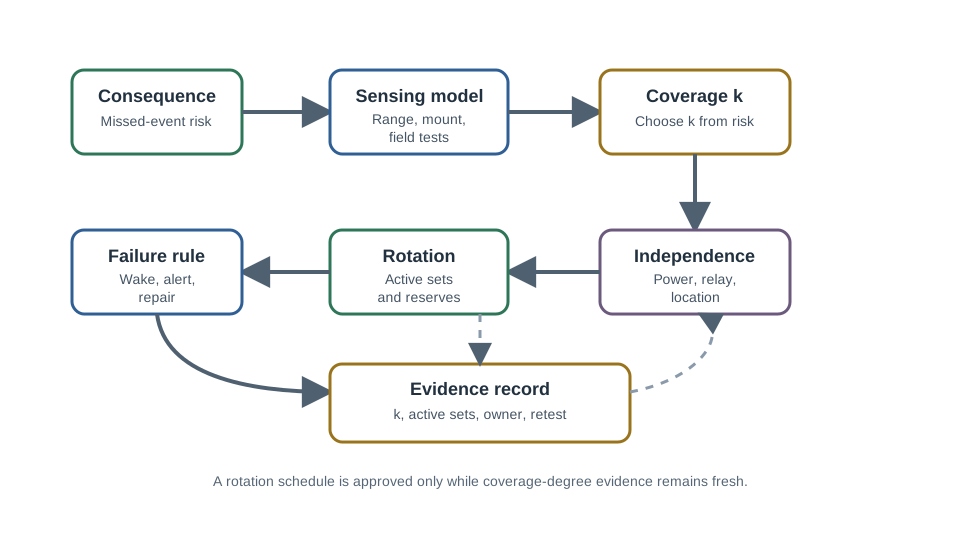
Single coverage answers whether each point is watched by at least one sensor. K-Coverage asks whether each point is watched by enough independent sensors to survive failure, maintenance, drift, or uncertain readings.
- The extra layers can improve reliability, but they also increase deployment cost, coordination complexity, radio traffic, and energy demand.
- k-Coverage should be justified by the consequence of a missed event.
- A low-risk environmental trend may only need one useful observation path.
- A safety, security, or high-value asset monitoring system may need redundant sensing paths, independent power zones, or separate communication routes.
Major section
Choosing A Coverage Degree
A coverage degree is a design requirement.
- It should be traceable to risk, repair access, and evidence quality.
- k = 1: Use when occasional local gaps are tolerable, the monitored signal changes slowly, and repair access is practical.
- k = 2: Use when a single local failure should not remove visibility, or when one reading needs a second nearby confirmation.
Major section
Choosing A Coverage Degree (continued)
k = 3 or higher: Use only when consequence, regulation, or operational risk justifies multiple independent observation paths.
- For target localization, the meaning of k changes from fault tolerance to position evidence.
- One sensor can show presence, but not a position fix.
- Two sensors can constrain the location, but practical two-dimensional localization normally needs at least three independent observations.
Major section
Rotation Sets · Disjoint Cover Sets and Lifetime
Rotation sets are groups of sensors that take turns being active.
- A rotation schedule can extend useful lifetime when the deployment has more sensors than the active requirement needs at one time.
- A strong rotation plan uses disjoint cover sets.
- The same extra sensors that protect coverage can also create rotation groups.
Major section
Rotation Evidence Record
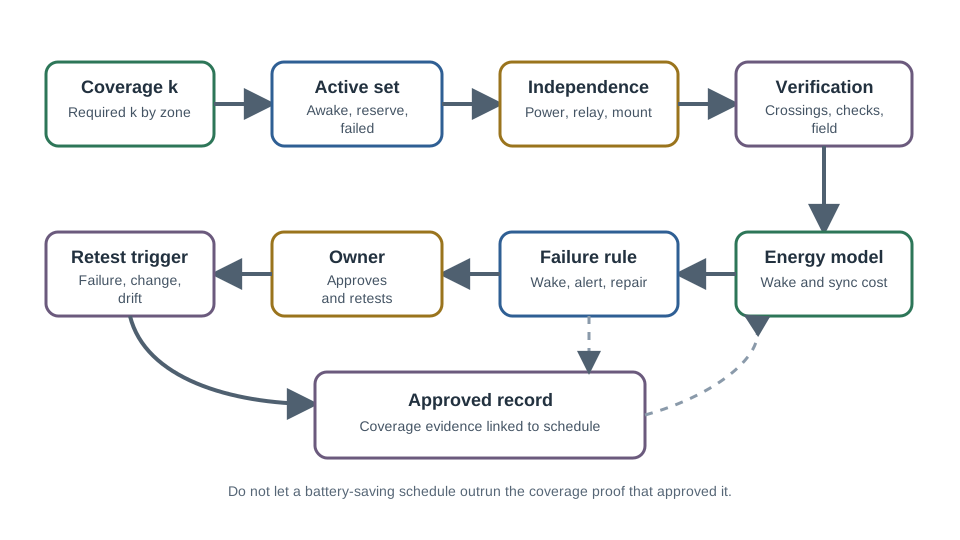
Required k by zone fixes the spatial boundary: Active set adds a distinct review condition: Awake, reserve, exposes the energy consequence.
- The ongoing rotation evidence record analysis should preserve all three.
- Example record: Cold-chain storage requires k = 2 temperature coverage in high-value zones during normal operation.
- In the visual at the WSN k-coverage rotation evidence record diagram, the two labels make the required comparison explicit.
- Three labels carry the instructional work in the chart at the WSN k-coverage rotation evidence record diagram.
Major section
Worked Reviews · Implementation Checklist
Scenario: soil or air-quality measurements are used for trend analysis, and short local gaps can be tolerated.
- Scenario: a single failed sensor should not create a blind spot in a high-value area.
- Scenario: a missed event has serious consequence, and a single confirmation path is not acceptable.
- Repair pattern: separate coverage redundancy from communication redundancy so a local sensing layer is not hidden behind one weak relay path.
Major section
Common Mistakes
Counting overlapping sensors as independent: Two sensors near the same obstruction, relay, or power source may not provide true fault tolerance.
- Approving rotation from lifetime alone: Battery savings do not matter if the active set no longer satisfies the required coverage degree.
- Using a generic k value: The coverage degree should come from risk, consequence, repair access, and confidence in the sensing model.
- Letting schedules become stale: Rotation evidence expires after node movement, replacement, low battery, obstruction, or topology change.
Major section
Summary · Key Takeaway
k-Coverage adds reliability by requiring multiple valid sensing paths for each monitored point.
- Rotation scheduling uses redundancy to save energy by changing which nodes are active.
- The two ideas must be reviewed together: a rotation schedule is useful only while it preserves the required coverage degree.
- The quality standard is evidence.
Major section
Concept Relationships
k-Coverage depends on consequence: The coverage degree should match risk and response needs, not a generic deployment template.
- Redundancy depends on independence: Two sensors count as useful redundancy only when they are not defeated by the same local failure.
- Rotation depends on verification: Each active set must satisfy the coverage requirement before reserve nodes sleep.
- Coverage depends on connectivity: Redundant sensing still needs reliable data paths for the active nodes that observe each zone.
Deck summary
Key takeaways
One sensor may cover the risky point.
- If you plan to rotate awake sets, test each set on its own.
- Longer sleep can save energy, but it may delay a wake or leave a hidden gap.
- K-coverage is a redundancy promise, not a magic lifetime multiplier.
- Single coverage answers whether each point is watched by at least one sensor. K-Coverage asks whether each point is watched by enough independent sensors to survive failure, maintenance, drift, or uncertain readings.
Retrieval practice
Recall check 1 of 5

Packet Pete says: answer from memory, then check your reasoning.
Q1A monitored zone is designed for k = 2 coverage. What must stay true if a single sensor (or its support path) fails?
Show answer
Answer: D k = 2 coverage means a single sensor failure still leaves every point with one independent observation path.
Retrieval practice
Recall check 2 of 5
Packet Pete says: answer from memory, then check your reasoning.
Q2A deployment needs 3-coverage for target localization but must also last a long time. How can rotation help?
Show answer
Answer: A Rotating disjoint cover sets can multiply lifetime, but a larger k makes each set larger and limits how many independent covers can be formed.
Retrieval practice
Recall check 3 of 5
Packet Pete says: answer from memory, then check your reasoning.
Q3A hard to repair zone has costly missed events. How should its coverage degree be chosen?
Show answer
Answer: C Risk and independence decide the degree before rotation is planned.
Retrieval practice
Recall check 4 of 5
Packet Pete says: answer from memory, then check your reasoning.
Q4A design claims k = 2 coverage for a monitored zone. Which review question best tests whether the claim is meaningful?
Show answer
Answer: B k-Coverage is a fault-tolerance claim.
Retrieval practice
Recall check 5 of 5
Packet Pete says: answer from memory, then check your reasoning.
Q5What must be true before approving a WSN rotation schedule that sleeps redundant nodes?
Show answer
Answer: B Rotation is acceptable only when the active set still satisfies the required coverage degree and the operational energy costs are included.
Print reference
Answers 1 of 2
Answer key.
- D · k = 2 coverage means a single sensor failure still leaves every point with one independent observation path.
- A · Rotating disjoint cover sets can multiply lifetime, but a larger k makes each set larger and limits how many independent covers can be formed.
- C · Risk and independence decide the degree before rotation is planned.
- B · k-Coverage is a fault-tolerance claim.
Print reference
Answers 2 of 2
Answer key.
- B · Rotation is acceptable only when the active set still satisfies the required coverage degree and the operational energy costs are included.