Wireless Sensor Networks · Study deck

Common WSN Design Mistakes

A wireless sensor network (WSN) links small sensing devices.

Packet Pete is your guide for this deck.

design-reviewenergy-managementdeployment
iotclass.org

After studying this chapter

Learning objectives

You will be able to:

  • separate sensing coverage, radio connectivity, routing load, energy budget, and operations evidence during review
  • explain why relay nodes, cluster heads, and gateways need different power and monitoring assumptions
  • repair common WSN design mistakes without changing the sensing goal unnecessarily
  • write a concise evidence record that keeps assumptions, tests, fixes, and retest triggers visible
iotclass.org

Major section

Start With the Field Story

A gateway is a bridge between that local network and another service.

  • At night, wet leaves weaken links, batteries cool, retries rise, and a busy bridge delays records.
  • The same design can fail without any one part being completely broken.
  • One successful packet does not prove coverage or lifetime.
iotclass.org

Major section

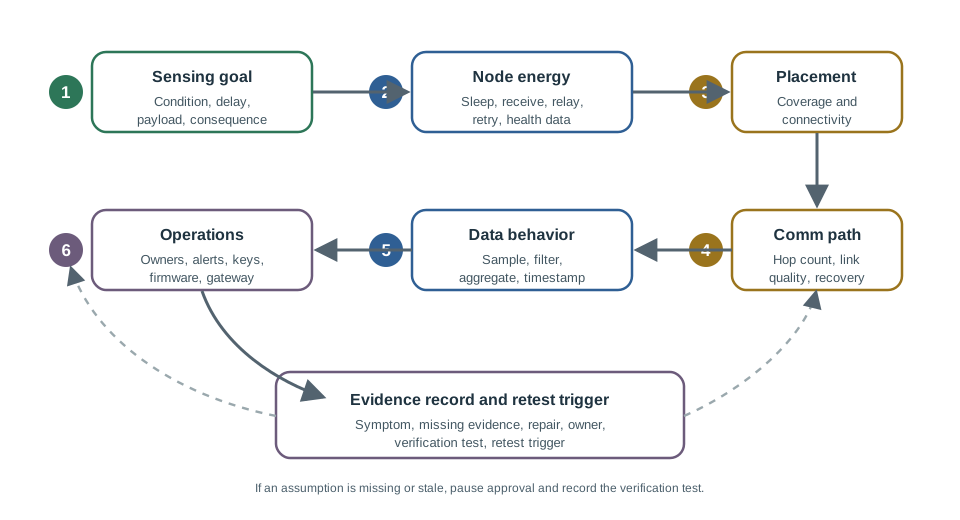
Review Route

The sensor can observe the intended room, yet a reinforced wall can block its path to the gateway.

  • Node energy and placement matter, but coverage alone cannot prove connectivity.
  • If the path fails, placement margin, alternate paths, or another gateway need review.
  • Retest after those parts change before approving node spacing or a service claim.

Why it matters

The route matters because later choices depend on earlier evidence.

WSN field failure example shows a temperature sensor covering the intended room while a reinforced wall blocks its radio path to the gateway. The review requires link-quality testing in the final installation before accepting connectivity.
iotclass.org

Major section

Review Route (continued)

The route matters because later choices depend on earlier evidence.

  • For example, a sampling interval cannot be reviewed until the decision latency is known.
  • A routing plan cannot be trusted until real placement and link evidence are available.
  • A battery budget cannot be approved until relay load, retries, and listening windows are included.
iotclass.org

Major section

Budgeting Nodes Like Sensors

Leaf sensors often send only their own readings.

  • Relays, cluster heads, and nodes near a sink may forward traffic for other nodes.
  • Treating those roles as equal is a common path to early failure.
  • Relay load is not a small detail.
  • It changes lifetime, maintenance routing, and failure impact.
iotclass.org

Major section

Radio Energy Waste Evidence

Not every battery complaint has the same cause.

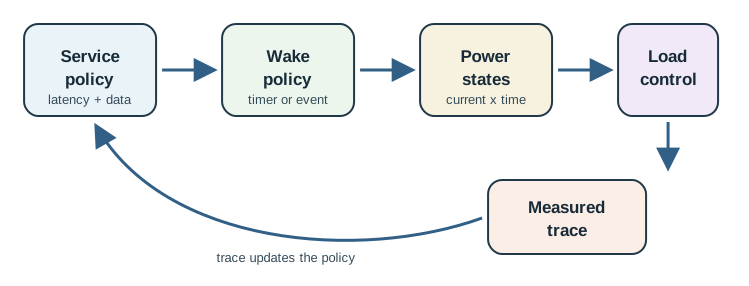
  • The trace separates listening from sleep, and the current-time ledger turns those states into an average current.
  • A battery-life estimate is credible only when the wake rule and measured current trace support the stated service.
  • A quick review example makes the distinction visible.
Low-power WSN strategy stack linking service policy, wake policy, measured power states, load control, and trace feedback.
iotclass.org

Major section

Radio Energy Waste Evidence (continued)

A soil-moisture node may send only one useful reading per minute, yet wake every second to check whether the channel is active.

  • If each check keeps the receiver awake for 20 ms, the node spends 1.2 seconds per minute listening before it has moved any sensor data.
  • The traffic is low, but the listening duty is not.
  • The repair must also avoid overcorrection.
iotclass.org

Major section

Coverage vs Connectivity

Connectivity asks whether the nodes can move data to a sink with enough reliability.

  • A design can satisfy one and fail the other.
  • Coverage and connectivity use different evidence.
  • A temperature sensor may observe the right room while still failing to reach the gateway through a reinforced wall.
iotclass.org

Major section

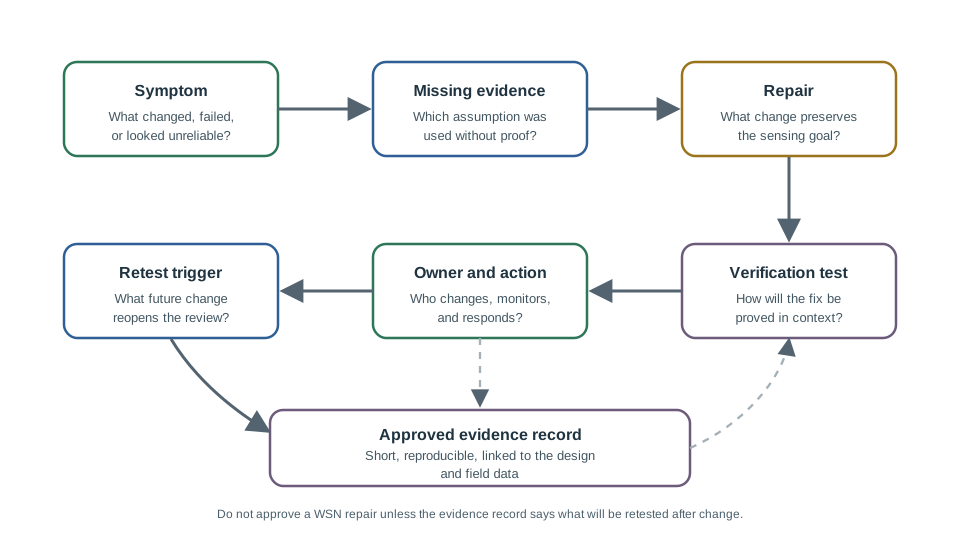
Evidence Record

Respectively, they adds a distinct review condition, adds a distinct review condition, and states how the claim is checked.

  • It leaves the evidence record claim with an explicit test boundary.
  • The record should be short enough to maintain, but specific enough that another reviewer can reproduce the decision.
  • Example record: Corridor temperature nodes were failing earlier near the gateway.
Evidence record for WSN mistake review linking symptom, missing evidence, repair, verification test, owner, and retest trigger.
iotclass.org

Major section

Worked Reviews

Symptom: battery sensors work during pilot testing but require service much earlier than the lifetime target.

  • A powered gateway can use a high-throughput backhaul, while battery sensors should use short, low-duty reporting with measured sleep behavior and health telemetry.
  • Symptom: nodes close to the gateway stop reporting before distant nodes, and downstream sections disappear together.
  • Symptom: readings arrive, but reviewers cannot tell whether differences are physical changes, placement differences, or firmware differences.
iotclass.org

Major section

Review Checklist

Requirement: The sensing goal, useful delay, payload, lifetime target, and maintenance limit are written in one place.

  • Energy: The budget includes sleep, sensing, transmit, receive, retries, joining, relay load, and health telemetry.
  • Placement: The design distinguishes sensing coverage from communication connectivity and uses measured link evidence.
  • Operations: Battery, link quality, last-heard time, firmware, gateway status, owners, and retest triggers are monitored.
  • Recovery: The team knows what happens when a relay, gateway, backhaul, or firmware rollout fails.
iotclass.org

Major section

Concept Relationships

Requirements drive radio choice: Radio selection depends on payload, delay, range, provisioning, power, and maintenance evidence.

  • Roles drive energy: Leaf nodes, relays, cluster heads, sinks, and gateways do not carry the same traffic or failure impact.
  • Placement drives trust: Coverage and connectivity must be tested under real mounting, obstruction, enclosure, and gateway conditions.
  • Data drives decisions: Sampling, aggregation, timestamps, and metadata should preserve the evidence needed for action.
iotclass.org

Deck summary

Key takeaways

A gateway is a bridge between that local network and another service.

  • The sensor can observe the intended room, yet a reinforced wall can block its path to the gateway.
  • The route matters because later choices depend on earlier evidence.
  • Leaf sensors often send only their own readings.
  • Not every battery complaint has the same cause.
iotclass.org

Retrieval practice

Recall check 1 of 4

Packet Pete says: answer from memory, then check your reasoning.

Q1A team selects a radio chip first, then finds it cannot meet the stated battery-life target. Which classic WSN design mistake is this?

AConfusing coverage with connectivity in the layout
BStarting with the radio instead of the requirement
CSampling far more often than the decision actually needs
DTreating operations and maintenance as a later problem
Show answer

Answer: B Choosing the radio before stating the lifetime requirement is the classic first WSN mistake.

iotclass.org

Retrieval practice

Recall check 2 of 4

Packet Pete says: answer from memory, then check your reasoning.

Q2A team adds RTS/CTS handshaking to reduce collisions, but total energy gets worse for tiny sensor payloads. What is the best explanation?

AThe RTS/CTS exchange changes the sensor payload into a larger measurement.
BThe RTS/CTS control exchange can cost more than the retransmissions it prevents.
CThe RTS/CTS exchange removes idle listening, so remaining energy is all payload.
DThe RTS/CTS exchange makes collisions free, so avoiding them has no value.
Show answer

Answer: B WSN MAC repairs should balance idle listening, overhearing, collisions, and control overhead rather than optimizing one waste source in isolation.

iotclass.org

Retrieval practice

Recall check 3 of 4

Packet Pete says: answer from memory, then check your reasoning.

Q3A WSN pilot reports correctly in the lab, but the design has no record of actual link quality after the sensor is placed inside its final enclosure and mounted on site. What is the best review finding?

AApprove it because lab delivery proves the final enclosed radio path.
BTest links with the final enclosure, placement, firmware and gateway.
CRaise the sampling rate so extra packets can mask weak field links.
DReplace the sensor element before checking mounting or gateway effects.
Show answer

Answer: B A WSN review should separate lab function from deployment evidence.

iotclass.org

Retrieval practice

Recall check 4 of 4

Packet Pete says: answer from memory, then check your reasoning.

Q4Several WSN nodes near the sink lose battery faster than distant leaf nodes. What should the reviewer inspect first?

AWhether distant nodes should report faster to equalize energy use.
BWhether those nodes relay, listen, retry, or sit on common sink paths.
CWhether dashboard colours exaggerate the reported battery decline.
DWhether one early replacement interval could simplify servicing.
Show answer

Answer: B Relay and sink-near nodes may forward more traffic and listen more often than leaf nodes.

iotclass.org

Print reference

Answers

Answer key.

  1. B · Choosing the radio before stating the lifetime requirement is the classic first WSN mistake.
  2. B · WSN MAC repairs should balance idle listening, overhearing, collisions, and control overhead rather than optimizing one waste source in isolation.
  3. B · A WSN review should separate lab function from deployment evidence.
  4. B · Relay and sink-near nodes may forward more traffic and listen more often than leaf nodes.
iotclass.org