Wireless Sensor Networks · Study deck
WSN Energy: Adaptive Duty-Cycle Evidence
A duty cycle is the share of time a radio or sensor stays active.
Packet Pete is your guide for this deck.

After studying this chapter
Learning objectives
An adaptive wake rule needs energy and delivery evidence under stale hints and relay constraints.
- Choose an input for a bounded wake rule.
- Test stale and false event hints.
- Measure energy per delivered result.
- Recheck coverage, delay, and the relay path.
Major section
Start With the Decision
A duty cycle is the share of time a radio or sensor stays active.
- A fixed sleep plan can miss a burst or waste power in quiet hours.
- Adaptive control changes that plan from measured inputs.
- The inputs must be checked for faults before they change the plan.
Major section
Adaptive Duty-Cycle Inputs
Information value: Name the signal that makes a reading more or less useful: local change, neighbor contrast, uncertainty, missed-event cost, or application priority.
- Some WSN schemes change wake and transmit behavior from evidence rather than from a fixed timer.
- An InTSeM-style rule adjusts a node's transmission rate or sleep time when the current reading, neighbor context, or expected information gain changes.
- Adaptive duty cycling is accepted only when it preserves the monitoring decision.
Major section
Adaptive Duty-Cycle Inputs (continued)
A social-sensing duty-cycle rule uses an outside signal, such as a public event indicator or local context feed, to increase wake probability around likely rare events and relax it when the event is unlikely.
- Rare-event evidence: Preserve the trigger source, false-trigger context, event class, and rule that separates a rare event from ordinary background activity.
- Network consequence: Retest relay availability, queueing, retransmissions, and gateway delivery after the duty-cycle rule changes.
- Saving energy by sleeping through an informative rare event is a failed schedule, even if the average current looks excellent.
- The record must state which interpretation is used.
Major section
Adaptive Duty-Cycle Inputs (continued)
An external signal can be useful when the physical event is rare but leaves advance evidence elsewhere.
- A public-event feed, weather warning, maintenance schedule, crowd report, or local context service can produce an estimate p^t=P(Et=1∣xt) that event Et will occur during interval t.
- That estimate must change a bounded probability of being awake, not become an unqualified command from an untrusted feed.
- Here at is the automaton's current action, while Dmin preserves baseline coverage and Dmax caps energy and congestion.
Major section
Adaptive Duty-Cycle Inputs (continued)
A node can implement Dt as a longer listen window, more frequent wake windows, or a probability of enabling a sensing cycle.
- A weak-estimation learning automaton updates at from uncertain reinforcement rather than pretending every external hint is true.
- where rt∈[0,1] is confidence that the higher-awake action was useful, α is the reward step, and β is the penalty step.
- This scheme fails safely only if stale feeds expire, adversarial or duplicated reports cannot force permanent high duty, and absence of social evidence cannot suppress locally detected danger.
Major section
Energy Evidence and Measurement
Average power estimates are helpful during design, but a WSN review should not approve a duty cycle from a calculator alone.
- Firmware and field conditions can change the result.
- The point is not to ban calculations.
- The point is to avoid pretending that a clean spreadsheet proves real battery life.
Major section
Energy Evidence and Measurement (continued)
Radio energy per useful bit depends on range, bitrate, packet length, and fixed state-transition costs together.
- The accepted record should say which current was measured, in what operating state, with what traffic, and under what environmental or installation conditions.
- Current alone does not decide the cheaper radio burst.
- The first term explains why short, slow bursts can be expensive: startup energy is divided among too few useful bits.
Major section
Energy Evidence and Measurement (continued)
The latter catches header overhead and lossy links that make a fast datasheet number look deceptively efficient.
- The useful comparison must include startup, transmit airtime, acknowledgement listening, delivery probability, and the retry cap, then divide the expected opportunity energy by the probability that useful payload arrives.
- Doubling range can therefore multiply the amplifier term by 2n—four times at n=2, eight times at n=3, and sixteen times at n=4.
- A higher bitrate shortens the on-air interval and can reduce the second term, provided the faster PHY does not require enough extra transmit power, bandwidth, or retransmissions to erase the saving.
Major section
Coverage, Latency, and Reporting Path · Hotspots and Load Balance
Duty cycling is not only a leaf-node problem.
- Coverage risk: A low-duty sensor may not observe a short event unless the event lasts longer than the sleep interval or a separate wake source is reliable.
- Latency risk: A reading can be technically collected but arrive too late for alarm, control, safety, or operational response.
- Nodes close to a gateway may relay traffic for many others.
Major section
Duty-Cycle Evidence Record · Two Different Things Both Called Duty Cycle
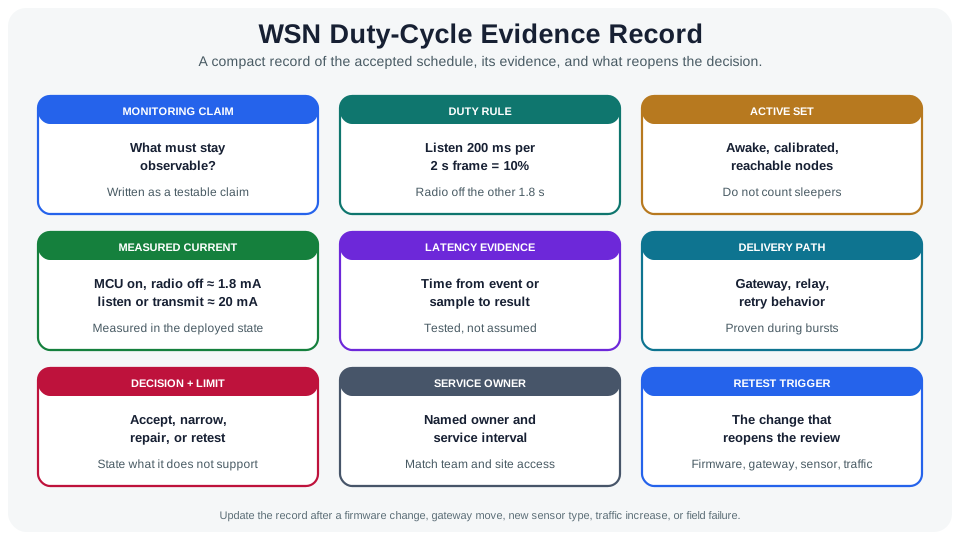
The monitoring claim states what must stay observable.
- The duty rule records a 200 ms listen window in a 2 s frame, or 10% duty, and the active set counts only awake, calibrated, reachable nodes.
Major section
Worked Review: Greenhouse Monitoring
The readings support crop management, not immediate safety alarms.
- Duty rule: Nodes wake on a planned interval, allow sensor stabilization, record the reading, and send through the accepted gateway path.
- Accepted limit: The schedule supports slow environmental trend monitoring.
- The same schedule would not automatically pass for fire detection or intrusion alarms.
Major section
Worked Review: Perimeter Alarm
The first proposal reuses the greenhouse sleep schedule because the hardware is similar.
- Claim: Fence-line crossings are detected and reported within the accepted response window.
- Problem: A long periodic sleep interval may miss short crossing events or report them too late.
- The hardware may be the same, but the monitoring claim is different.
Major section
Worked Review: Pipeline Valve Wake Rule
Most readings are routine, but selected valves require faster reporting after a pressure anomaly.
- Claim: Named valves have routine status reporting, and selected critical valves report anomaly state through the accepted gateway path.
- Critical valves have a separate event wake rule and a validated relay path.
- This example shows why hybrid schedules are common.
Major section
Worked Review: Pipeline Valve Wake Rule (continued)
Evidence needed: Measured current for routine and anomaly states, gateway delivery from weak route segments, and relay behavior during burst traffic.
- Known limit: Noncritical route segments are not approved for immediate alarm response unless they join the event wake rule and pass latency tests.
- Retest trigger: Reopen after valve additions, gateway movement, terrain change, repeated retransmission, maintenance-route change, or firmware change.
- A single duty cycle for every node can either waste energy on routine points or underprotect critical points.
- That makes the greenhouse, perimeter, and valve policies comparable without pretending that one sleep-current number approves all three claims.
Major section
Common Duty-Cycle Mistakes
Counting sleeping sensors as coverage: Installed devices should not satisfy the claim unless their wake rule supports the active monitoring state.
- Approving a percentage without a latency test: A low duty cycle may be fine for trend logging and unacceptable for alarms.
- Using spreadsheet lifetime as field proof: Battery estimates need measured current, traffic evidence, and service observations before approval.
- Forgetting recovery states: Retries, reconnects, firmware updates, calibration, and gateway failures can dominate energy during weak periods.
Major section
Ordering: Duty-Cycle Review · Figure Review: Energy per Accepted Delivery
The active window is not radio airtime alone: Bias / bridge: Amp + filter: ADC: MCU, and: Radio each need a measured duration, and their startup, acknowledgement, and retry costs determine the true duty-cycle energy record.
- Radio comparisons should normalize the complete burst budget by successfully delivered payload bits at the same reach and packet-error rate.

Major section
Concept Relationships · Continue Your Route
Duty cycling connects directly to coverage, deployment sizing, routing, gateway placement, and maintenance planning.
- Coverage tells which active sensors must observe the environment.
- Deployment sizing decides how many nodes and relays are needed.
- Routing and gateway design decide whether readings can leave the field.
- Maintenance planning decides whether the accepted service interval is realistic.
Deck summary
Key takeaways
A duty cycle is the share of time a radio or sensor stays active.
- Information value: Name the signal that makes a reading more or less useful: local change, neighbor contrast, uncertainty, missed-event cost, or application priority.
- A social-sensing duty-cycle rule uses an outside signal, such as a public event indicator or local context feed, to increase wake probability around likely rare events and relax it when the event is unlikely.
- An external signal can be useful when the physical event is rare but leaves advance evidence elsewhere.
- Radio energy per useful bit depends on range, bitrate, packet length, and fixed state-transition costs together.
Retrieval practice
Recall check 1 of 2

Packet Pete says: answer from memory, then check your reasoning.
Q1A WSN review says a storage room has redundant sensing because two sensors are installed at each location. One sensor sleeps for long intervals and has no event wake rule. What is the best conclusion?
Show answer
Answer: B A sleeping sensor may support redundancy, but only when the duty-cycle rule preserves the coverage and response promised by the claim.
Retrieval practice
Recall check 2 of 2
Packet Pete says: answer from memory, then check your reasoning.
Q2A team wants to reuse a low-duty environmental logging schedule for a leak alarm because it saved battery life in a pilot. What should the reviewer require?
Show answer
Answer: B A duty cycle is approved for a monitoring claim, not for a device model or battery type.
Print reference
Answers
Answer key.
- B · A sleeping sensor may support redundancy, but only when the duty-cycle rule preserves the coverage and response promised by the claim.
- B · A duty cycle is approved for a monitoring claim, not for a device model or battery type.