RFID, NFC & UWB · Study deck
WirelessHART TDMA and Channels
Picture a refinery sensor that reports valve pressure once each cycle.
Radio Remi is your guide for this deck.

After studying this chapter
Learning objectives
You will be able to:
- Explain: When a device sends upstream data, the schedule should give the device a transmit slot to at least one neighbor, then give the next hop a later slot toward the gateway.
- Explain: The network manager must give the reading a planned send time, a changing channel, and another route so one bad patch of air does not hide the process state.
- Explain: With a two-hop path, one report may need a device-to-router link and a router-to-gateway link, plus retry opportunities on one or both edges.
- Explain: Each superframe contains time slots.
Major section
Start With the Story
Nearby welding makes one radio channel noisy.
- The network manager must give the reading a planned send time, a changing channel, and another route so one bad patch of air does not hide the process state.
- A distant system may plan and review the schedule, but loss of that service must not erase the last known safe plan.
- This opening does not size a whole plant network or prove every source of noise.
Major section
Determinism From Slots, Resilience From Hopping
TDMA divides time into fixed 10 ms slots, and a message plus its acknowledgement fit inside one slot, so communication is scheduled rather than contended.
- A device knows exactly when it may transmit.
- Hopping gives resilience: interference on one channel is less likely to dominate every scheduled transmission.
- Neither is enough by itself for a plant.

Major section
Determinism From Slots, Resilience From Hopping (continued)
On top of that, the network hops channels by using a different frequency across scheduled opportunities, so no single narrowband interferer can block every report for long.
- Together they make 2.4 GHz usable for monitored industrial traffic that must arrive with known freshness and quality evidence.
- A 1 second superframe has 100 slot positions at 10 ms each.
- Channel hopping changes the risk profile of those opportunities.
Major section
TDMA Schedule Anatomy
A WirelessHART schedule is built from repeating superframes.
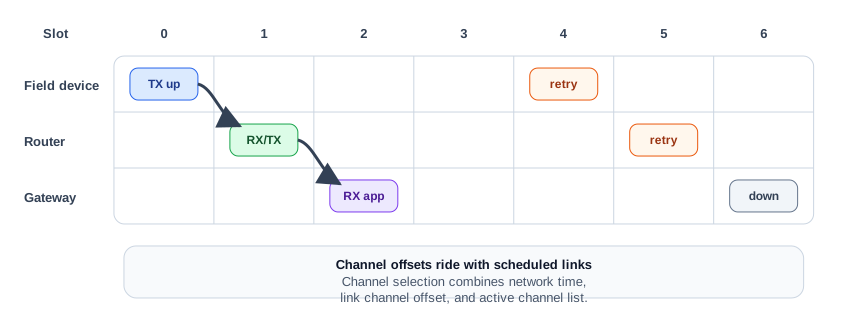
- Each superframe contains time slots.
- A scheduled link tells a device what to do in a particular slot: transmit, receive, advertise, or remain idle.
- The schedule also carries a channel offset, which is combined with network time to choose the actual RF channel for that transmission.
Major section
TDMA Schedule Anatomy (continued)
The important distinction is that a slot is not just "a device's turn." It is a specific communication opportunity between a sender and receiver, with a direction, a route purpose, and a channel-hopping decision.
- A single process value may consume multiple scheduled links as it moves across a mesh path toward the gateway.
- The device sends while its router listens in one 10 ms slot.
- Each link also has a channel offset.
Major section
TDMA Schedule Anatomy (continued)
The router needs a second slot to send to the gateway.
- Thus, two ideal hops use at least 2×10 ms=20 ms before queue time or retries.
- It works with the shared slot clock and the list of active channels.
- Planned retry slots make link strength a visible cost in the schedule instead of an unseen delay.
Major section
Slots, Superframes, And Channels
The review should identify those links explicitly, not just confirm that the tag exists.
- You can say when a reading should arrive, which contention-based radios cannot promise in the same way.
- A practitioner review starts by mapping the process requirement to links.
- Channel planning should be recorded the same way.
Major section
Slots, Superframes, And Channels (continued)
With a two-hop path, one report may need a device-to-router link and a router-to-gateway link, plus retry opportunities on one or both edges.
- If diagnostics show retries on channels 15 and 20, but not on the rest of the active set, the smallest defensible change may be a temporary blacklist for those channels with a review date.
- If retries cluster on Router B across several channels, the issue is more likely route health, antenna placement, shielding, or schedule pressure.
- Because the schedule is fixed and known, latency is bounded and predictable.
Major section
Channel Hopping
Channel hopping prevents a link from depending on one RF channel for every attempt.
- A strong local interferer may damage one part of the band while other channels remain usable.
- Hopping spreads attempts across the usable set, so a single poor channel does not dominate every scheduled transmission.
- Channel hopping is not magic.
Major section
Blacklisting and Coexistence Evidence
A blacklist is too small if known-bad channels remain active and keep consuming retries.
- A blacklist is too large if it removes usable diversity and forces too much traffic onto the remaining channels.
- The operational goal is a defensible active channel set, reviewed when the RF environment changes.
- the WirelessHART channel hopping and blacklisting flow showing channel-quality evidence, blacklist decision, active hopping set, scheduled retries, and post-change validation diagram keeps channel exclusions tied to retry and schedule evidence.
- A scheduled transmission uses its slot, channel offset, and active channel list to choose an RF channel.

Major section
Time Synchronization And Blacklist Validation
All of this depends on tight time synchronization.
- Every device must agree on slot boundaries to sub-millisecond accuracy, or TDMA collapses into collisions and missed acknowledgements.
- The schedule tells a device when to act, the hopping pattern tells it which channel to use, and the blacklist removes frequencies that evidence says are persistently poor.
- Under the hood, the channel for a transmission is derived from network time, the assigned channel offset, and the active channel list.
Major section
Graph Routing Interaction
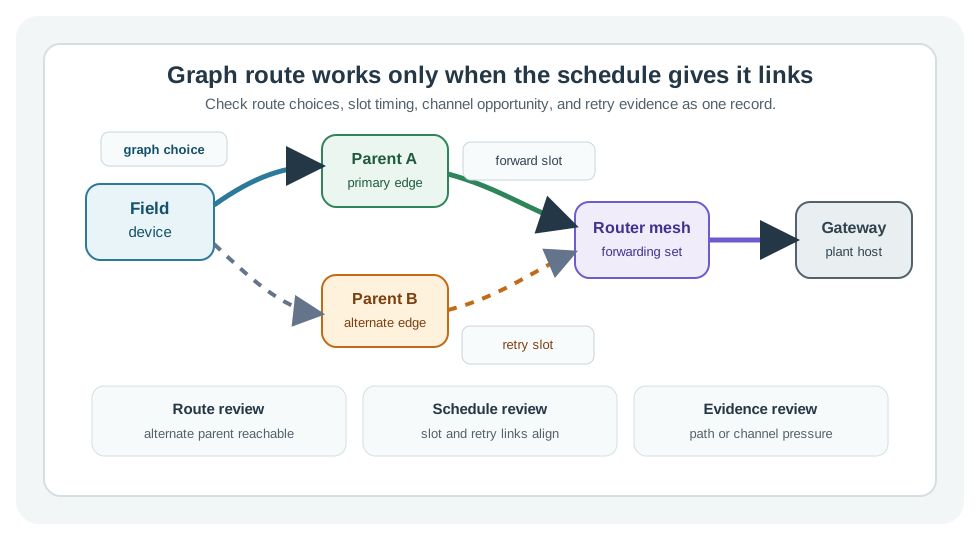
A graph can name alternate next hops, but those paths only help if transmit and receive opportunities exist at the right time.
- Likewise, a schedule can reserve slots, but those slots must align with route ownership and expected traffic direction.
- For resilience, the graph may provide another parent and the schedule may reserve alternate or retry links.
- When a device sends upstream data, the schedule should give the device a transmit slot to at least one neighbor, then give the next hop a later slot toward the gateway.
- The Network Manager uses link evidence to adjust both the route graph and the slot plan.
Major section
Troubleshooting Patterns
Retries cluster on one channel: Check channel-quality evidence and recent site changes.
- A blacklist may be justified if the problem is persistent and localized to a channel.
- The issue may be topology rather than channel quality.
- A route with several hops needs enough upstream, downstream, and retry opportunities in the right order.
Deck summary
Key takeaways
Nearby welding makes one radio channel noisy.
- TDMA divides time into fixed 10 ms slots, and a message plus its acknowledgement fit inside one slot, so communication is scheduled rather than contended.
- On top of that, the network hops channels by using a different frequency across scheduled opportunities, so no single narrowband interferer can block every report for long.
- A WirelessHART schedule is built from repeating superframes.
- The important distinction is that a slot is not just "a device's turn." It is a specific communication opportunity between a sender and receiver, with a direction, a route purpose, and a channel-hopping decision.
Retrieval practice
Recall check 1 of 3

Radio Remi says: answer from memory, then check your reasoning.
Q1In WirelessHART, what does channel hopping accomplish for scheduled traffic?
Show answer
Answer: B Channel hopping spreads scheduled transmissions across channels, reducing repeated exposure to a single interferer.
Retrieval practice
Recall check 2 of 3
Radio Remi says: answer from memory, then check your reasoning.
Q2A WirelessHART network shares the 2.4 GHz band with a fixed Wi-Fi access point on a known channel, yet keeps delivering process data reliably. Which mechanisms explain this?
Show answer
Answer: D WirelessHART combines synchronized 10 ms TDMA slots, per-slot channel hopping across the active IEEE 802.15.4 channel set, and evidence-based blacklisting so a known 2.4 GHz interferer does not dominate every scheduled report.
Retrieval practice
Recall check 3 of 3
Radio Remi says: answer from memory, then check your reasoning.
Q3A WirelessHART network shows repeated retries on a small subset of channels, while the same devices work normally on other channels. What is the strongest next action?
Show answer
Answer: B Blacklisting should be evidence-driven.
Print reference
Answers
Answer key.
- B · Channel hopping spreads scheduled transmissions across channels, reducing repeated exposure to a single interferer.
- D · WirelessHART combines synchronized 10 ms TDMA slots, per-slot channel hopping across the active IEEE 802.15.4 channel set, and evidence-based blacklisting so a known 2.4 GHz interferer does not dominate every scheduled report.
- B · Blacklisting should be evidence-driven.