RFID, NFC & UWB · Study deck

WirelessHART Network Management

Picture a pressure sensor joining a busy plant network.

Radio Remi is your guide for this deck.

diagnosticsgraph-routingindustrial-wireless
Radio Remi, the module guide, in a scene from this chapter.
iotclass.org

After studying this chapter

Learning objectives

You will be able to:

  • Explain what evidence the WirelessHART Network Manager uses to maintain routes, schedules, and channel choices.
  • Describe how join policy, graph routing, TDMA schedule updates, and diagnostics work together during operations.
  • Review route health without making unsupported claims about uptime, delivery percentage, or failover timing.
  • Plan schedule and coexistence changes with clear acceptance evidence and rollback triggers.
iotclass.org

Major section

Start With the Story

It needs a safe path and a time to speak without drowning out other devices.

  • The WirelessHART Network Manager is the service that plans those shared paths and times.
  • The manager should adjust the plan and leave a record that an operator can review.
  • It should name the device, time, allowed role, first route, and first message.
iotclass.org

Major section

Start With the Story (continued)

The manager is powerful, so its own failure matters.

  • This simple story assumes that the manager can see enough of the network to act.
  • Real plants may have moving equipment, interference, and maintenance mistakes.
  • Under the Hood explains graph choices, timing, and security limits.
  • The Network Manager is where a WirelessHART mesh becomes an operated system.
iotclass.org

Major section

In 60 Seconds

WirelessHART network management is centralized, but it should not be treated as magic automation.

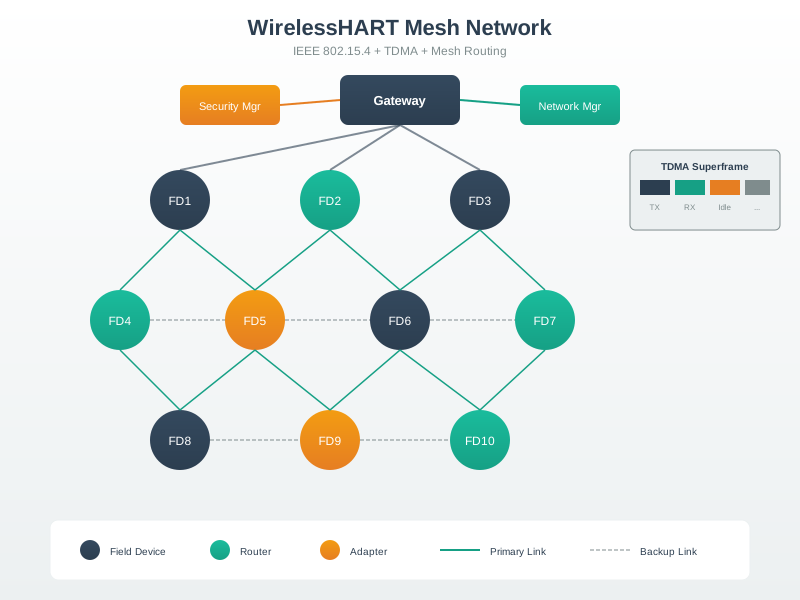
  • The Network Manager maintains a view of field devices, neighbors, graph routes, superframes, link use, and channel observations.
  • It uses that evidence to admit devices, compute graph and schedule revisions, apply channel masks, and create diagnostics for operators.
  • A durable WirelessHART operation record answers five questions: what changed, why it changed, which devices and links were affected, what evidence showed the change was acceptable, and what condition would trigger rollback or another optimization cycle.
iotclass.org

Major section

Phoebe's Field Notes: Why "Rotate the Antenna" Is a Real Fix

The mathematical gist.: At 2.4 GHz, the 12.5 cm wavelength makes a quarter-wave antenna about 3.13 cm long.

  • Metal only a few centimetres away can reshape that antenna's pattern.

Numbers to remember

12.5 cmthe 12.5 cm wavelength makes a quarter-wave antenna about 3.13 cm long.
3.13 cmthe 12.5 cm wavelength makes a quarter-wave antenna about 3.13 cm long.
8 dBAn 8 dB realized-gain loss leaves 15.8% of the former directional power
iotclass.org

Major section

Management Boundary

The Network Manager is responsible for network decisions.

  • The evidence loop begins with field diagnostics—neighbors, link quality, retries, queue age, missed reports, and channel observations—crossing the gateway boundary.
WirelessHART management evidence loop showing field diagnostics flowing into the gateway-hosted Network Manager and Security Manager, producing controlled join, graph, schedule, channel, and operations-record revisions
iotclass.org

Major section

Join Policy

Device admission should be handled as a controlled operation, not as a casual scan for nearby radios.

  • A join request is only one input.
  • The Network Manager and supporting key service should also check the commissioning record, device identity, expected role, intended measurement, and allowed operating area.
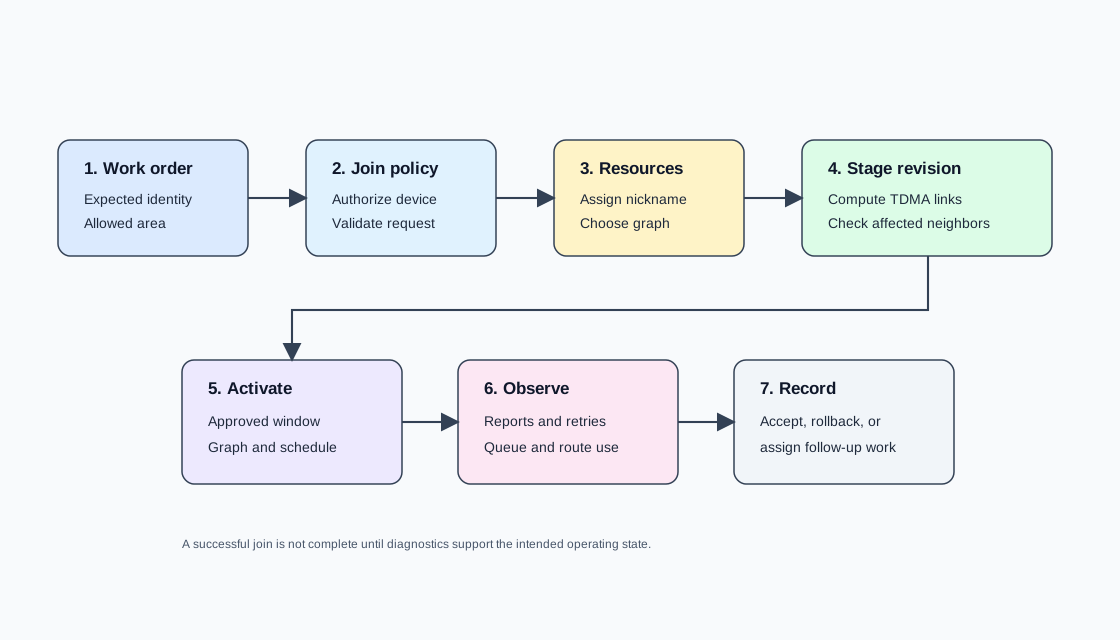
  • The join flow separates admission from acceptance.

Why it matters

Staging and post-change diagnostics remain explicit steps because a valid identity can still overload a route or consume the wrong schedule capacity.

WirelessHART join and schedule change flow from admission evidence through graph and schedule activation
iotclass.org

Major section

Graph Route Health

WirelessHART graph routes are manager-computed forwarding choices.

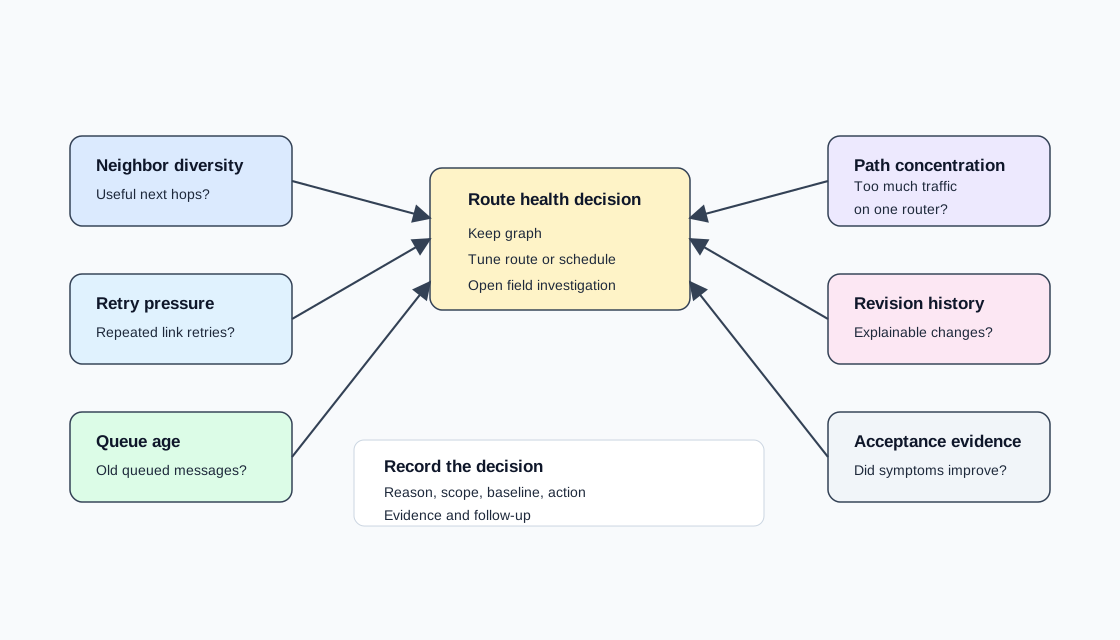
  • The important operational question is not whether a graph exists, but whether the graph still fits the evidence seen in the plant.
  • When route health degrades, prefer an evidence-based change: update the graph, adjust a schedule, investigate a field obstruction, or add a planned router.
WirelessHART route health review showing neighbor diversity, retry pressure, queue age, path concentration, and graph revision evidence
iotclass.org

Major section

Schedule Changes

WirelessHART scheduling is a controlled resource allocation problem.

  • A schedule change should preserve the intent of existing measurements while admitting new traffic or removing stale traffic.
  • The acceptance criteria should be written before activation.
  • A change is not complete until the diagnostic evidence matches the operational intent.
iotclass.org

Major section

Common Pitfalls

Treating manager optimization as proof of health: A graph can be optimized against stale or incomplete field evidence.

  • Admitting devices without a commissioning record: Unknown devices create ambiguous diagnostics and make later investigations harder.
  • Changing update periods without schedule review: Faster reporting consumes schedule resources and can move congestion to intermediate routers.
iotclass.org

Major section

Summary

WirelessHART network management depends on evidence: joins, neighbors, routes, schedules, channel observations, and diagnostics.

  • The Network Manager computes routes and schedules, but operators still need controlled admission, acceptance criteria, and records.
  • Channel masks and schedule changes should be treated as managed revisions with a reason and a review condition.
  • Operations records make WirelessHART networks maintainable across shifts, maintenance windows, and later investigations.
iotclass.org

Deck summary

Key takeaways

It needs a safe path and a time to speak without drowning out other devices.

  • The manager is powerful, so its own failure matters.
  • WirelessHART network management is centralized, but it should not be treated as magic automation.
  • The mathematical gist.: At 2.4 GHz, the 12.5 cm wavelength makes a quarter-wave antenna about 3.13 cm long.
  • The Network Manager is responsible for network decisions.
iotclass.org

Retrieval practice

Recall check 1 of 3

Radio Remi says: answer from memory, then check your reasoning.

Q1A durable WirelessHART operation record should answer which set of questions?

AWhat changed, why, which devices and links were affected, and the rollback trigger
BOnly the total number of devices that are currently on the network
COnly the brand and the model number of the gateway hardware in use
DOnly the current outdoor air temperature measured at the plant site
Show answer

Answer: A A durable WirelessHART record states what changed, why, which devices/links were affected, and the rollback trigger.

iotclass.org

Retrieval practice

Recall check 2 of 3

Radio Remi says: answer from memory, then check your reasoning.

Q2In a WirelessHART network, a relay link degrades during operation. How does normal process data keep flowing, and how would an engineer instead test one exact path for diagnostics?

AEach device independently floods the message to all of its neighbours until it arrives.
BSource routing provides the redundancy for normal data, and graph routing is only for diagnostics.
CThe whole network stops until an operator manually reassigns every single slot.
DGraph routing gives alternate next-hops so traffic reroutes automatically; source routing pins one message to a chosen path.
Show answer

Answer: D The central Network Manager schedules slots and provides graph routing (redundant paths, self-healing) for operational data and source routing (fixed explicit path) for diagnostics, adapting from health reports.

iotclass.org

Retrieval practice

Recall check 3 of 3

Radio Remi says: answer from memory, then check your reasoning.

Q3A new WirelessHART pressure transmitter has joined successfully, but nearby routers now show higher retry counts and older queued messages. What should the Network Manager review before making the device permanent?

AThe join evidence, graph assignment, schedule revision, route concentration, and post-join diagnostics for the affected neighbors
BReview the device identity and postpone schedule review until the new transmitter has collected a longer operating history.
CReview the gateway connection first, since it carries the field readings to the host and may be the bottleneck.
DReview the channel mask first, since excluding noisy frequencies may reduce the neighbors' retry counts.
Show answer

Answer: A A join operation should be accepted only after identity, graph, schedule, route concentration, and diagnostic evidence all support the intended operating state.

iotclass.org

Print reference

Answers

Answer key.

  1. A · A durable WirelessHART record states what changed, why, which devices/links were affected, and the rollback trigger.
  2. D · The central Network Manager schedules slots and provides graph routing (redundant paths, self-healing) for operational data and source routing (fixed explicit path) for diagnostics, adapting from health reports.
  3. A · A join operation should be accepted only after identity, graph, schedule, route concentration, and diagnostic evidence all support the intended operating state.
iotclass.org