RFID, NFC & UWB · Study deck
WirelessHART Fundamentals
Imagine a pressure unit on a factory pipe.
Radio Remi is your guide for this deck.

After studying this chapter
Learning objectives
You will be able to:
- Explain why WirelessHART uses a scheduled industrial mesh instead of contention-based wireless access
- Identify the responsibilities of field devices, adapters, gateways, the Network Manager, and plant applications
- Describe how time slots, superframes, channel hopping, and graph routes work together
- Frame device joining, session handling, and key management as controlled network-policy decisions
Major section
Start With the Story
Its reading must reach the control room even when metal blocks one radio path.
- A long radio range alone cannot prove that the warning will arrive on time.
- WirelessHART is a plant radio system that gives devices planned time slots and more than one possible path.
- The network designer should start with the control decision.
Major section
Start With the Story (continued)
A paper route is only a test plan until the installed path is measured.
- They may be different teams.
- Both need the same time and device names when a report is late.
- Agree on what the screen shows while the field fact is old.
- This simple view leaves out the full schedule and protection process.
Major section
Eddie's Math Bridge: Wavelength And Band Choice
The mathematical gist: WirelessHART's 2.4 GHz carrier has a 12.5 cm wavelength and a 3.13 cm quarter-wave scale.
- Hopping across 2.405–2.480 GHz barely changes that wavelength, so it combats fades and interference rather than undoing the band choice.
Major section
Industrial Context
WirelessHART is an industrial wireless standard for process instrumentation.
- It keeps the HART command model familiar to process plants while replacing the wired field link with an IEEE 802.15.4 based wireless mesh.
- The important design choice is not "wireless instead of wires"; it is scheduled wireless with centrally managed network policy.
- Hard real-time interlocks, emergency shutdown paths, and other safety-critical functions need their own engineering basis.
Major section
HART Heritage And Retrofit Fit
It preserves the HART command set and device-description model already used by host applications, asset-management tools, and technicians.
- The radio is important, but backward compatibility is the adoption lever.
- Under the familiar application layer is a managed IEEE 802.15.4 radio system with synchronized slots, channel hopping, graph routing, and mandatory security services.
- The output should be a plant evidence record.
Major section
Operating Model
WirelessHART networks are planned and supervised.
- Field devices do not compete randomly for airtime.
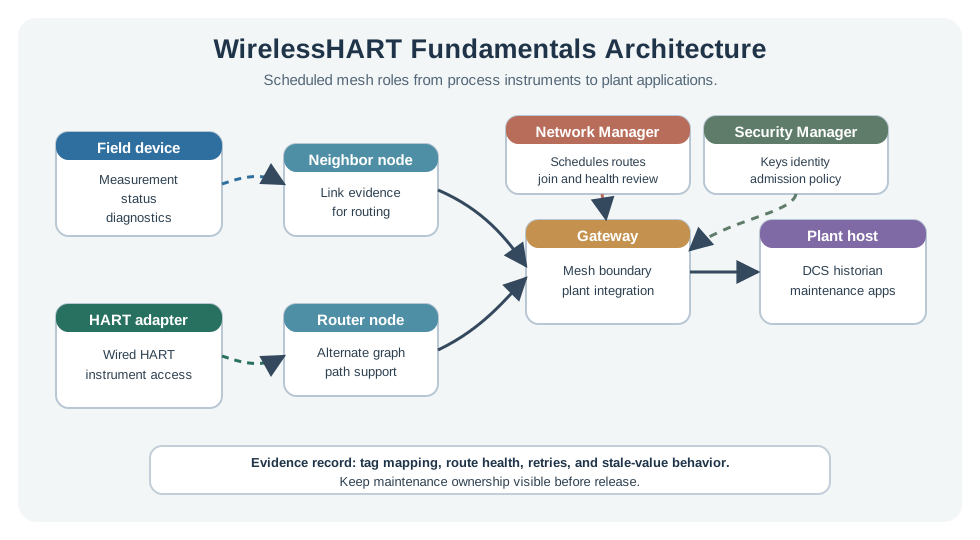
- The Network Manager builds communication schedules and routing graphs, the gateway connects the mesh to the plant network, and each device follows assigned time and channel behavior.
- Neighbor and router nodes provide link and alternate-path evidence before data reaches the gateway.
Major section
Component Ownership Checklist
The adapter is easy to underestimate.
- The mesh itself is still managed rather than improvised: devices discover neighbors, the Network Manager evaluates link evidence, and routes can change when the installed environment changes.
- Commissioning should be written as a component checklist, not a radio-only checklist.
- If 3 of the 16 devices have only one stable neighbor, the evidence points to a route-diversity problem before it becomes a plant-data problem.
Major section
Scheduled Mesh Behavior
The result is not magic reliability.
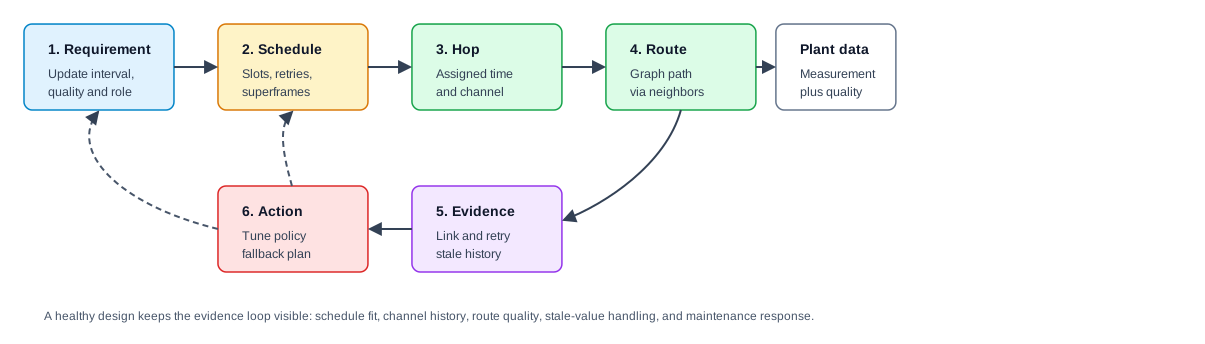
- The network can say which routes, channels, neighbors, retries, and device-health indicators supported a measurement.
- The schedule assigns slots, retries, and superframes; each hop needs an allocated time and channel before a graph route can carry a value through neighbors.
Major section
Protocol Stack View
Both use managed wireless access, but application meaning, network adaptation, security, and gateway handling require different operating records.
- Installed HART tools and mixed-payload requirements may lead to different choices.
- A shared radio layer does not prove that managers, gateways, or application procedures can be swapped.

Major section
Compatibility, Join State, And Stale Values
By preserving HART commands and device descriptions, WirelessHART lets the same configuration tools, asset-management software, and technicians work with wireless devices.
- Security services are mandatory in normal WirelessHART operation.
- Device admission, session behavior, and encrypted communication are part of the system design rather than optional add-ons.
Major section
Compatibility, Join State, And Stale Values (continued)
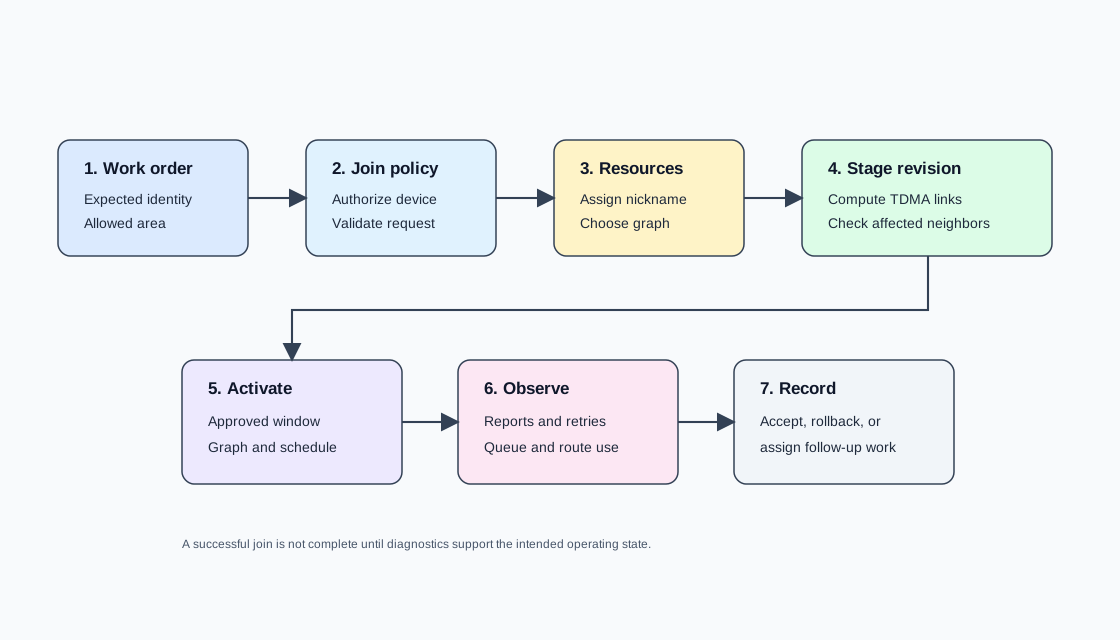
A staged revision computes TDMA links and checks affected neighbors; activation occurs in an approved window.
- Reports, retries, queue use, and route behavior then show whether the new device is operating as intended.
- The final record may accept, roll back, or assign follow-up work.
- A replacement transmitter with bad join material must fail admission, while a joined device with weak routes must remain a visible fault rather than silently feeding stale values.
Major section
Compatibility, Join State, And Stale Values (continued)
If a replacement transmitter is installed with the wrong join material, it should fail before it becomes an untrusted process value.
- If it joins but has weak routes, it should remain visible as a diagnostic problem rather than silently degrading the historian.
- If a pressure measurement is expected every 30 seconds and the host marks it stale at 90 seconds, the third missed update reaches the stale threshold.
- If route evidence shows repeated misses on one path, the manager can reroute, but the plant system still needs to know when data quality is no longer fit for the alarm or monitoring decision.
Deck summary
Key takeaways
Its reading must reach the control room even when metal blocks one radio path.
- A paper route is only a test plan until the installed path is measured.
- The mathematical gist: WirelessHART's 2.4 GHz carrier has a 12.5 cm wavelength and a 3.13 cm quarter-wave scale.
- WirelessHART is an industrial wireless standard for process instrumentation.
- It preserves the HART command set and device-description model already used by host applications, asset-management tools, and technicians.
Retrieval practice
Recall check 1 of 3

Radio Remi says: answer from memory, then check your reasoning.
Q1What is the core operating discipline of a WirelessHART network?
Show answer
Answer: C WirelessHART's core discipline is scheduled communication, with the Network Manager assigning slots, routes, and channels.
Retrieval practice
Recall check 2 of 3
Radio Remi says: answer from memory, then check your reasoning.
Q2A refinery with a large installed base of wired HART instruments wants to add wireless monitoring with minimal retraining and tooling changes. Why is WirelessHART attractive, and what lets it include the existing wired devices?
Show answer
Answer: C WirelessHART extends HART, preserving commands and device descriptions so existing tools and staff carry over.
Retrieval practice
Recall check 3 of 3
Radio Remi says: answer from memory, then check your reasoning.
Q3A plant wants to add wireless pressure monitoring to a pipe rack. Which statement best captures the WirelessHART design discipline?
Show answer
Answer: C The discipline is centrally planned scheduling and routing by the Network Manager, followed by operational review of link, retry, and stale-value evidence.
Print reference
Answers
Answer key.
- C · WirelessHART's core discipline is scheduled communication, with the Network Manager assigning slots, routes, and channels.
- C · WirelessHART extends HART, preserving commands and device descriptions so existing tools and staff carry over.
- C · The discipline is centrally planned scheduling and routing by the Network Manager, followed by operational review of link, retry, and stale-value evidence.