IoT Fundamentals · Study deck
Radio Waves and Frequency Bands
Picture a sensor that works beside the receiver but fails after a metal cabinet closes.
Physics Phoebe is your guide for this deck.

After studying this chapter
Learning objectives
Relate the band trade-off to the installed path, then test the worst position.
- Frequency sets wavelength and antenna scale.Lower frequency usually means longer wavelength.
- Cabinet materials change the installed path.Cabinet materials and clutter can change the installed path.
- Measure delivery at the worst position.A catalogue range is not a site result.
Major section
In 60 Seconds · Start With the Story
A headline range cannot describe the installed path.
- A gateway means the boundary system that connects local devices to another network or service.
- Received signal strength means the estimated power at the radio.
- The received signal strength indicator means its reported measure; it is shortened to RSSI.
Major section
Why Frequency and Wavelength Decide the Link
Radio is how most IoT devices talk without wires.
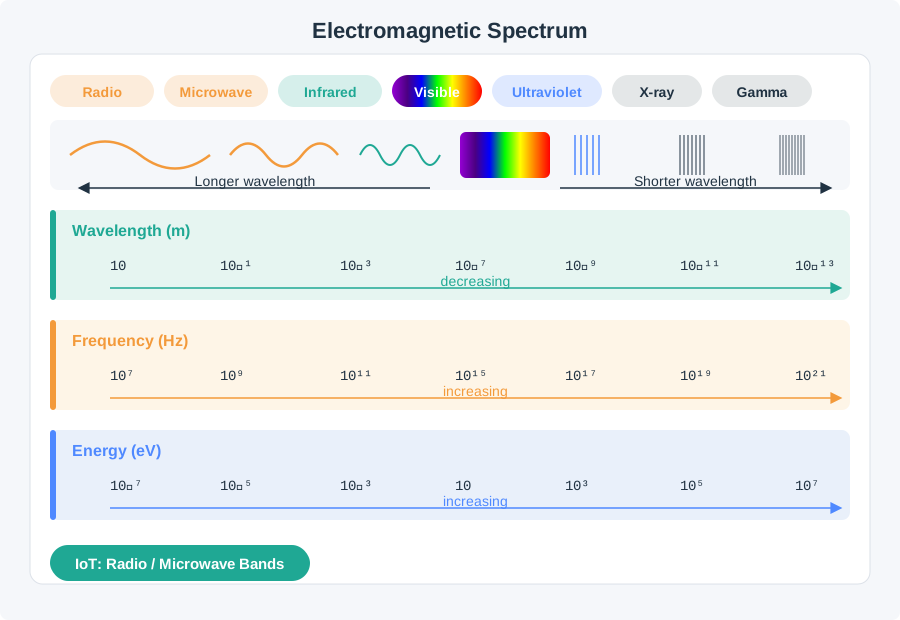
- The single most useful intuition is this: a lower frequency means a longer wave, and a longer wave bends around and passes through everyday objects more easily and reaches farther for the same power.
- Frequency rises as wave length falls, so use λ=c/f.
Major section
Why Frequency and Wavelength Decide the Link (continued)
Reopen the record when the site, traffic, enclosure, or margin changes.
- A higher frequency means a shorter wave, which can carry more data but is blocked, reflected, and scattered more by the walls and clutter of a real building.
- This rule does not set range by itself.
- Lower frequencies therefore need larger antennas.
Major section
Why Frequency and Wavelength Decide the Link (continued)
Wavelength gives a physical direction, but the link budget, local occupancy, real enclosure, and worst-point logs decide whether that direction survives.
- The mathematical gist: One wave cycle lasts 1/f, so wavelength is λ=c/f and a quarter-wave antenna scale is L1/4=λ/4.
- Material loss, antenna design, power, receiver need, noise, and local rules also shape the installed path.
- Small, infrequent messages do not require a high band.
Major section
Why Frequency and Wavelength Decide the Link (continued)
The same rule also explains why there is no universal best IoT band.
- That gives 0.333 m and 8.33 cm near 900 MHz, 0.125 m and 3.12 cm at 2.4 GHz, and 0.0600 m and 1.50 cm at 5 GHz.
- A high hiss has a short wave and is easily stopped by a closed door.
- Datasheet range is usually a best-case, open-air figure.
Major section
Why Frequency and Wavelength Decide the Link (continued)
Holding distance fixed, the f2 term in free-space loss makes 5 GHz cost 14.9 dB more than 900 MHz before real walls, bodies, detuning, or multipath.
- A deep bass note has a long wave and travels through walls and around corners, which is why you hear a neighbor's bass but not their cymbals.
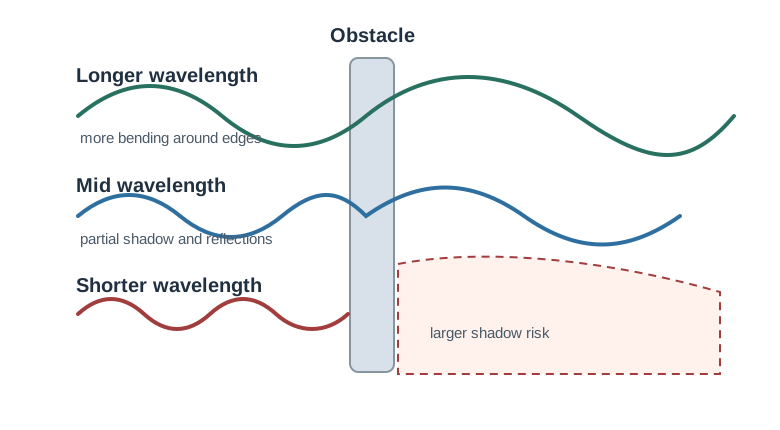
- Radio behaves the same way: the long, low-frequency wave gets around and through obstacles, while the short, high-frequency wave is more easily stopped.
- A sensor waveform, microphone signal, or digital bit stream starts as a baseband signal near zero frequency.
Major section
Why Frequency and Wavelength Decide the Link (continued)
If this gives you enough to reason about a band, you can stop here.
- Good band choice starts by writing the job first, then choosing the frequency range whose wavelength, antenna size, and available bandwidth fit that job.
- A radio transmitter shifts that information onto a carrier so it can travel through an assigned channel and coexist with other users of the spectrum.
- A common resonant element is about a quarter of the wavelength.
Major section
Why Frequency and Wavelength Decide the Link (continued)
Amplitude modulation varies the carrier's strength; frequency modulation varies the carrier's instantaneous frequency.
- Modern IoT radios use more efficient digital modulation, but the review habit is the same: separate the payload from the radio channel that carries it, then check occupied bandwidth, interference, receiver support, and regional rules.
- Amplitude-shift keying (ASK) changes carrier strength, frequency-shift keying (FSK) chooses among carrier frequencies, and phase-shift keying (PSK) changes the carrier phase.
- The columns in Figure: Band choice is a trade-off compare bands by the job they can serve.
Major section
Why Frequency and Wavelength Decide the Link (continued)
Sub-GHz examples have modest data rates and better reach and building penetration, which suits sparse field telemetry.
- The 2.4 GHz column offers more bandwidth for local Wi-Fi, BLE, Zigbee, and Thread links, but its shared spectrum can be crowded.
- The arrows summarize the trade between range, penetration, and bandwidth; they are tendencies, not a site guarantee.
- Very small antenna and more available bandwidth, but the shortest reach and most obstacle loss.
Major section
Why Frequency and Wavelength Decide the Link (continued)
Better reach and penetration, but the efficient antenna is large and may not fit a tiny enclosure.
- The lower arrows summarize the illustrated trade-off: bandwidth increases as reach and building penetration decrease.
- Beginner ExamplesA soil-moisture sensor across a large field, sending a few bytes per hour, favors a lower sub-gigahertz band for reach.
- The exact bands you may legally use, and at what power, depend on your region.
Major section
Why Frequency and Wavelength Decide the Link (continued)
A higher frequency is not simply "better." It buys data capacity and small antennas at the cost of range and obstacle penetration.
- Translate data need into bandwidth need: More data per second generally needs more bandwidth, and wide bandwidth is easier to find at higher frequencies.
- IntermediateFor a wearable with a 2 cm antenna budget, explain why 2.4 GHz is more feasible than a sub-gigahertz band.
- If your job is to choose a band and prove it works, you can stop here.
Major section
Under the Hood: Wavelength, Obstacles, and Antennas · Checkpoint: Summary
The deeper layer explains why the band trade-off exists.
- Wavelength is the yardstick that decides how a wave meets an object of a given size, which is why it, and not frequency alone, governs propagation behavior.
- The zone is widest near the midpoint of the link and is larger at lower frequencies.
Deck summary
Key takeaways
A headline range cannot describe the installed path.
- Radio is how most IoT devices talk without wires.
- Reopen the record when the site, traffic, enclosure, or margin changes.
- Wavelength gives a physical direction, but the link budget, local occupancy, real enclosure, and worst-point logs decide whether that direction survives.
- The same rule also explains why there is no universal best IoT band.
Retrieval practice
Recall check 1 of 3

Physics Phoebe says: answer from memory, then check your reasoning.
Q1A device must reach a gateway through several interior walls while sending only small, infrequent messages. Which choice fits best?
Show answer
Answer: A Longer wavelengths pass through and bend around obstacles more effectively, which matters more than data capacity here.
Retrieval practice
Recall check 2 of 3
Physics Phoebe says: answer from memory, then check your reasoning.
Q2A product needs reliable links across a multi-floor concrete building, sends only small status messages, and runs on a coin cell. Which plan is strongest?
Show answer
Answer: C Penetration is the constraint, small messages do not need a high band, and field validation replaces guesswork.
Retrieval practice
Recall check 3 of 3
Physics Phoebe says: answer from memory, then check your reasoning.
Q3A 2.4 GHz link uses a quarter-wave monopole. The team moves to a sub-gigahertz band near 900 MHz for better penetration. Using wavelength = c / frequency, what happens to the efficient antenna length?
Show answer
Answer: A The wavelength rises from about 12.5 cm at 2.4 GHz to about 33 cm near 900 MHz, so the quarter-wave element grows.
Print reference
Answers
Answer key.
- A · Longer wavelengths pass through and bend around obstacles more effectively, which matters more than data capacity here.
- C · Penetration is the constraint, small messages do not need a high band, and field validation replaces guesswork.
- A · The wavelength rises from about 12.5 cm at 2.4 GHz to about 33 cm near 900 MHz, so the quarter-wave element grows.